
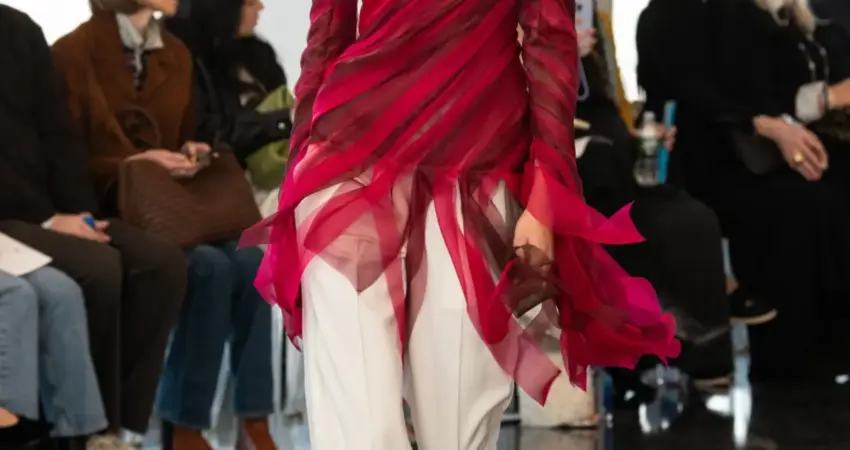
The 102nd floor of One World Trade Center served as the soaring backdrop for the return of J. Mendel to the fashion vanguard, marking the first time the venerable house has been reviewed by major industry publications since 2022. The Spring 2027 Ready-to-Wear presentation also served as the formal introduction of Jonathan Cohen as the brand’s resident creative director. By staging the event in the clouds of Lower Manhattan, the label attempted to bridge its historical "uptown glamour" with a modern, "downtown" altitude. However, the juxtaposition of the expansive, panoramic views of New York City against the tightly defined aesthetic of the collection highlighted the central challenge facing the heritage brand: how to evolve a legacy rooted in 19th-century furriery into a relevant 21st-century luxury powerhouse.
A Legacy of Craftsmanship: From St. Petersburg to New York
To understand the weight of Jonathan Cohen’s debut, one must look at the 157-year trajectory of the J. Mendel name. Founded in 1870 in St. Petersburg, Russia, the house originally served the Romanov court, establishing a reputation for unparalleled fur craftsmanship. Following the Russian Revolution, the family relocated to Paris, where the brand operated for several decades as a premier furrier. It was not until 1981 that Gilles Mendel, the fifth generation of the family, established a permanent presence in New York City, opening a salon at Elizabeth Arden on Fifth Avenue.
The brand’s pivot toward a full lifestyle luxury house began in earnest in 2002 with the official introduction of ready-to-wear. This era coincided with the height of New York’s "socialite" culture, where the brand became the de facto uniform for the city’s elite. Names like Tinsley Mortimer and Byrdie Bell were frequently photographed in J. Mendel’s intricate, feathered designs at high-profile events such as the Frick Young Fellows Ball. The brand reached a cultural zenith in January 2011 when actress Natalie Portman appeared on the cover of Vogue wearing a pale pink, hand-pleated silk chiffon gown, an image that remains a touchstone for the house’s romantic identity.
Gilles Mendel departed from his namesake brand in 2018, leaving a creative vacuum that the company has sought to fill with various design leads. The appointment of Jonathan Cohen represents a strategic move to stabilize the brand’s creative direction and re-engage with a market that has shifted significantly since the early 2000s.
The Spring 2027 Collection: Technical Innovation and Aesthetic Reversion
Jonathan Cohen’s inaugural collection for J. Mendel sought to deconstruct the brand’s eveningwear DNA and reassemble it into a more versatile wardrobe. The designer’s stated objective was to "work backwards" from formal evening attire into pieces that could function for daytime or cocktail hours. This was evidenced in the opening look: a pair of slim trousers paired with a bias-cut chiffon top. The top featured strips of fabric in varying shades of red, a design choice Cohen noted was inspired by the "couture-like inner finishing" of the garments within the J. Mendel atelier.
A significant technical highlight of the collection was the use of traditional fur-working machinery to manipulate non-fur materials. Cohen presented a leather jacket featuring puckered pockets, constructed using a fur machine that fuses seams rather than sewing them with traditional allowances. This technique eliminates bulk and results in a garment that is remarkably lightweight, effectively transposing the artisanry of a furrier onto modern leather goods. This use of technology suggests a path forward for the brand, utilizing its specialized equipment to create high-tech, luxury outerwear that does not rely on animal pelts—a crucial pivot as global demand for fur continues to decline.
However, the collection also leaned heavily on the brand’s archives. Look 15, a short, skin-baring ensemble in "pretty in pink," was a direct homage to pop culture icons of the early 2000s, specifically Britney Spears. While this tapped into the current trend for "Y2K" nostalgia, critics noted that it felt somewhat disconnected from the sophisticated, architectural setting of the 102nd floor.
Industry Context and Market Data
The return of J. Mendel comes at a volatile time for the global luxury market. According to recent industry reports, the luxury eveningwear segment has seen a 12% shift toward "versatile luxury"—garments that can be styled for multiple occasions rather than single-use gala gowns. Cohen’s attempt to introduce separates and "day(ish) wear" aligns with these broader economic trends.
Furthermore, the brand is navigating a post-fur landscape. Since 2018, many of the world’s leading luxury groups, including Kering and LVMH brands, have implemented fur-free policies. J. Mendel, whose identity was once inseparable from fur, has had to reinvent its "glamour" through silk, chiffon, and leather. The Spring 2027 collection featured fur-paneled separates, but they were noted for their perceived heaviness compared to the more successful, fluid pieces in printed pleated chiffon.
Data from retail analysts suggests that heritage brands undergoing creative director transitions typically see a two-year "adjustment period" before market share stabilizes. For J. Mendel, the challenge is reclaiming a customer base that has migrated to newer, more "minimalist luxury" brands while maintaining the romanticism that Natalie Portman and the socialites of the 2010s once championed.
Official Responses and Creative Vision
Following the show, Jonathan Cohen expressed his reverence for the brand’s history while acknowledging the need for evolution. "I always remember that [Natalie Portman] dress being so beautiful and I loved how easy it looked," Cohen remarked, emphasizing his desire to maintain the brand’s signature "ease" even in complex constructions.
The choice of One World Trade Center was intentional, intended to signal a "new height" for the company. Representatives for the brand indicated that the move downtown was a symbolic gesture, moving away from the traditional Upper East Side associations of the past toward a more global, modern New York identity. While the location provided a sense of grandeur, some industry observers suggested that the collection’s "uptown" sensibilities—often described as "champagne wishes and caviar dreams"—felt somewhat at odds with the raw, structural environment of the 102nd floor.
Analysis of Implications: Bridging the Gap
The Spring 2027 collection serves as a litmus test for whether a brand so closely associated with a specific era of New York high society can successfully transition into a contemporary fashion fixture. The technical innovation seen in the fused-seam leather jacket is perhaps the most promising indicator of the brand’s future. It demonstrates a way to preserve the "unique access to a skilled atelier" that Cohen possesses while producing garments that feel modern and functional.
However, the collection’s struggle with fit in certain looks and a general "sense of the past" suggests that the brand is still finding its footing. To remain relevant in a competitive market, analysts suggest that J. Mendel must do more than simply reference its archival successes. The "uptown glamour" that once defined the label must be tempered with what some critics call "raw concrete energy"—a nod to the grit and dynamism of contemporary New York City life.
The broader implication for the fashion industry is the ongoing difficulty of "rebooting" heritage brands. While the J. Mendel name carries significant weight and historical prestige, the modern consumer is increasingly focused on brand values, sustainability, and day-to-day wearability. Cohen’s debut has successfully put J. Mendel back on the "Vogue Runway" map, but the long-term success of the brand will depend on its ability to move beyond being "caught in amber."
As the house moves toward the Fall 2027 season, the industry will be watching to see if Cohen can further refine the balance between the brand’s furrier roots and a more grounded, urban aesthetic. The technical foundation is present; the next step is a conceptual evolution that matches the literal heights of its most recent runway location. For now, J. Mendel has proven it can still command a room—or a skyscraper—but the task of defining its role in the modern fashion landscape remains an ongoing project.

0 Comments