
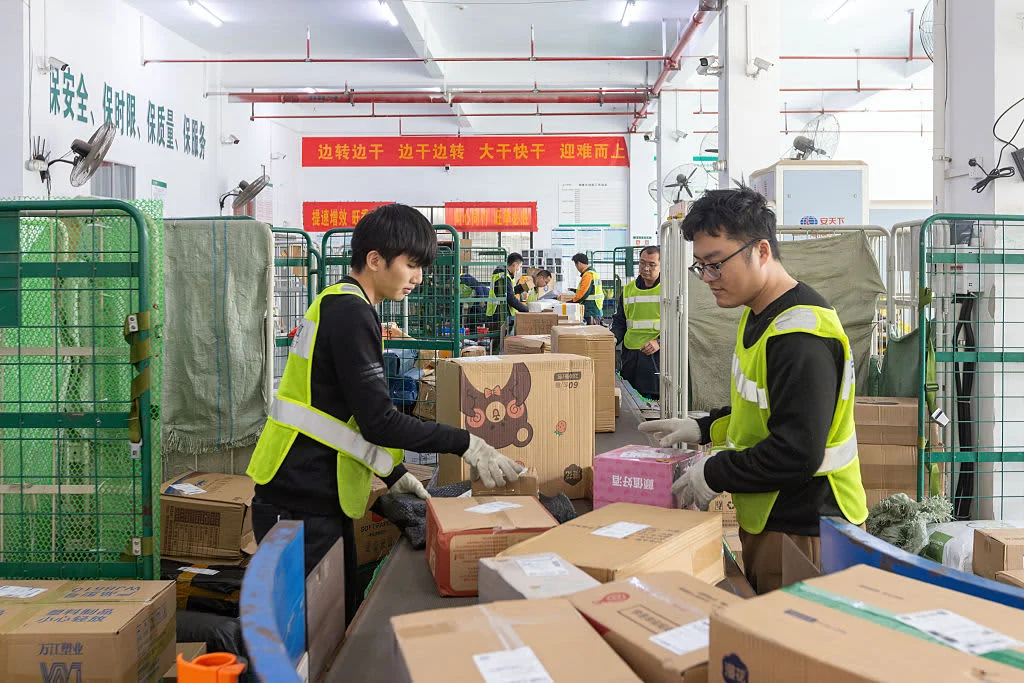
China’s economy has commenced 2026 on a remarkably strong footing, with key indicators for consumption and industrial production surpassing market expectations. This early surge, buoyed by significant holiday spending and resilient foreign demand, provides an initial boost to the world’s second-largest economy, even as underlying structural issues and escalating geopolitical tensions present a complex outlook. The data, released by the National Statistics Bureau on Monday, paints a nuanced picture of recovery tempered by familiar challenges.
An Unexpected Surge in Consumption and Production
Retail sales for the first two months of the year recorded a 2.8% increase from a year earlier, comfortably outperforming economists’ consensus forecast of 2.5% growth. This figure, while positive, reflects a discernible deceleration from the 4% rise observed during the corresponding January-February period in 2025, indicating a moderating pace of consumer spending compared to the immediate post-pandemic rebound. Much of this consumption momentum was attributed to the mid-February Lunar New Year holiday, a period traditionally marked by heightened spending. Yuhan Zhang, a principal economist at The Conference Board’s China center, highlighted significant gains in sectors such as tobacco and alcohol sales, alongside a notable uptick in spending on luxury goods like gold and jewelry. The extended holiday period witnessed a steady and widespread rise in spending across the country, encompassing everything from burgeoning hotel bookings to robust duty-free shopping figures. This strong showing during the festive season has, somewhat paradoxically, dampened immediate hopes for large-scale, broad-based stimulus measures from policymakers, who may now perceive less urgency for aggressive intervention.
Concurrently, industrial output climbed by an impressive 6.3% in the first two months, significantly exceeding the 5% jump estimated by a Reuters poll. Industrial production has consistently been a relative bright spot in China’s economic landscape, largely propelled by resilient external demand. This demand, particularly from key trading partners in European and Southeast Asian nations, has provided a crucial impetus, supporting factory activity and output despite global economic uncertainties. The manufacturing sector, a cornerstone of China’s economic might, demonstrated robust performance, with significant contributions from high-tech manufacturing and new energy industries. Data showed a particular strength in the production of electric vehicles, solar panels, and advanced machinery, signaling a continued push towards higher-value manufacturing.
Export Momentum and Investment Nuances
China’s export momentum, a critical component of its growth strategy, extended robustly into 2026, defying a backdrop of increasing criticism from international trade partners regarding its perceived excess capacity. Outbound shipments surged by nearly 22% in the first two months of the year, underscoring the enduring competitiveness of Chinese goods on the global stage. This export strength, however, comes at a time when major economies, including the European Union and the United States, are scrutinizing China’s industrial policies, particularly in sectors like electric vehicles and renewable energy, citing concerns over state subsidies and potential market distortions. These trade tensions represent a significant geopolitical headwind that could impact future export performance.
Investment in fixed assets (FAI), a broad category that includes property, infrastructure, and manufacturing, rose by 1.8% from a year earlier. This figure surprisingly outperformed estimates, which had predicted a 2.1% contraction. However, a deeper dive into the FAI data reveals a persistent Achilles’ heel: investment in real estate development continued its protracted decline, falling by 11.1% in January and February. While this rate of decline moderated from the steeper 17.2% drop recorded in 2025, it underscores the ongoing severity of the property crisis. Separate data released on Monday further highlighted the distress in the housing market, showing that the prolonged decline in China’s home prices across 70 major cities worsened in February, with new-home prices dropping 3.2% from a year earlier – the steepest decline in eight months, according to Reuters. This sustained downturn in the property sector continues to weigh heavily on consumer confidence and local government finances, posing a significant challenge to overall economic stability.
In contrast, investment excluding property development demonstrated resilience, rising by 5.2% year over year. This growth was primarily supported by substantial inflows into infrastructure projects and the manufacturing sector, reflecting Beijing’s strategic pivot towards bolstering key industrial capabilities and essential public works. This rebalancing act aims to offset the drag from the property market, channeling capital towards areas deemed more productive and aligned with long-term growth objectives. The context for this shift is crucial: fixed asset investments experienced a historic slump in 2025, declining 3.8% year over year, a direct consequence of the deepening property downturn and tighter constraints on local governments’ borrowing capacities, which had historically fueled much of China’s infrastructure boom.
Chronology of Challenges and Policy Responses
China’s economic trajectory in recent years has been defined by a series of interconnected challenges, necessitating a continuous evolution of policy responses. The origins of the current property crisis can be traced back to 2020, when regulators introduced the "Three Red Lines" policy, a set of debt-to-asset ratios designed to curb excessive borrowing by property developers. While intended to de-risk the sector, this policy inadvertently triggered a liquidity crunch, leading to defaults by major players like Evergrande and Country Garden, and a sharp decline in new project construction. This crisis has had cascading effects, eroding household wealth, dampening consumer confidence, and straining local government finances heavily reliant on land sales.
In response, Beijing has implemented a range of targeted measures, including easing mortgage rules, providing financial support to "whitelist" projects to ensure completion, and encouraging state-backed entities to acquire distressed assets. These efforts, however, have yet to fully stabilize the market, as evidenced by the continued decline in home prices.
Simultaneously, China has been navigating a complex global geopolitical landscape. Trade tensions with the United States intensified significantly during the late 2010s, leading to tariffs and restrictions on technology transfers. More recently, concerns over China’s industrial overcapacity have emerged as a flashpoint with the European Union, which has launched investigations into Chinese electric vehicle subsidies and other sectors. These external pressures have prompted Beijing to emphasize domestic demand and technological self-reliance as core tenets of its "dual circulation" development strategy.

Geopolitical Headwinds and Energy Security
Despite the encouraging economic data, government officials remain acutely aware of growing headwinds stemming from geopolitical tensions and deep-rooted structural problems within its growth model. These factors have exerted significant pressure on corporate profitability and overall economic stability. The National Statistics Bureau explicitly acknowledged these challenges, stating, "We should be aware that the evolving external environment is exerting a great impact on China and the geopolitical risks keep rising."
During a press briefing on Monday, spokesperson Fu Linghui reiterated China’s confidence in its energy supply capacity, asserting that it remained sufficient to cope with the heightened volatility in global oil prices. He emphasized that Beijing would closely monitor the impact of these fluctuations on domestic inflation. This assurance comes at a critical juncture, as the escalating crisis in the Middle East, particularly the potential for disruptions in the Strait of Hormuz, has raised global concerns about energy security.
However, data suggests that Beijing may be more insulated from a potential Strait of Hormuz closure than many other major economies. Over the past two decades, China has strategically diversified its energy sources and meticulously built up its strategic reserves. As of January 2026, China held an estimated 1.2 billion barrels of onshore crude stockpiles, a volume deemed sufficient to meet domestic demand for three to four months. Furthermore, analyses by experts like Rush Doshi, director of China Strategy Initiative at the Council on Foreign Relations, indicate that seaborne oil imports through the Hormuz waterway now account for less than half of China’s total oil shipments. Nomura further estimated that oil flows through Hormuz represent a mere 6.6% of China’s total energy consumption, significantly mitigating direct exposure to potential disruptions in that critical chokepoint.
Nonetheless, the broader implications of an escalating crisis in the Middle East could still pose a substantial demand shock to China’s export-reliant economy. Higher energy costs could feed into inflationary pressures globally, disrupt intricate global supply chains, and significantly dampen consumer and business spending across its key trading partners in Europe and Asia. Zhiwei Zhang, president and chief economist at Pinpoint Asset Management, warned that "the turmoil in the Middle East is set to show its impact on the global economy in the coming months," and expressed his expectation for Chinese policymakers to "watch the development closely and respond through fiscal policy if necessary."
Analyst Projections and Policy Outlook
Major financial institutions are already recalibrating their forecasts in light of these global uncertainties. Goldman Sachs, for instance, trimmed its China real GDP growth forecast by 0.1 percentage point on Friday, primarily due to higher energy costs. Notably, this was a smaller reduction compared to the 0.3 to 0.5 percentage point cuts it projected for other regional economies, reflecting China’s relative insulation. Goldman also revised its annual consumer inflation outlook for China upwards to 0.9%, from an earlier forecast of 0.6%, and anticipates factory-gate prices to rebound by 0.8% this year as the ripple effects of higher oil prices permeate the supply chain.
Just last week, the Chinese leadership unveiled its annual economic goals for 2026 during the Two Sessions parliamentary meetings. The GDP growth target was set at a range of 4.5% to 5%, marking the least ambitious goal since the early 1990s. This more conservative target signals Beijing’s pragmatic acknowledgment of the multifaceted challenges ahead, prioritizing quality of growth and structural reforms over sheer speed. The urban unemployment rate, a closely watched social indicator, stood at 5.3% in the first two months of this year, a slight increase from the average rate of 5.2% observed throughout 2025. While still within a manageable range, it highlights the ongoing need for job creation, particularly for youth, a demographic that has faced elevated unemployment rates in recent years.
Broader Impact and Implications
The early 2026 economic data from China carries significant implications both domestically and globally. Internally, the robust performance in consumption and industrial output offers a glimmer of hope that Beijing’s efforts to rebalance its economy are yielding some results. However, the persistent weakness in the property sector continues to be a major drag, impacting household wealth, local government revenues, and broader investor confidence. The government’s continued focus on targeted support for "new quality productive forces" – sectors like advanced manufacturing, digital economy, and green technologies – is evident in the investment data, suggesting a strategic shift away from traditional growth drivers. Yet, the challenge remains to stimulate broad-based consumer confidence and private investment, which are crucial for sustainable, domestically driven growth.
Globally, China’s economic health has far-reaching repercussions. A strong Chinese economy provides a vital boost to global trade and commodity markets, benefiting countries that export raw materials and intermediate goods to China. The surge in exports, particularly in advanced manufacturing, also underscores China’s increasing role in global supply chains, albeit amidst growing concerns from Western economies about fair competition and overcapacity. The stability of China’s economy is also critical for global financial markets, as any significant downturn could send ripples across international investment flows.
Looking ahead, Beijing’s policymakers face a delicate balancing act. They must continue to address the deep-seated structural issues, particularly in the property and local government debt sectors, while simultaneously fostering new growth engines and navigating a volatile geopolitical landscape. The more modest GDP growth target for 2026 suggests a greater emphasis on stability and quality of development. Further targeted fiscal measures, such as infrastructure spending and tax relief for businesses, are likely, alongside continued efforts to enhance monetary policy flexibility. The trajectory of China’s economy in the coming months will be a crucial determinant of both its domestic stability and its influence on the global economic stage.
— CNBC’s Evelyn Cheng contributed to this story.

0 Comments