
The Prix Versailles, an annual set of architectural awards established in 2015 and often associated with UNESCO, focuses on the intersection of economic growth and cultural heritage. For the 2026 cycle, the judges emphasized terminals that act as regional ambassadors, reflecting local flora, geography, and traditions. The list includes Guangzhou’s flower-inspired Terminal 3, Frankfurt’s modular city-sized expansion, Pittsburgh’s mountain-mimicking roofline, and San Diego’s glass-wrapped waterfront gateway. Later this year, three of these seven projects will be selected to receive prestigious world titles for architecture, interior design, and exterior design.
The Evolution of Airport Architecture: From Transit Hubs to Cultural Destinations
The 2026 selection reflects a broader trend in the aviation industry: the "aerotropolis" or the airport-city. As global air traffic continues to recover and expand post-pandemic, regional authorities are investing billions of dollars to ensure their primary gateways are more than just functional. Jérôme Gouadain, Secretary General of the Prix Versailles, noted during the announcement that contemporary airports have become "innovative, inescapable hallmarks of their regions and their eras."

The innovation, according to Gouadain, lies in the resolution of the historical conflict between speed and comfort. While traditional airport design prioritized the rapid movement of passengers through security and to gates, the 2026 laureates prioritize the "singularity of tourism." This approach values the traveler’s time, offering environments that are accessible, human-centric, and environmentally conscious. Furthermore, these infrastructures leave a lasting footprint on the land, serving as emblems of the economic and social dynamics that shape modern societies.
Detailed Profiles of the 2026 World’s Most Beautiful Airports
Guangzhou Baiyun International Airport, Terminal 3 (China)
Guangzhou, historically celebrated as China’s "City of Flowers," has seen its Terminal 3 designed as a tribute to its subtropical identity. A collaboration between Artelia and the Guangdong Architectural Design and Research Institute, the terminal is one of the world’s largest transport buildings. The design draws heavily from Lingnan culture, utilizing a sequence of curves, terraces, and light-filled atriums that evoke images of clouds and water. Beyond its organic interior forms, the terminal features the highest open-air public observation deck at any Chinese airport, allowing passengers to engage with the airfield in a way rarely seen in modern aviation.
Frankfurt Airport, Terminal 3 (Germany)
Architect Christoph Mäckler’s vision for Frankfurt’s newest expansion focuses on urban familiarity. By arranging the terminal around spaces that resemble streets, plazas, and neighborhood squares, the design provides passengers with intuitive points of orientation. This "city within a city" concept is bolstered by significant public art installations, most notably three rotating rings made of colored aluminum discs that change appearance based on the viewer’s movement. The terminal’s modular design is a strategic choice, ensuring that the infrastructure can adapt to future technological shifts and changes in passenger volume without requiring a complete overhaul.
.jpg)
Lokapriya Gopinath Bardoloi International Airport, Terminal 2 (India)
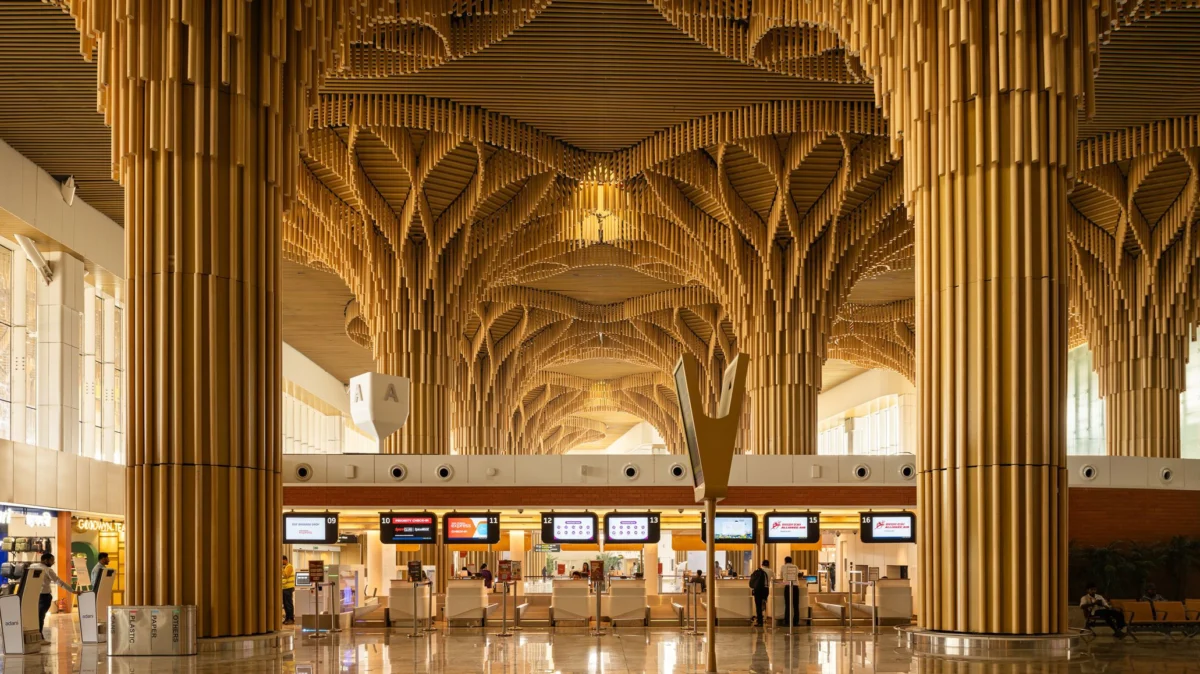
Located in Guwahati, this terminal serves as a gateway to Northeast India. Architect Nuru Karim took inspiration from the bamboo orchid, a flower native to the region. The interior is characterized by a "sky forest"—a vast landscape of branching structures and vaulted ceilings that mimic a dense canopy. The flooring and overhead patterns are designed to trace the movement of the Brahmaputra River, acting as a natural wayfinding system for travelers. By incorporating Indigenous art and local craft traditions, the terminal functions as an informal gallery of Assamese culture.
Navi Mumbai International Airport, Terminal 1 (India)
The Navi Mumbai project is one of the most ambitious engineering feats in modern India. Designed by Zaha Hadid Architects, the terminal features a canopy conceived as a lotus flower opening to the sun. Its petals float above the structure, sweeping down into sculptural columns. The construction required the redirection of rivers, the reclamation of marshland, and the relocation of high-voltage power lines. Opened in 2025, the terminal integrates interactive digital artworks that add a layer of contemporary dynamism to the transition spaces, reinforcing the "lotus" motif through fluted, flower-like geometry.
Techo International Airport (Cambodia)
Designed by the world-renowned firm Foster + Partners, Techo International Airport in Phnom Penh pays homage to Cambodian heritage. The terminal’s undulating canopy mirrors the rooflines of traditional palaces and temples. The ceiling, inspired by traditional basketry, creates a filtered light effect that reduces the need for artificial lighting and mechanical ventilation, hitting key sustainability targets. The central space is populated by native rumduol trees—Cambodia’s national flower—bringing the outdoors inside. The layout is intentionally simple, prioritizing short walking distances and clear sightlines from check-in to boarding.

Pittsburgh International Airport (United States)
Pittsburgh’s new terminal is a direct reflection of the Allegheny Mountains and the wooded landscapes of Western Pennsylvania. Designed by Gensler and HDR in association with Luis Vidal + Architects, the roof rolls and folds to mimic the local topography. Thirty-eight steel columns branch out to create a man-made forest within the hall. A standout feature is the "Petal Tunnel," inspired by the city’s famous Fort Pitt Tunnel, providing a cinematic transition for travelers. The design also addresses the common American airport issue of "terminal fatigue" by shortening walking distances and providing four outdoor terraces for fresh air.
San Diego International Airport, Terminal 1 (United States)
The defining feature of San Diego’s Terminal 1 is an 800-foot-long wall of curved glass. Developed by Gensler in collaboration with artist James Carpenter, the facade filters heat and glare while flooding the interior with the city’s famous natural light. This design recalls the city’s waterfront promenades and gardens. Architecturally, the project utilized an innovative structural system that eliminated many internal columns, creating a more open, breathable space. This efficiency contributed to a 30% reduction in the building’s carbon footprint, a significant achievement for the busiest single-runway airport in the United States.
Chronology of Selection and Award Process
The journey to the 2026 Prix Versailles list began years prior, as these terminals moved from the drawing board to completion. The selection process involves a rigorous review of architectural submissions from around the globe, focusing on "extraordinary architecture" that contributes to the local environment.

- Pre-2024: Construction and phased openings of the nominated terminals, including the landmark opening of Navi Mumbai’s Terminal 1.
- Early 2025: Submissions and nominations are gathered by the Prix Versailles secretariat in Paris.
- June 15, 2025: The official "World’s Most Beautiful Airports" list is unveiled at the UNESCO headquarters in Paris.
- Late 2025: An international jury composed of renowned architects, designers, and cultural figures will convene to deliberate on the three final "World Titles."
- Early 2026: The winners of the Architecture, Interior, and Exterior world titles are officially honored, setting the standard for the 2026 aviation year.
Supporting Data and Sustainability Benchmarks
The airports on the 2026 list are not merely beautiful; they are high-performance machines. For instance, the San Diego Terminal 1 expansion is part of a $3.4 billion project aimed at handling an estimated 28 million passengers annually by 2035. Its 30% carbon footprint reduction is a benchmark for U.S. aviation. Similarly, the Techo International Airport in Cambodia is designed to be a Class 4F airport, capable of handling large aircraft like the Airbus A380, with a Phase 1 capacity of 13 million passengers.
In India, the Navi Mumbai International Airport is expected to eventually handle 90 million passengers per year, relieving the immense pressure on the existing Chhatrapati Shivaji Maharaj International Airport. The sustainability features in these designs, such as the natural ventilation in Cambodia and the modularity in Frankfurt, represent a collective industry effort to reach "Net Zero" carbon emissions by 2050, as pledged by the Air Transport Action Group (ATAG).
Broader Impact and Industry Implications
The selection of these seven airports signals a paradigm shift in how global cities view their connectivity. In an era where remote work and digital nomadism are rising, the airport serves as the physical handshake between a region and the world. By investing in "beauty" and "sense of place," these regions are betting on the idea that a pleasant, culturally rich transit experience will drive tourism and business investment.

Furthermore, the emphasis on local flora—such as the bamboo orchids in Guwahati and the rumduol trees in Phnom Penh—highlights a move toward "Biophilic Design." Studies in environmental psychology suggest that incorporating natural elements into high-stress environments like airports can significantly reduce passenger anxiety and improve overall well-being.
The 2026 Prix Versailles list confirms that the future of aviation is not just about the planes in the sky, but the terrestrial spaces where our journeys begin and end. These seven terminals stand as monuments to human ingenuity, proving that even the most complex infrastructure can be a work of art that honors the environment and the people who pass through it.

0 Comments