
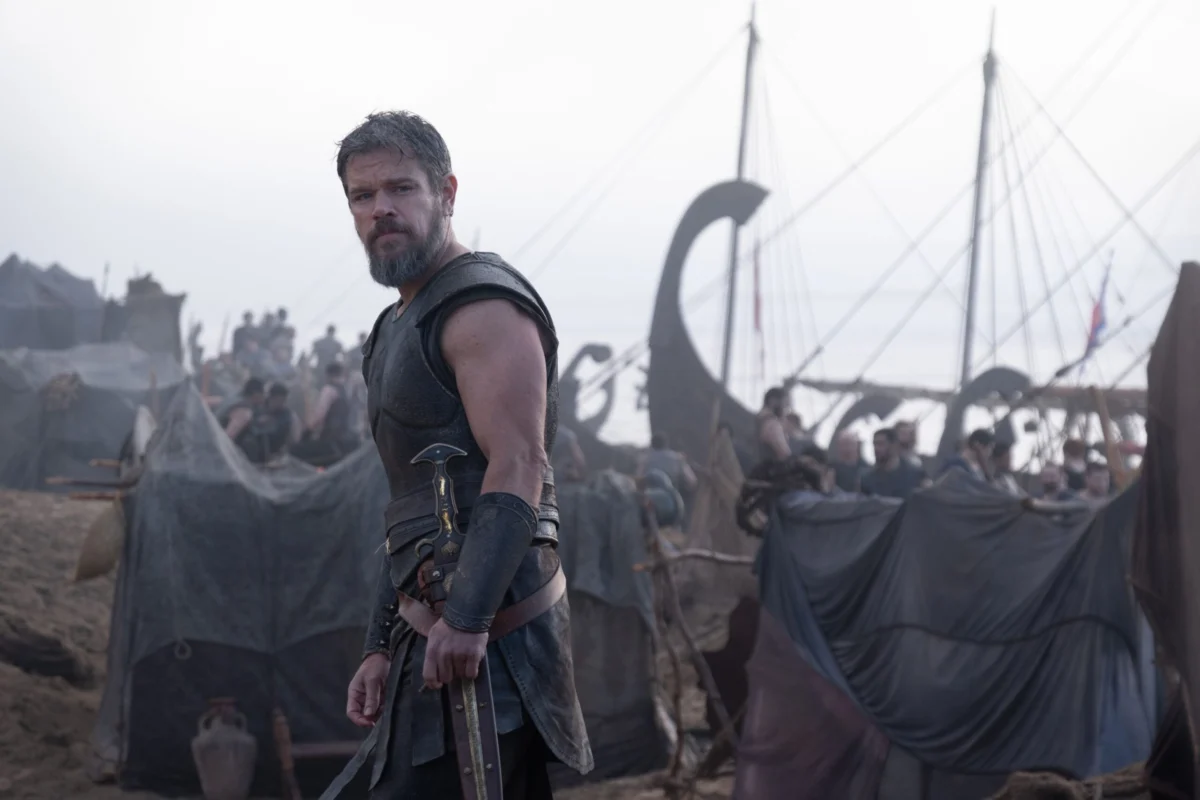
In a cinematic endeavor that mirrors the epic scope of its ancient source material, director Christopher Nolan and his acclaimed production designer, Ruth De Jong, have brought Homer’s timeless poem, The Odyssey, to life with a commitment to tangible, physically realized worlds. Eschewing the widespread reliance on digital effects, the duo championed a philosophy of practical construction and immersive environments, aiming to fully transport both actors and audiences into the fantastical realms of Odysseus’s arduous 20-year journey home. This ambitious undertaking, spanning 91 days of principal photography across six countries, represents a monumental achievement in contemporary filmmaking, pushing the boundaries of what is possible in large-scale production.

De Jong, whose previous work on Nolan’s Oscar-nominated Oppenheimer garnered critical praise, articulated the core principle guiding their vision: "We both believe in the ethos of practically building an entire set," she stated in an interview with Architectural Digest. "And we’re not interested in having actors engage with blue or green screens. We wanted to immerse them completely—as well as the audience." This dedication to verisimilitude meant that the fantastical elements of The Odyssey, from mythical creatures to divine interventions, would be grounded in real-world textures, scale, and the visceral experience of being present in a meticulously crafted environment.
The genesis of the project was marked by a singular, expansive directive from Nolan. "I asked Chris, ‘What are my parameters?’" De Jong recalled. His response, "The entire world," set the stage for an unparalleled quest to capture the vastness of Odysseus’s 20-year odyssey. The production team embarked on an exhaustive search, exploring diverse landscapes from the dense forests of Japan to the sun-drenched beaches of Australia, all in pursuit of locations that could embody the epic scale and inherent mystery of the hero’s trials. This global reconnaissance was crucial in finding settings that possessed the necessary texture, grandeur, and an evocative sense of the unknown, essential for translating Homer’s vivid descriptions into a cinematic reality.

Crafting the World of The Odyssey: A Global Tapestry
The chosen locales were not merely backdrops but active participants in the narrative, chosen for their atmospheric qualities and dramatic potential. Scotland’s rugged cliffs and tempestuous seas provided the dramatic setting for Odysseus’s encounter with the sorceress Circe, portrayed by Samantha Morton. The stark, otherworldly beauty of Iceland’s black sand beaches served as a compelling stand-in for the underworld, Hades, a realm of profound consequence and mythical dread. Morocco’s breathtakingly remote coast offered the perfect, enchanting environment for the sea nymph Calypso, brought to life by Charlize Theron. These significant filming locations were augmented by additional principal photography in Greece, Italy, and the United States, culminating in a truly international production that spanned a remarkable six countries.
The heart of the narrative, Odysseus’s home island of Ithaca, demanded a dual approach to its realization. The exterior shots of the Bronze Age palace were filmed at the historic 15th-century Castle of Santa Caterina, perched dramatically atop the island of Favignana in western Sicily. The arduous ascent of the 900-foot terrain by cast and crew alike underscored the commitment to authenticity. "Once we saw the bones of it, we thought, ‘Wow, what a backdrop this gives us,’" De Jong commented, highlighting the inherent grandeur of the chosen site.

In stark contrast, the interior of Odysseus’s palace, specifically the megaron—the great hall where Penelope, played by Anne Hathaway, endures the siege of the suitors—was meticulously constructed on a colossal soundstage in Los Angeles. This expansive set, stretching the length of two football fields and reaching three stories high, was a testament to De Jong’s dedication to seamless immersion. "I worked really hard to make all the ins and outs look seamless so you would never guess we were on a set," she explained, emphasizing the intricate detail that went into making the artificial environment indistinguishable from reality. The quarters for Penelope and her loyal servant, portrayed by Mia Goth, were also constructed on this LA soundstage, providing a controlled yet authentic environment for intimate scenes.
Navigating the Perils of Odysseus’s Return
The perilous voyages of Odysseus across the Mediterranean were not merely depicted through visual effects but were genuinely filmed on open water, demanding a fleet of seaworthy vessels capable of withstanding the rig uors of maritime production. "We needed a fleet of sea-worthy ships to carry all these actors and rowers and take on the waves," De Jong stated. The centerpiece of this fleet, Odysseus’s "hero ship," was a 115-foot-long vessel originally sourced from Stavanger, Norway. This formidable vessel was then transformed by the production team with authentic Greek warship ornamentation, including bronze detailing on the bow and stern. This magnificent ship embarked on its own substantial journey, traveling from Scotland to Morocco, embodying the spirit of exploration and resilience central to the epic.

The climactic events of the Trojan War, a pivotal moment in Odysseus’s legendary exploits, were staged with breathtaking scale in the historic mud-brick village of Aït Benhaddou in the Ouarzazate province of Morocco. De Jong described the endeavor as akin to having a "playground," with the directive to create a representation of Troy that conveyed its status as the "New York City of the ancient world." This necessitated the construction of an astonishing two-and-a-half acres of sets, encompassing the Temple of Athena, its formidable gates, doors, towers, and intricate staircases. Even the surrounding olive trees were imported to enhance the environmental authenticity. "We built everything that catches fire in the movie," De Jong noted, underscoring the practical approach to depicting the war’s destructive fury. The existing structures of the Moroccan village were ingeniously integrated into the set, allowing for the portrayal of chaotic scenes within its narrow, winding streets.
The iconic Trojan Horse, a symbol of cunning strategy and deception, was another monumental practical creation. Designed and constructed in Los Angeles at the outset of production, the colossal wooden structure was then transported overseas. The scene depicting its discovery was filmed on a beach in Essaouira, Morocco. In a testament to the film’s commitment to visceral experience, actors actually sheltered within the belly of the horse as it was positioned partially submerged in the chilling waters of the Atlantic, further immersing the cast in the historical and mythical context of the narrative.

A Legacy of Practical Grandeur
Reflecting on the immense undertaking, De Jong expressed profound admiration for the collaborative spirit and dedication of the film’s crew. "My passion is to be able to bring Chris’s film to life," she said, emphasizing the personal investment in realizing Nolan’s vision. She drew a powerful parallel between the film’s scale and ambition and that of classic epics, stating, "This movie is like the Lawrence of Arabia of our times." Her concluding thoughts underscored the rarity and potential historical significance of such a production: "When I think about what this crew signed up for and said yes to and executed, I just don’t know if it will ever be done again."
The production of The Odyssey under Christopher Nolan’s direction, with Ruth De Jong at the helm of its visual design, stands as a compelling argument for the enduring power of practical filmmaking in an era increasingly dominated by digital artistry. The film’s commitment to creating tangible worlds and authentic experiences not only honors the spirit of Homer’s epic but also sets a new benchmark for ambitious, large-scale cinematic storytelling. The sheer logistical complexity, combined with an unwavering dedication to aesthetic integrity and immersive detail, has resulted in a film that is as much a marvel of production design as it is a faithful, thrilling adaptation of a literary masterpiece. The impact of this approach is likely to resonate throughout the industry, inspiring future filmmakers to explore the profound possibilities of grounded, real-world creation in bringing fantastical narratives to life.

0 Comments