
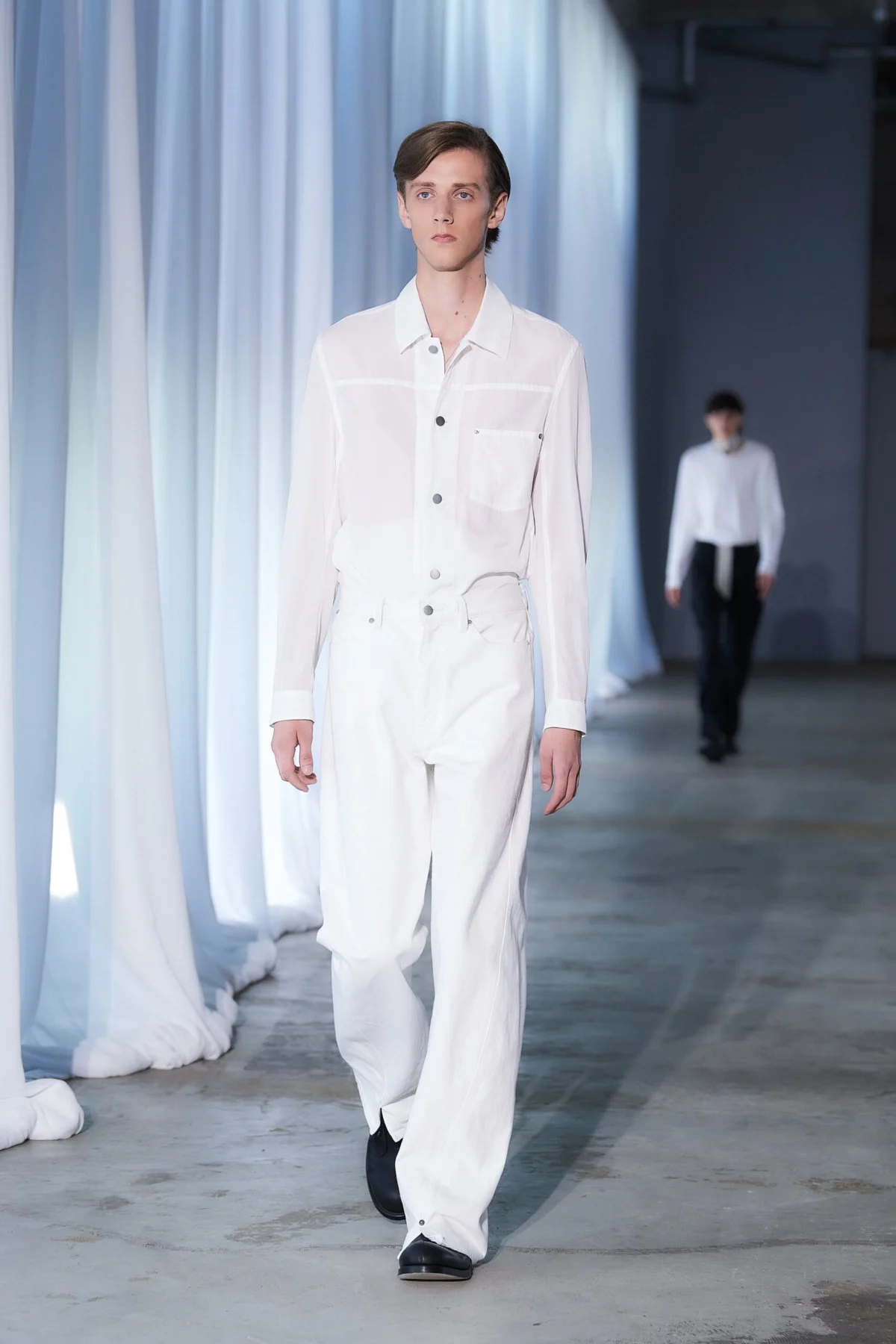
The latest collection from the Japanese fashion label Attachment, titled Lightly, represents a significant evolution in designer Koki Enomoto’s exploration of the relationship between the human form and the atmospheric environment. Unveiled in a stark, concrete warehouse characterized by its industrial austerity, the presentation centered on a single, sheer white curtain illuminated from behind, serving as a metaphorical representation of the collection’s core theme: the visibility of the invisible. Enomoto’s creative direction for this season was catalyzed by a singular moment of observation during a morning run earlier this year, where the sight of gray netting fluttering from a highway overpass prompted a meditation on how fabric can reveal the presence of the wind. This observation has been translated into a series of garments that prioritize fluid movement, technical textile engineering, and a refined silhouette that moves away from the pervasive oversized trends of recent years.
The Conceptual Foundation of the Lightly Collection
The genesis of the Lightly collection lies in Enomoto’s desire to capture the ephemeral nature of air and motion. During a walkthrough at his showroom, the designer articulated that his goal was to create clothing that acted as a medium for the environment, much like the netting he witnessed. By focusing on how fabric sways and reacts to the wearer’s movement, Enomoto sought to manifest the "invisible" forces of the atmosphere through the "visible" medium of fashion. This philosophical approach led to a design process that began with the physical properties of the fabric itself, rather than a preconceived sketch or a traditional tailoring template.
The collection’s title, Lightly, serves as both a description of the garments’ physical weight and an instruction on how they should be worn and perceived. In a fashion landscape often dominated by heavy layering or rigid structuralism, Enomoto’s focus on the "space between the fabric and the body" offers a counter-narrative. This space is not merely a void but a functional component of the garment’s architecture, allowing for ventilation, movement, and a specific character that only emerges when the piece is in motion.
Chronology and Development Process
The development of the Lightly collection followed a rigorous timeline that bridged the gap between spontaneous inspiration and technical execution. Following the initial spark of inspiration in early 2024, Enomoto and his design team spent several months in the laboratory phase, experimenting with textile blends that could achieve the desired "flutter" without sacrificing durability or sartorial structure.
By mid-year, the focus shifted to the "merging of categories," a hallmark of the Attachment brand under Enomoto’s leadership. This phase involved the creation of hybrid garments, such as the "shirt-blouson," which combines the lightweight nature of a traditional button-down with the protective qualities and silhouette of an outer layer. By August, the collection had been refined to excise any extraneous details—removing visible hardware, simplifying seams, and focusing on hidden functional elements like drawstring waists that provide form without the need for heavy internal structures. The final presentation in the warehouse setting was the culmination of this cycle, designed to strip away the noise of the traditional runway and focus the viewer’s attention on the interplay of light, fabric, and air.
Technical Innovation in Textile Science
A primary driver of the collection’s success is the sophisticated use of materials, particularly in the reinterpretation of classic workwear and tailoring. One of the standout technical achievements in the Lightly collection is the use of translucent cupra cotton. Cupra, a regenerated cellulose fiber derived from cotton linter, is known for its silk-like hand and excellent moisture-regulating properties. By utilizing this material for trucker jackets—a staple of rugged workwear—Enomoto has transformed a historically heavy garment into a diaphanous, breathable piece suitable for high-temperature environments.
Further evidence of textile innovation is found in the collection’s leather offerings. Enomoto presented leather blazers engineered to a degree of thinness that allows the sleeves to be rolled up with the same ease as poplin cotton. This feat of material processing challenges the traditional limitations of leather, making it a viable option for spring and summer wardrobes. Additionally, the inclusion of yellow silk hooded shirts with striped patterns demonstrated a commitment to luxury materials that offer both visual depth and skin-contact comfort. These garments were specifically designed to billow during movement, occasionally revealing the wearer’s skin and reinforcing the theme of transparency and lightness.
A Shift in Silhouette Strategy
The Lightly collection marks a deliberate departure from the "oversized" aesthetic that has dominated both luxury and streetwear sectors for the past decade. Enomoto’s analysis of contemporary fit led him to the conclusion that excessive volume often results in a loss of structural integrity. He noted that when a garment is made too large, it fails to hold its form beautifully and can overwhelm the wearer’s natural proportions.
In response, Attachment has shifted toward a slimmer, more contoured fit. However, this is not a return to the restrictive "skinny" fits of the early 2000s. Instead, Enomoto has pioneered a "technical slim" silhouette. This approach uses precise tailoring and adjustable elements, such as the drawstring waist on cotton shirts, to allow the garment to follow the lines of the body while maintaining enough internal volume for air circulation. The result is a look that appears fully dressed and sharp but feels weightless and unrestricted to the wearer.
Market Analysis and Industry Implications
The strategic direction taken by Enomoto with the Lightly collection aligns with broader shifts in the global menswear market. As "quiet luxury" and "technical minimalism" continue to gain traction, consumers are increasingly seeking garments that offer versatility across different climates and social settings. The "shirt-blouson" and the ultra-light leather blazer are prime examples of "trans-seasonal" clothing—items that can be layered or worn alone, bridging the gap between formal and casual attire.
Data from recent retail trend reports suggest a growing demand for "high-performance naturals"—fabrics that combine the comfort of natural fibers like silk and cotton with the technical performance of synthetics. Attachment’s use of cupra and ultra-thin leather positions the brand at the forefront of this trend. Furthermore, by moving away from oversized silhouettes, Enomoto is catering to a demographic of professional men who seek a modern, streamlined aesthetic that reflects a more disciplined and refined personal style.
Official Responses and Logical Implications
While official reviews from major fashion houses are still being compiled, industry insiders at the showroom walkthrough noted the collection’s potential to redefine the "urban uniform." Logical inferences from buyers suggest that the Lightly collection will perform well in metropolitan markets such as Tokyo, New York, and Paris, where the "heat island effect" makes traditional spring/summer tailoring impractical.
The implication for the Attachment brand is a solidification of its identity as a leader in Japanese minimalist design. Under Enomoto’s guidance, the brand is successfully navigating the transition from the legacy of its founder, Kazuyuki Kumagai, to a future defined by atmospheric inspiration and textile experimentation. The collection suggests that the future of menswear lies not in adding more features, but in the sophisticated removal of the unnecessary.
Broader Impact on Sustainable Design
Though not explicitly marketed as a "green" collection, the principles behind Lightly carry significant implications for sustainable fashion. By focusing on high-quality, durable materials like silk, cupra, and leather, and by creating timeless, minimalist silhouettes, Enomoto is promoting a "buy less, buy better" philosophy. The reduction of extraneous hardware—zippers, snaps, and heavy linings—not only contributes to the lightness of the garment but also simplifies the recycling and breakdown process of the textiles at the end of their lifecycle.
Moreover, the emphasis on breathability and climate-adaptive clothing is a direct response to a warming global climate. As summers become longer and more intense, the fashion industry is under pressure to innovate beyond the standard t-shirt and shorts. Enomoto’s Lightly collection provides a blueprint for how high-end tailoring can evolve to remain relevant and functional in a changing environment, ensuring that the wearer can maintain a sophisticated appearance without sacrificing physical comfort.
In conclusion, Koki Enomoto’s Lightly collection for Attachment is a masterclass in the power of subtle observation and technical execution. By finding inspiration in a piece of wind-blown netting, Enomoto has managed to create a cohesive sartorial language that speaks to the modern need for lightness, movement, and refined structure. As the collection moves from the warehouse floor to global retail spaces, it is poised to influence the trajectory of minimalist menswear for seasons to come.

0 Comments