
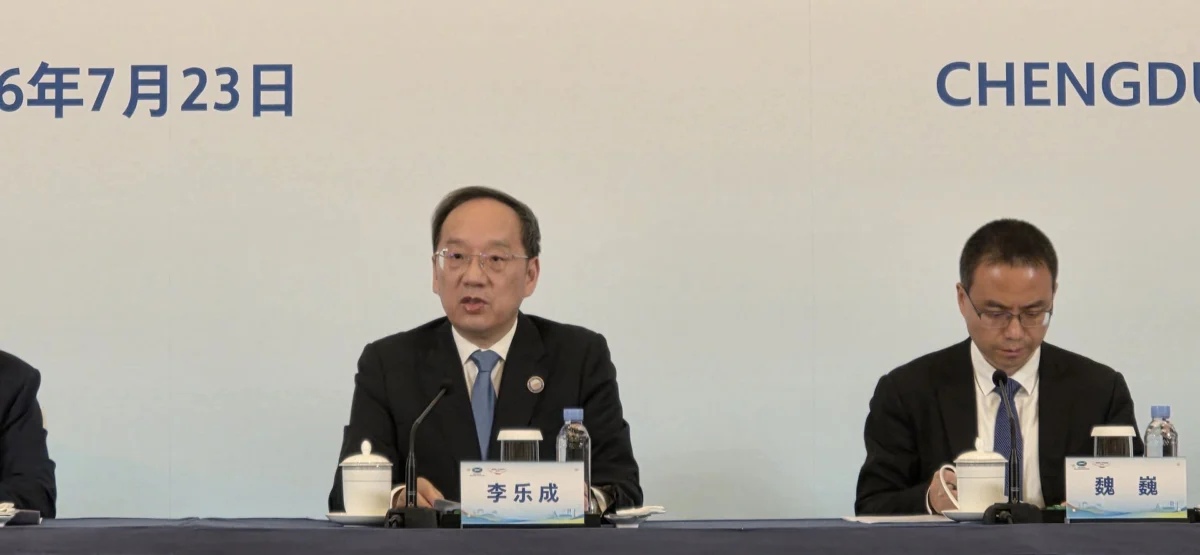
CHENGDU, China – The 21 member economies of the Asia-Pacific Economic Cooperation (APEC), including global technological powerhouses like the United States and China, have released a landmark "Chengdu statement on AI" that signals a significant shift in the global approach to artificial intelligence governance. Issued during the APEC Digital Weeks on July 23, 2026, the statement underscores a multilateral consensus on balancing the revolutionary potential of open-source AI development with stringent demands for security, data protection, and intellectual property rights. This pivotal declaration, chaired by China’s Minister of Industry and Information Technology, Li Lecheng, marks the first time open-source cooperation in AI has been addressed at a ministerial level within APEC, reflecting a growing international desire to guide AI’s trajectory amidst its accelerating evolution.
The "Chengdu statement" specifically champions support for open-source development while simultaneously emphasizing the necessity for models and projects that "employ strong security assurance through development and deployment." This nuanced stance reflects a global pivot away from the traditionally libertarian ethos of open-source software, towards a framework increasingly influenced by state oversight and national security considerations. The dialogue surrounding this statement acknowledges the dual nature of AI – a powerful engine for innovation and economic growth, but also a potential vector for novel risks ranging from cybersecurity threats to geopolitical instability.
The Evolving Landscape of Open-Source AI and Geopolitical Tensions
The conversation around AI, particularly open-source models, has become increasingly complex. Open-source AI models, like those developed by Chinese companies DeepSeek and GLM 5.2, are freely available for use and modification, contrasting sharply with proprietary, closed-source models offered by many U.S. firms such as Anthropic, which typically require payment and restrict access to their underlying architecture. This accessibility of open-source models fosters rapid innovation and democratization of AI technology, allowing a wider array of developers and researchers to build upon existing foundations. However, it also raises concerns about potential misuse, lack of oversight, and the difficulty in embedding robust security features from inception.
The geopolitical dimension of this debate is particularly salient. China has emerged as a significant player in open-source AI development, a trend that has drawn scrutiny and accusations from the U.S. regarding alleged intellectual property theft. The APEC statement, by explicitly calling for "trusted open-source AI" and "strong security assurance," seeks to navigate these tensions. Wei Sun, principal analyst for artificial intelligence at Counterpoint Research, noted that this phrasing provides "security-conscious economies room to support open models while still demanding testing, transparency, data protection and deployment controls." This suggests an ongoing effort to define what constitutes a ‘trusted’ open-source ecosystem, moving the debate beyond a simple open vs. closed dichotomy.
Winston Ma, an adjunct professor of law at New York University, highlighted that the statement’s "explicit alignment around open-source ecosystems and compute infrastructure" confirms a regional shift. He suggests that the Asia-Pacific region is increasingly favoring open-weight systems, which are combined with state-coordinated energy, telecommunications, and digital infrastructure. This integrated approach signifies a comprehensive strategy to leverage AI while maintaining a degree of national control over critical digital infrastructure.
APEC’s Role in Shaping the Digital Future
The APEC Digital Weeks in Chengdu served as a critical platform for these discussions. APEC, established in 1989, is a regional economic forum comprising 21 member economies that collectively account for approximately 60% of global GDP and 48% of world trade. Its primary goal is to promote free trade and sustainable economic growth across the Asia-Pacific region. While traditionally focused on trade and investment liberalization, APEC has increasingly expanded its agenda to address emerging challenges and opportunities in the digital economy. Previous APEC meetings have touched upon digital transformation, cybersecurity, and data flows, but the 2026 Chengdu statement marks a definitive step into the complex realm of AI governance at a ministerial level.
Minister Li Lecheng, who presided over the meeting, emphasized that all participating parties acknowledged the inherent risks associated with AI. He called for enhanced dialogue across governments, the private sector, and academia to facilitate information sharing on critical issues such as cybersecurity, supply chain resilience, and the burgeoning problem of online scams perpetuated by advanced AI. This collaborative approach is deemed essential for developing comprehensive and adaptable regulatory frameworks that can keep pace with rapid technological advancements.
The timing of the Chengdu statement is also noteworthy, coming amidst growing reports of Washington and Beijing independently seeking tighter controls over their homegrown AI capabilities. The joint endorsement of a framework that balances open innovation with security concerns, despite the prevailing geopolitical competition, underscores the universal recognition of AI’s transformative power and the imperative for collective action.
Broader Implications and the Road Ahead
The APEC statement’s emphasis on "strong security assurance" reflects a growing global trend towards AI regulation. The European Union’s groundbreaking AI Act, the U.S. Executive Orders on AI safety and security, and the G7 Hiroshima Process on AI are all testament to this global push for responsible AI development. The APEC statement adds a crucial regional dimension to this global mosaic, demonstrating that diverse economies can find common ground on principles, even if the implementation details will vary.
The implications of this statement are far-reaching. For the global AI industry, it signals a future where regulatory compliance and security audits will become increasingly integral to product development and deployment, even for open-source models. This could necessitate greater investment in AI safety research, ethical guidelines, and robust testing protocols. Startups and smaller developers might face new hurdles in navigating these requirements, while larger corporations with dedicated compliance teams may adapt more readily.
Economically, the commitment to "open-source ecosystems and compute infrastructure" could foster further regional collaboration and investment in shared digital infrastructure. This might include joint ventures in data centers, cloud computing resources, and AI research hubs, potentially creating a more interconnected and resilient digital economy across the Asia-Pacific. However, the exact mechanisms for ensuring "strong security assurance" across such diverse economies will be a critical challenge, requiring harmonized standards and trusted certification processes.
The Dawn of the Quantum Computing Era
Adding another layer of urgency to these discussions, Janet De Silva, chair of the APEC Business Advisory Council Digital and Innovation working group, urged ministers to prepare for the advent of the quantum computing era. Her remarks highlighted that "we need trusted encryption to ensure the security of our entire financial system, ensuring that quantum computing is not only a security measure but also an opportunity to bring competitiveness."
Quantum computing, with its immense processing power, poses a potential threat to current cryptographic standards that secure everything from financial transactions to national security communications. If current encryption methods are rendered obsolete by quantum algorithms, the integrity of global digital infrastructure could be severely compromised. Therefore, the development of quantum-resistant cryptography becomes paramount. De Silva’s intervention underscores the need for proactive policymaking that anticipates future technological shifts rather than merely reacting to present challenges. The convergence of advanced AI with emerging quantum capabilities presents both unprecedented opportunities for innovation and formidable challenges for security and governance.
The APEC "Chengdu statement on AI" thus represents a pivotal moment in the global effort to govern artificial intelligence. It acknowledges the transformative power of open-source innovation while firmly planting a flag for security, responsibility, and national interest. As the world hurtles towards an AI-driven future, the principles articulated in Chengdu will likely serve as a foundational guide for nations striving to harness AI’s potential while mitigating its inherent risks, all while preparing for the next frontier of computing. The debate is no longer about whether AI should be open or closed, but rather how to build an open ecosystem that is universally trusted and secure enough for widespread governmental and enterprise deployment.

0 Comments