
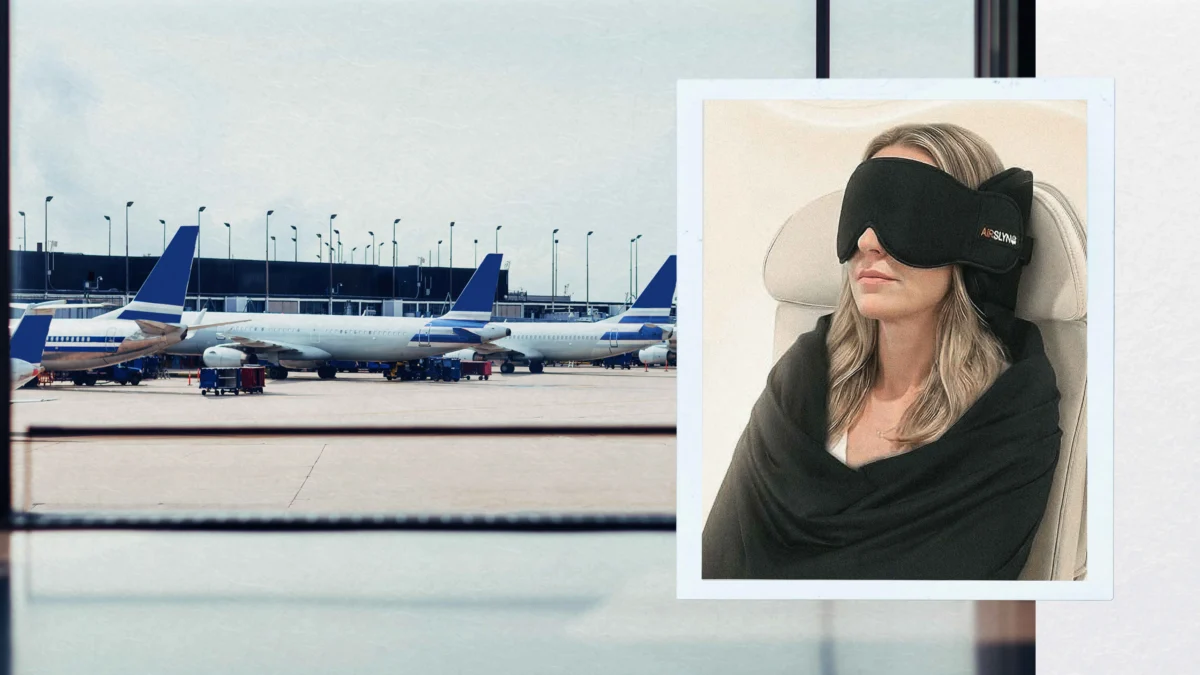
The pursuit of rest during long-haul air travel has birthed a multi-billion-dollar industry focused on the "sleep economy," as passengers increasingly seek ways to mitigate the physical toll of economy-class seating. In a market saturated with memory foam U-shaped pillows and inflatable cushions, a new contender has emerged: the AirSlyng. This three-in-one airplane sleep support system, currently retailing for $40, aims to address the fundamental biomechanical failures of traditional travel aids. By integrating a headrest-anchored pillow, a blackout eye mask, and a supportive chest sling, the device attempts to replicate the physiological benefits of swaddling, a technique traditionally used to soothe infants, adapted now for the modern adult traveler navigating the constraints of 31 inches of seat pitch.
The Biomechanics of In-Flight Exhaustion
To understand the utility of the AirSlyng, one must first analyze the anatomical challenges posed by standard airline seating. Most economy seats are designed for an upright or slightly reclined posture that does not support the human head’s weight—approximately 10 to 12 pounds—once the neck muscles relax during deep sleep. This lack of support leads to the "head bob" phenomenon, where the head drops forward or sideways, triggering the body’s "startle reflex" or hypnic jerks. This cycle prevents the passenger from entering Rapid Eye Movement (REM) sleep, leaving them fatigued upon arrival.
Traditional neck pillows frequently fail because they only provide lateral support and often push the head forward, exacerbating the misalignment of the cervical spine. Furthermore, the shrinking dimensions of economy cabins—where seat width has decreased from an average of 18 inches in the early 2000s to as little as 16 inches on some low-cost carriers—make bulky, inflatable sleep aids impractical. The AirSlyng enters this landscape as a compact, integrated solution designed to stabilize the head and torso simultaneously, thereby neutralizing the disruptive effects of turbulence and gravity.
Product Architecture and Chronology of Use
The AirSlyng system is characterized by its modular design, which emphasizes portability and ease of deployment. The entire unit is housed in a cushioned case that, when packed, occupies a volume comparable to a standard reusable water bottle. This footprint is critical for modern travelers who are increasingly restricted by "personal item" only baggage policies.
The chronology of the system’s deployment typically begins once the aircraft has reached its cruising altitude. The setup process involves unzipping the compact case, which then doubles as the primary pillow component. This case features a specialized strap system that secures it to the existing aircraft headrest. This anchoring mechanism is the device’s most significant departure from free-floating pillows, as it provides a fixed point of resistance.
Once the pillow is anchored, the user attaches the integrated Velcro sleep mask. This mask serves a dual purpose: it blocks ambient light—a known disruptor of melatonin production—and attaches directly to the pillow unit. This connection creates a gentle tension that prevents the head from falling forward. The final stage of the setup is the "sling" or blanket component. This fabric section loops around the neck and torso, allowing the user to tuck their arms inside. This configuration applies light, distributed pressure across the chest and arms, a method known in clinical settings as Deep Pressure Stimulation (DPS). DPS is documented to lower cortisol levels and increase the production of serotonin, facilitating a more profound state of relaxation.
Field Testing: New York to Calgary
The efficacy of the AirSlyng was recently evaluated during a six-hour transcontinental flight from New York City to Calgary. This route, often characterized by varying cabin temperatures and the cramped configurations of narrow-body aircraft, served as a rigorous testing ground for the device’s claims.
During the initial hour of the flight, the device remained stowed in a carry-on bag, demonstrating its minimal impact on legroom. Upon reaching cruising altitude, the deployment of the system took approximately two minutes. Despite the initial learning curve associated with the Velcro attachments, the system proved intuitive. The primary observation during the flight was the total elimination of the "head lull." By securing the eye mask to the anchored pillow, the tester’s head remained in a neutral vertical position throughout the duration of the sleep cycle.

The sling component addressed a secondary but frequent issue in economy travel: arm placement. In a standard seat, passengers often struggle to find a comfortable position for their arms without encroaching on a neighbor’s space or the armrest. The AirSlyng’s cocoon-like wrap internalized the arms, providing a sense of security and physical boundaries within the shared cabin space. Upon the aircraft’s descent into Calgary, the system was dismantled and repacked into its case in under 60 seconds, fitting easily beneath the seat for the remainder of the flight.
Comparative Market Analysis
The travel accessory market is currently valued at over $30 billion globally, with a significant portion dedicated to comfort-enhancing products. To position the AirSlyng within this market, it must be compared against three primary categories of sleep aids:
- The Traditional U-Pillow: While inexpensive and widely available, these offer no forward head support and are often too bulky to carry comfortably when not in use.
- Inflatable Front-Leaners: These large, box-like structures require the passenger to lean forward onto a tray table. While they prevent head-bobbing, they are often viewed as socially awkward and are rendered useless if the passenger in the preceding row reclines their seat.
- Supportive Wraps/Scarves: Products like the Trtl pillow provide lateral support using internal toggles. However, they do not offer the light-blocking or arm-securing features integrated into the AirSlyng.
At a price point of $40, the AirSlyng occupies a mid-tier position. Its value proposition lies in its "three-in-one" functionality, reducing the need for passengers to pack separate masks, blankets, and pillows. Furthermore, the inclusion of machine-washable fabrics addresses a long-standing hygiene concern regarding travel gear, which is frequently exposed to high-touch surfaces and recycled cabin air.
The Evolution of Travel Wellness
The rise of products like the AirSlyng reflects a broader shift in consumer behavior toward "travel wellness." As airline "unbundling" continues to strip away amenities like blankets and pillows from economy cabins, passengers are taking responsibility for their own comfort. This has led to a surge in high-tech, ergonomically focused gear.
Industry analysts suggest that the next decade of travel will be defined by "frictionless" experiences. For the long-haul flyer, friction is not just found in security lines or boarding processes, but in the physical exhaustion of the journey itself. A product that can successfully mitigate "jet lag" by ensuring higher quality in-flight rest has significant economic value, potentially saving a traveler a full day of recovery time at their destination.
From a flight operations perspective, compact sleep systems are generally preferred over bulky inflatables. Cabin crews have frequently cited oversized sleep gear as a potential hazard during emergency evacuations. The AirSlyng’s low profile and the fact that it remains attached to the seat or the person’s torso—rather than obstructing the floor or the tray table—aligns more closely with aviation safety recommendations.
Implications for the Future of Long-Haul Travel
The success of integrated sleep systems may eventually influence aircraft interior design. While some airlines are experimenting with "bunk" style configurations for economy passengers (such as Air New Zealand’s Skynest), these remain premium upgrades. For the vast majority of travelers, the standard upright seat will remain the reality for the foreseeable future.
Innovations like the AirSlyng represent a "bottom-up" solution to the problems of the aviation industry. Until seat designs undergo a radical transformation to prioritize human physiology over passenger density, the market for sophisticated, portable sleep enclosures will continue to expand. The AirSlyng’s ability to provide a "swaddled" environment suggests that the future of travel comfort may lie not in more padding, but in better stabilization and sensory deprivation.
In conclusion, the AirSlyng offers a pragmatic response to the deteriorating comfort levels of modern air travel. By combining the psychological comfort of a swaddle with the physical necessity of head stabilization, it provides a viable path to rest for the "in-flight insomniac." As travelers continue to seek ways to reclaim their well-being at 35,000 feet, the integration of multiple functions into a single, compact, and affordable device sets a new benchmark for the travel accessory industry. For $40, the promise of arriving at a destination feeling fully rested is an investment that many frequent fliers will find increasingly difficult to ignore.

0 Comments