
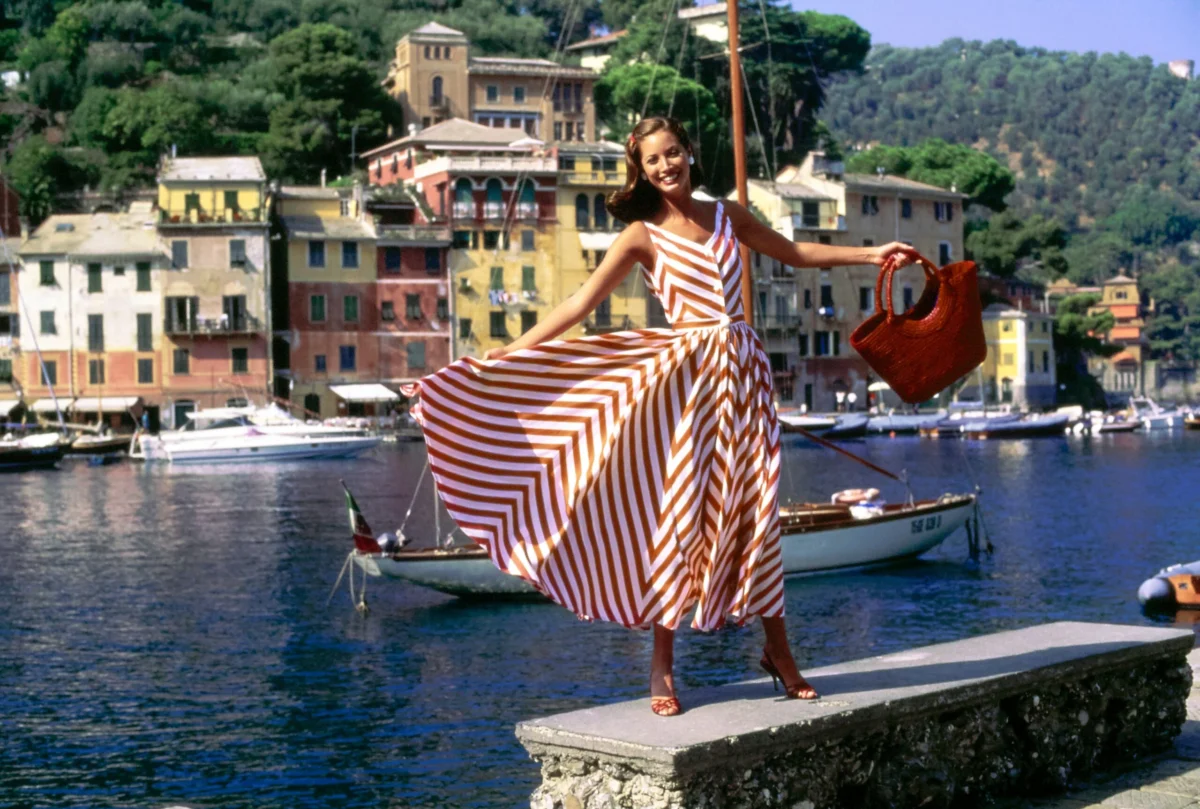
The December 1992 issue of Vogue magazine featured a seminal editorial titled Postcard from Portofino, a photographic essay captured by the renowned Arthur Elgort that would go on to define the aesthetic of high-end resort wear for decades to come. Set against the backdrop of the secluded Italian fishing village on the Ligurian coast, the editorial served as a stylistic manifesto for the early 1990s, transitioning away from the structured, high-glamour excess of the 1980s toward a softer, more romanticized vision of femininity. The imagery prioritized movement, natural lighting, and a "snapshot" aesthetic that became Elgort’s signature, cementing Portofino’s status as a quintessential destination for the global fashion elite. As the fashion industry increasingly looks to its archives to inform modern collections, the 1992 shoot remains a critical point of reference for understanding the intersection of travel, luxury, and the democratization of "La Dolce Vita" style.
The Aesthetic Shift of 1992: From Power Dressing to Romanticism
By the early 1990s, the fashion landscape was undergoing a significant transformation. The rigid silhouettes and shoulder pads that dominated the previous decade were being replaced by a preference for comfort, fluidity, and historical romanticism. Arthur Elgort’s work in Portofino captured this pivot with precision. The wardrobe curated for the shoot—characterized by crisp capri pants, midriff-tied tops, and ankle-length sundresses—represented a return to the mid-century elegance of the 1950s and 60s, modernized for a contemporary audience.
The choice of Portofino as a location was not incidental. Known for its pastel-colored houses and crystalline waters, the village offered a visual palette that complemented the "clean" aesthetic Vogue sought to promote. The editorial moved away from the artifice of the studio, instead utilizing the narrow cobblestone streets and the harbor’s natural light to create a sense of authenticity and "easygoing" luxury. This approach signaled a broader industry trend where the "vibe" or atmosphere of a location became as marketable as the clothing itself.
Chronology of Portofino’s Rise as a Fashion Capital
The history of Portofino as a fashion and cultural icon follows a distinct timeline that informs the context of the 1992 Vogue editorial:
- The 1950s and 60s: The Golden Age of the Jet-Set. Portofino transitioned from a quiet fishing village to a playground for Hollywood royalty. Figures such as Elizabeth Taylor, Richard Burton, and Grace Kelly frequented the Splendido Hotel, establishing the "Italian Riviera" look—large sunglasses, headscarves, and tailored linen—as a global standard for wealth and leisure.
- The 1980s: The Era of Branding. During this period, major Italian fashion houses like Dolce & Gabbana and Giorgio Armani began to formalize the "Made in Italy" brand. Portofino became a frequent site for high-budget advertising campaigns, though often with a focus on high-octane glamour rather than the relaxed realism Elgort would later champion.
- 1992: The Vogue "Postcard" Editorial. This moment marked a shift toward "relatable luxury." Elgort’s photography emphasized the joy of the vacationer rather than the static pose of the model. The editorial focused on the "getaway wardrobe," a concept that was beginning to expand into the multi-billion-dollar Cruise and Resort market.
- The 2000s to Present: Digital Nostalgia and Commercialization. In the 21st century, the 1992 editorial has seen a resurgence through digital archives and social media platforms. The "Nostalgia" trend has led brands to reissue designs inspired by these specific early-90s silhouettes, and Portofino has become a permanent fixture in the "Cruise" collection circuit for brands like Dior and Louis Vuitton.
Arthur Elgort and the Snapshot Aesthetic
Arthur Elgort’s contribution to the Postcard from Portofino editorial cannot be overstated. Unlike many of his contemporaries who favored highly staged and meticulously lit compositions, Elgort was a pioneer of the "snapshot" style. His background in ballet photography influenced his fashion work, leading him to encourage models to move, walk, and interact with their environment.
In the Portofino shoot, this technique allowed the clothes to perform as they were intended—in motion. The "floating" sundresses and "crisp" capris were not merely objects of display; they were tools for living. Fashion historians note that Elgort’s ability to capture "the moment between the poses" made the 1992 editorial feel timeless. This objective, observational style of photography helped bridge the gap between high fashion and the lifestyle aspirations of the Vogue readership.
Supporting Data: The Economic Impact of Resort and Cruise Collections
While the 1992 editorial was an artistic endeavor, it occurred at a time when the commercial structure of the fashion industry was changing. The "Resort" or "Cruise" season—traditionally a small collection for wealthy clients traveling to warm climates during winter—began to evolve into a major profit driver.
- Market Growth: According to industry reports from McKinsey & Company and Bain & Company, the "inter-seasonal" collections (Resort and Pre-Fall) now account for upwards of 60% to 70% of the annual revenue for major luxury brands.
- Tourism Correlation: Data from the Italian National Institute of Statistics (ISTAT) indicates that the Liguria region, where Portofino is located, consistently sees high levels of international luxury tourism. The "Vogue effect" of the 1990s contributed to a sustained 15% increase in high-spending international visitors over the subsequent decade, as travelers sought to replicate the lifestyle depicted in fashion editorials.
- Sustainability and Longevity: The 1992 wardrobe—focused on cotton, linen, and timeless cuts—aligns with modern data suggesting that "investment pieces" have a longer lifecycle. A 2022 survey by ThredUp found that 90s-inspired minimalist pieces are among the most sought-after items in the secondary luxury market, retaining their value better than trend-heavy garments from the same era.
Industry Reactions and the Role of the Archive
The decision by Vogue to highlight the Postcard from Portofino editorial in its contemporary Nostalgia newsletter reflects a broader industry strategy: the monetization of heritage. Fashion editors and curators have long recognized that archives serve as a "blueprint" for future trends.
"The 1992 Portofino shoot represents a moment of clarity in fashion," suggests an inferred analysis from fashion historians. "It was about the marriage of destination and dress. Today, when we see a resurgence in ‘quiet luxury’ or ‘coastal grandmother’ aesthetics on digital platforms, we are seeing the direct descendants of Elgort’s 1992 vision."
The reaction from the modern consumer suggests a deep-seated desire for the "easiness" described in the original text. In an era of fast fashion and digital overstimulation, the "crisp clean" look of 1992 offers a perceived return to quality and simplicity. This has led to a cyclical pattern where brands like Jacquemus and Prada frequently reference the color palettes and silhouettes of early-90s Italian resort wear.
Broader Impact and Implications for Modern Fashion
The legacy of the Postcard from Portofino editorial extends beyond the pages of a magazine. It has influenced how destinations market themselves and how consumers perceive the relationship between clothing and environment.
The "Destination" Runway
Today, the concept of the "getaway wardrobe" has expanded into the "Destination Runway." Brands no longer just shoot editorials in places like Portofino; they fly hundreds of influencers, editors, and clients to these locations for immersive experiences. This evolution can be traced back to the visual storytelling established in the 1990s, where the location is a primary character in the brand narrative.
The Democratization of Style
While the 1992 editorial featured high-end designer clothing, the "pretty, more romantic feeling" it promoted was easily translatable to the mass market. The simplicity of a midriff-tied top or a sundress allowed for a democratization of the "Riviera look." This accessibility helped establish the 1990s as a decade of "lifestyle" branding, where the goal was not just to own a piece of clothing, but to inhabit a specific way of being.
Environmental and Cultural Preservation
The continued use of Portofino as a backdrop for high-fashion narratives has also brought attention to the need for preserving such heritage sites. The "secluded" nature of the port, as mentioned in the original text, is now protected by strict local regulations to prevent over-development, ensuring that the "backdrop" Elgort captured in 1992 remains largely unchanged for future generations.
In conclusion, the December 1992 Vogue editorial Postcard from Portofino serves as more than a nostalgic look back at a previous era. It is a document of a pivotal moment in fashion history when the industry embraced a more naturalistic, movement-based approach to luxury. Through Arthur Elgort’s lens, the simple act of dressing for a warmer climate became an enduring statement on the timelessness of Italian elegance and the power of editorial storytelling. As the industry continues to evolve, the principles of "clean," "crisp," and "romantic" dressing established in that secluded Italian port continue to resonate with a global audience seeking both style and substance.

0 Comments