
The Pre-War Landscape: Barbershops and the Straight Razor
At the dawn of the 20th century, personal grooming was frequently a communal rather than a private activity. For many men, shaving was a weekly or bi-weekly event performed by a professional barber. The primary tool of the era was the straight razor, an implement that required significant skill to master and constant maintenance to remain functional. To maintain a straight razor, a man needed to regularly "strop" the blade on a leather strap and "hone" it on a stone. Furthermore, the lack of indoor plumbing in many households meant that obtaining the hot water necessary for a comfortable lather was a labor-intensive process involving wood-burning stoves.
Due to these technical barriers, facial hair was the norm. Beards and ornate mustaches served as symbols of maturity and social status. While the safety razor had been invented in the late 19th century, it had yet to achieve mass-market penetration. It was not until King Camp Gillette secured U.S. Patent No. 775,134 in 1904 that the foundation for a grooming revolution was laid. Gillette’s innovation was not merely the safety guard, but the disposable blade. By selling the razor handles at a low cost and profiting from the recurring sale of blades, Gillette created a business model that would eventually dominate the industry. Yet, even with this innovation, domestic sales remained modest until the intervention of the United States federal government.
World War I and the Necessity of the Clean Shave
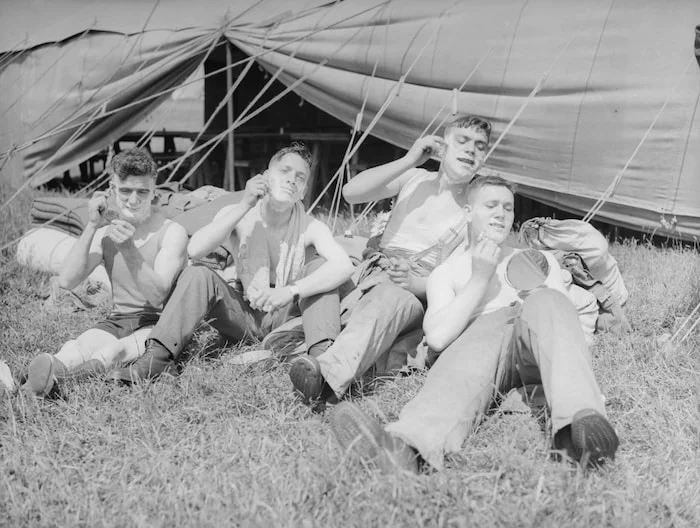
The entry of the United States into World War I in 1917 served as the first major catalyst for standardized grooming. The shift was driven by a lethal new development in modern warfare: chemical weapons. The introduction of chlorine and mustard gas on the Western Front necessitated the universal issuance of gas masks to infantrymen. For a gas mask to function effectively, it required a perfect, airtight seal against the wearer’s skin. Any amount of facial hair—even a few days of stubble—could create a gap in the seal, allowing toxic vapors to enter the mask and cause agonizing injury or death.
Consequently, the U.S. Army mandated that all soldiers be clean-shaven. To facilitate this, the War Department purchased 3.5 million Gillette safety razors and 32 million blades to be distributed among the troops. This move effectively turned the American military into a massive testing ground for Gillette’s product. Millions of young men, many of whom had never shaved themselves, were suddenly required to perform the task daily.
Chronology of Shaving Standardization:
- 1904: King C. Gillette patents the safety razor with disposable blades.
- 1914: Outbreak of WWI; European powers begin experimenting with chemical warfare.
- 1917: The U.S. enters WWI; the Army mandates clean-shaven faces for gas mask efficacy.
- 1918: Millions of American "Doughboys" return home with safety razors and a habit of daily shaving.
- 1926: Market data shows American men purchasing over 2 million razor blades per day, signaling the permanent decline of the professional barber’s monopoly on shaving.
World War II: The Rise of the Dopp Kit and Dental Hygiene
While World War I introduced the safety razor, World War II expanded the scope of male grooming to include comprehensive hygiene. By the 1940s, the U.S. military sought to improve the overall health and morale of its 16 million service members through standardized personal care kits. This era saw the rise of the "Dopp kit," named after Charles Doppelt, a leather goods manufacturer from Chicago.
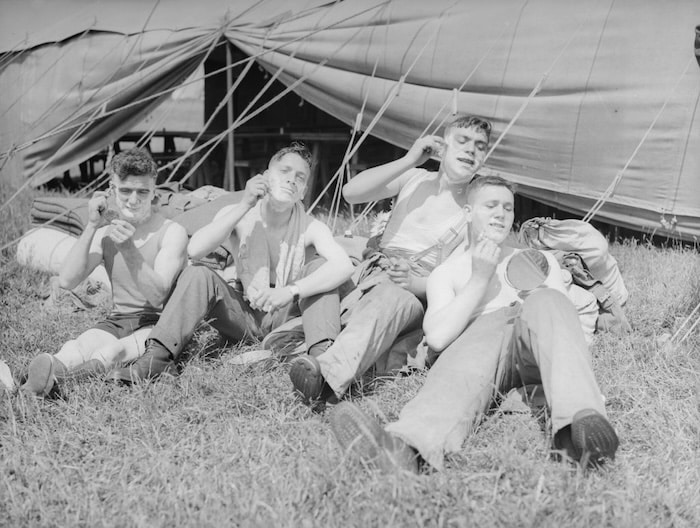
Doppelt had designed a compact, waterproof-lined leather pouch for toiletries in 1919, but it was during World War II that the U.S. Army contracted for millions of these bags. The Dopp kit became a standard-issue item, containing a safety razor, shaving cream (or "brushless" cream for use in the field), a comb, a mirror, and a bar of soap. The inclusion of these items ensured that regardless of where a soldier was stationed—from the jungles of the Pacific to the forests of Germany—he could maintain a level of grooming that reflected military discipline.
A significant addition to the WWII grooming regimen was the toothbrush. Prior to the war, regular toothbrushing was not a widespread habit among the American working class. However, the military faced a significant problem with "trench mouth" (acute necrotizing ulcerative gingivitis), a painful condition that had incapacitated thousands of troops during WWI. To combat this, the military mandated daily toothbrushing and issued nylon-bristled brushes, a relatively new technology developed by DuPont in 1938.
Technological Innovations and Tactical Adaptations
The pressures of total war also drove material innovations in grooming products. To conserve strategic metals like brass and aluminum for the production of ammunition and aircraft, Gillette and other manufacturers transitioned to using Bakelite—an early form of plastic—and light alloys for razor handles.
Furthermore, grooming products were occasionally repurposed for tactical or survival needs. War correspondent Ernie Pyle documented that frontline troops often used shaving cream as a multi-purpose ointment to soothe sunburns, treat fleabites, and even prevent "trench foot" by massaging it into their feet to create a moisture barrier. In more clandestine operations, intelligence agencies like the OSS (Office of Strategic Services) created "concealment kits" disguised as standard shaving sets. These kits contained hollowed-out brushes and razors that hid compasses, silk maps, and counterfeit currency to assist downed pilots or escaped prisoners of war.
Data and Economic Impact
The economic legacy of these wartime mandates is profound. The "razor and blade" model pioneered by Gillette and accelerated by government contracts became a cornerstone of modern consumerism.
- Pre-WWI (1903): Gillette sold only 51 razors and 168 blades.
- Post-WWI (1920s): Annual sales of blades reached into the hundreds of millions.
- Post-WWII (1946): The dental hygiene industry saw a 400% increase in toothbrush sales compared to the pre-war era, as returning veterans continued the habits they were taught in basic training.
The standardization of the Dopp kit also led to the genericization of the term. Today, "Dopp kit" is used broadly to describe any men’s toiletry bag, regardless of the manufacturer, illustrating the deep cultural penetration of wartime terminology.
Institutional Responses and Cultural Analysis
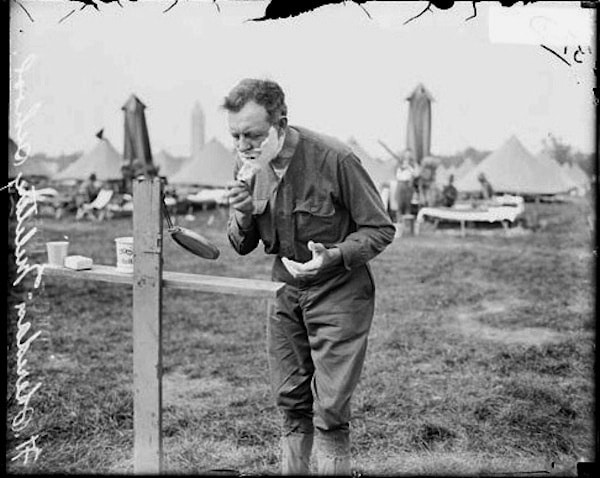
Military historians and sociologists suggest that the emphasis on grooming was about more than just hygiene or gas mask seals; it was a tool for psychological conditioning. By requiring soldiers to maintain a clean-shaven face and neat hair, the military enforced a sense of order and "civilization" amidst the chaos of combat. General George S. Patton was a notable proponent of this philosophy, famously insisting that his troops remain clean-shaven even in the heat of battle, believing that personal neatness was directly correlated with combat discipline and self-respect.
Upon their return to civilian life, the millions of veterans from WWI and WWII acted as "cultural ambassadors" for these new standards. The 1950s "corporate man" aesthetic—characterized by a close shave and a short, combed haircut—was essentially a civilian adaptation of the military officer’s look. The grooming industry capitalized on this, using advertising to link clean-shaven faces with patriotism, professional success, and modernity.
Long-Term Implications for the 21st Century
The rituals established between 1914 and 1945 continue to define the "normal" male routine in the 21st century. While the 1960s and 70s saw a temporary resurgence of facial hair as a form of counter-cultural rebellion, the baseline for professional grooming remains rooted in the standards set by the mid-century military. Even the recent "beard movement" of the 2010s relies on modern grooming tools—trimmers, oils, and specialized soaps—that are marketed through the same retail channels established during the post-war consumer boom.
In conclusion, the American man’s morning routine is a living artifact of the World Wars. The safety razor, the toothbrush, and the Dopp kit are not merely tools of vanity; they are products of industrial mobilization and tactical necessity. As men today stand before their mirrors, they are participating in a standardized ritual of hygiene that was once a matter of life and death in the trenches and on the battlefields of the 20th century. This history serves as a reminder of how large-scale historical events can permanently reshape the most intimate aspects of daily life.

0 Comments