
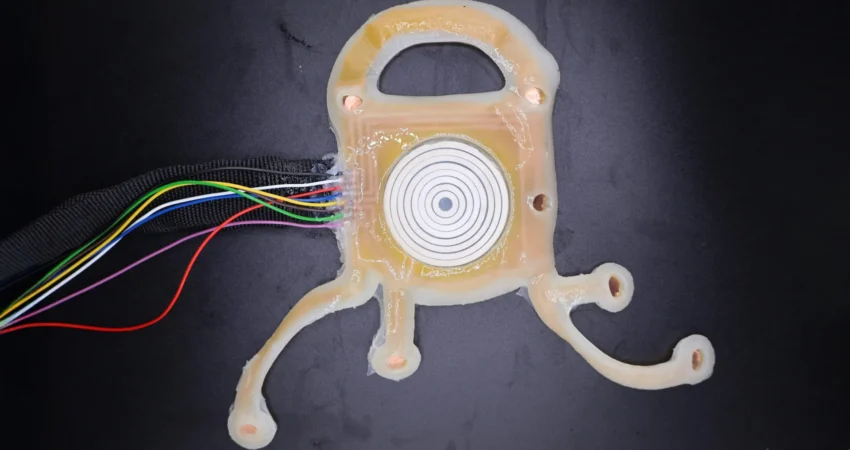
Researchers at the University of Texas at Austin have unveiled a revolutionary soft wearable patch, dubbed NEUSLeeP, that has demonstrated significant improvements in REM sleep in real-world testing. This innovative device bypasses the need for medication or surgical intervention, offering a novel non-invasive approach to enhancing a crucial stage of sleep. The NEUSLeeP patch ingeniously integrates gentle ultrasound stimulation with sophisticated electrodes capable of tracking brain activity in real-time. This dual functionality allows the patch to precisely target deep brain regions essential for REM sleep while simultaneously monitoring the brain’s intricate responses, paving the way for a deeper understanding of sleep mechanisms and the development of effective treatments for sleep disorders.
A New Era in Sleep Science: The Genesis of NEUSLeeP
The development of NEUSLeeP represents a significant leap forward in the field of sleep science and neurotechnology. For years, researchers have sought non-invasive methods to modulate brain activity, particularly in the deep structures that govern complex physiological processes like sleep. Traditional approaches often involve pharmaceuticals with potential side effects or invasive procedures that carry inherent risks. The UT Austin team’s breakthrough lies in their ability to achieve targeted neuromodulation of these deep brain regions through a comfortable, skin-attached device.
"This is the first time we’ve been able to noninvasively target deep brain regions involved in REM sleep, while simultaneously monitoring brain activity," stated Kai Wing "Kevin" Tang, a recent UT biomedical engineering Ph.D. graduate who spearheaded the research effort. Tang’s pioneering work, conducted under the supervision of Huiliang "Evan" Wang, assistant professor in the Cockrell School of Engineering’s Department of Biomedical Engineering and principal investigator (PI) for the project, has culminated in a device with profound implications. Professor Wang elaborated on the significance of the NEUSLeeP patch, noting, "Our skin-attached NEUSLeeP patch opens up new possibilities for understanding sleep and treating sleep disorders in home settings." This statement underscores the device’s potential to democratize advanced sleep monitoring and intervention, moving beyond the confines of specialized sleep laboratories.
The research journey leading to NEUSLeeP involved extensive theoretical modeling, iterative design, and rigorous testing. Early stages focused on understanding the precise frequencies and intensities of ultrasound that could safely and effectively penetrate the skull to reach the targeted brain areas without causing discomfort or harm. Concurrently, the development of sensitive, yet unobtrusive, electrodes was crucial for capturing the subtle electrical signals of brain activity, particularly the distinct patterns associated with different sleep stages. The integration of these two technologies into a flexible, wearable form factor presented significant engineering challenges, requiring expertise in materials science, bioengineering, and signal processing.
Clinical Validation: Tangible Improvements in REM Sleep
The efficacy of the NEUSLeeP patch was put to the test in a compelling study involving 28 participants, the results of which were recently published in the prestigious journal Nature Communications. This peer-reviewed publication signifies the robust scientific validation of the research findings. The study’s outcomes were remarkably positive, indicating that NEUSLeeP significantly shortened the time it took for individuals to enter REM sleep and extended the duration of this vital sleep stage.
On average, participants using the NEUSLeeP patch achieved REM sleep an impressive 43 minutes sooner than their baseline. Furthermore, they remained in REM sleep for approximately 16 minutes longer per night. These figures are not merely statistical curiosities; they represent a substantial enhancement in sleep architecture, particularly for individuals who struggle to initiate or maintain REM sleep. The study encompassed a diverse group of participants, including both healthy sleepers and those reporting existing sleep difficulties. This broad applicability suggests that NEUSLeeP could offer benefits across a wide spectrum of the population.
Critically, user feedback from the study was overwhelmingly positive. Participants described the NEUSLeeP patch as comfortable and safe to wear throughout the night. The research team meticulously monitored for any adverse effects, and the study reported minimal to no significant negative reactions, further bolstering the device’s potential for widespread adoption. This comfort and safety profile is a crucial differentiator from many existing sleep interventions, which can be associated with side effects ranging from grogginess and dependency to more serious health concerns.
Beyond Sleep: Potential Benefits for Stress and Emotional Well-being
The impact of NEUSLeeP extends beyond simply improving sleep duration and quality. The study revealed intriguing correlations between the device’s stimulation and markers of physiological and emotional health. Among healthy participants, NEUSLeeP stimulation was observed to increase heart rate variability (HRV). HRV is a widely recognized physiological indicator of the autonomic nervous system’s balance and the body’s capacity to adapt to stress. A higher HRV is generally associated with better stress resilience and overall cardiovascular health.
Further investigation using brain imaging techniques provided deeper insights. The imaging revealed discernible changes in neural circuits known to be involved in emotional processing and regulation. This finding suggests that by enhancing REM sleep, NEUSLeeP may indirectly contribute to improved mood regulation and psychological resilience.
Gregory Fonzo, an assistant professor in the Dell Medical School’s Department of Psychiatry and Behavioral Sciences and one of the project’s co-principal investigators, emphasized the profound connection between REM sleep and mental health. "REM sleep is not just about dreaming — it’s about emotional reset and stress adaptation," Fonzo explained. "By enhancing REM, we may help people better cope with stress and improve their overall well-being." This perspective highlights the holistic impact of NEUSLeeP, positioning it not just as a sleep aid but as a potential tool for enhancing mental fortitude.
The scientific community has long recognized the intricate link between disrupted REM sleep and various mental health conditions. Conditions such as depression, anxiety disorders, and post-traumatic stress disorder (PTSD) are frequently characterized by aberrant REM sleep patterns. Current therapeutic strategies for these conditions, while sometimes effective, often rely on pharmacotherapy or behavioral interventions that may not directly address the underlying sleep dysregulation or can lead to undesirable side effects. The prospect of a non-invasive technology that can positively influence REM sleep offers a promising alternative or complementary approach to existing treatments.
A Roadmap for the Future: Clinical Trials and Commercialization
Buoyed by these promising initial results, the research team is now embarking on the next phase of NEUSLeeP development, which includes larger-scale clinical trials. These future studies are designed to rigorously verify the initial findings and, crucially, to evaluate the device’s efficacy in treating specific sleep-related disorders. The team plans to investigate NEUSLeeP’s potential benefits for individuals suffering from chronic insomnia, as well as those with PTSD and depression, where REM sleep disturbances are a significant component of their symptomatology.
The researchers also envision broader applications for NEUSLeeP beyond therapeutic interventions. They see significant potential for its use in home-based sleep monitoring, providing individuals with continuous, objective data about their sleep patterns without the need for clinical visits. Furthermore, NEUSLeeP could serve as a valuable tool in neuroscience research, enabling scientists to explore the fundamental mechanisms of sleep and consciousness in greater detail and in more naturalistic settings. The development of personalized sleep treatments, tailored to an individual’s unique sleep profile and needs, is another exciting frontier that NEUSLeeP could unlock.
Vincent Mysliwiec, M.D., a professor at UT Health San Antonio and a leading expert in sleep disorders who also served as a co-PI on the project, expressed a compelling vision for the technology’s future. "Our vision is a future where patients with mental health disorders can optimize their sleep with a noninvasive and safe treatment," Dr. Mysliwiec stated. "This technology could help millions of people get the restorative sleep they need." His endorsement from a seasoned clinician in the field of sleep medicine lends significant weight to the potential impact of NEUSLeeP.
Recognizing the immense potential of NEUSLeeP, the research team is actively pursuing its translation from the laboratory to the market. They are collaborating with Discovery to Impact, UT Austin’s dedicated commercialization unit, to navigate the complex path toward bringing this innovative technology to the public. This collaboration aims to facilitate regulatory approvals, manufacturing partnerships, and ultimately, widespread accessibility. A patent application has already been filed for the NEUSLeeP device, safeguarding the intellectual property and underscoring the novelty and commercial viability of the invention.
A Collaborative Endeavor: The Minds Behind NEUSLeeP
The creation of NEUSLeeP is a testament to interdisciplinary collaboration and the dedication of a talented research team. Beyond the lead researchers, the project benefited from the contributions of numerous individuals from various departments and institutions:
- Department of Biomedical Engineering, UT Austin: William D. Moscoso-Barrera, Mengxia Yu, Mengmeng Yao, Jinmo Jeong, Ilya Pyatnitskiy, Anakaren Romero Lozano, Jiachen Wang, Ju-Chun Hsieh, Tony Sungjin Chae, Daniel Song, Julieta Garcia, Rithvik Mittapalli, and Adam Bush. Their collective expertise in engineering, materials, and signal processing was instrumental in the device’s design and development.
- College of Natural Sciences, Department of Psychology, UT Austin: Benjamin Baird contributed crucial insights from the field of psychology, informing the understanding of sleep’s cognitive and emotional implications.
- Fralin Biomedical Research Institute, Virginia Tech: Wynn Legon’s involvement brought valuable external expertise, further enriching the project’s scientific foundation.
The successful development of NEUSLeeP signifies a pivotal moment in the pursuit of accessible and effective sleep solutions. By leveraging the power of non-invasive neuromodulation and real-time brain monitoring, this wearable patch offers a beacon of hope for individuals struggling with sleep disorders and for those seeking to enhance their overall mental and physical well-being. The journey from concept to clinical validation has been impressive, and the path toward commercialization promises to bring this groundbreaking technology to the millions who stand to benefit from its restorative power. The implications for public health, particularly in the realm of mental health, are substantial, potentially ushering in a new era of personalized and non-pharmacological interventions for sleep-related ailments.

0 Comments