
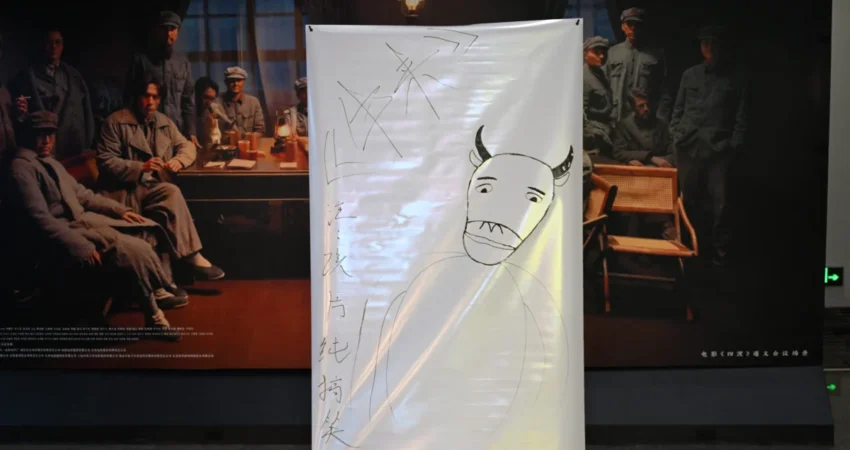
Beijing, China – A profound transformation is sweeping through China’s entertainment sector, driven by the potent combination of surging artificial intelligence capabilities and the evolving dynamics of audience attention. This shift has led to an unprecedented flood of short-drama films, a "fail-fast" production model designed to rapidly test audience interest and capitalize on viral phenomena. A striking illustration of this new paradigm emerged on August 21, 2026, when a hand-drawn poster for "Niu Lai" (Here Comes the Cow) adorned a Beijing cinema, advertising a low-budget Chinese animated film that defied conventional success metrics. Widely derided for its crude visuals, "Niu Lai" unexpectedly became a viral sensation, drawing crowds eager to witness its perceived shortcomings, ultimately grossing millions.
The phenomenon of "Niu Lai" is emblematic of a broader industry shift where agility and rapid content generation, often powered by AI, are challenging traditional entertainment models. Chinese producers are now "flooding the zone" with vertical-format short-dramas, a strategy that allows them to gauge audience interest with minimal capital outlay before committing heavily to distribution and audience acquisition. This contrasts sharply with traditional entertainment models, which typically invest substantial capital upfront in production before gauging market reception.
The Rise of the Micro-Drama Economy
The short-drama industry has not merely grown; it has exploded. Producers now release short, serialized content, often optimized for mobile viewing, directly to audiences. "A platform or producer can test a vertical serial’s opening clips with a defined audience and expand promotion when it converts," explained Ashley Dudarenok, founder of ChoZan, a leading digital consultancy. This iterative approach allows companies to quickly identify and scale titles that resonate with viewers while swiftly pivoting away from those that do not, embodying a true "fail-fast" philosophy.
This high-volume production strategy has been dramatically accelerated by generative AI. The technology has slashed the time and cost traditionally associated with content creation, from scriptwriting and character design to animation and post-production. According to estimates published by China’s Netcasting Services Association (CNSA), an astonishing 128,000 short-dramas were released in China during the first quarter of 2026 alone. More than 95% of these titles were reportedly AI-generated or heavily AI-assisted, underscoring the technology’s pervasive influence on the industry.
The economic footprint of this burgeoning sector is substantial. CNSA estimated China’s micro-drama and "manju" (a term often used interchangeably with micro-drama) market at approximately 100 billion yuan (US$15 billion) in 2025. This rapid growth saw the format surpass long-form video in average daily use, cementing its position as the second most popular audiovisual category among Chinese consumers. The appeal of these short, digestible narratives lies in their ability to deliver quick hooks and satisfying resolutions, catering perfectly to declining attention spans and on-the-go consumption habits prevalent in modern urban life.
Chronology of a Content Revolution
The roots of China’s short-drama surge can be traced back several years, with key developments accelerating in recent times:
- Pre-2023: Early forms of short-form video content gain traction on platforms like Douyin (TikTok) and Kuaishou, laying the groundwork for serialized narratives. Production costs for promotional ad impressions are relatively low, estimated at 50-80 yuan per 1,000 impressions.
- 2023: The "fail-fast" model begins to solidify, with producers experimenting with vertical-format content. Generative AI tools start to become more accessible and sophisticated, hinting at their future impact.
- 2025: The micro-drama market reaches an estimated 100 billion yuan (US$15 billion), indicating significant commercial viability. Production costs for ad impressions rise significantly to 150-200 yuan, occasionally exceeding 300 yuan during peak competitive periods, signaling intensifying competition for audience attention.
- Q1 2026: A staggering 128,000 short-dramas are released in China, with AI playing a dominant role in over 95% of them. This quarter marks a pivotal moment where AI-driven production becomes the norm rather than the exception.
- July 2026: The city of Jiaxing in Zhejiang Province becomes a hub for micro-drama production, with dozens of related enterprises and professional industry platforms supporting the sector’s growth. Staff members are observed working on script refinement, on-location filming, AI post-production, and overseas translation and distribution, illustrating the comprehensive ecosystem being built around these short-form narratives.
- August 21, 2026: The animated film "Niu Lai" garners widespread attention, not for its quality, but for its perceived "badness," becoming a viral hit and demonstrating an alternative path to commercial success in the AI-accelerated content landscape.
Economic Dynamics and Challenges
While the allure of low production costs – often just a few hundred thousand yuan for a short drama – is strong, the economics of the micro-drama industry are complex. Vertical titles can generate substantial advertising revenue, with opt-in video ads reportedly earning about 11 times Mintegral’s Android benchmark in the first half of the year. However, these impressive revenue figures are frequently offset by the equally substantial costs associated with distribution and audience acquisition.
"While making a short drama may cost only a few hundred thousand yuan, making the right audience see it can cost far more," Dudarenok elaborated. The escalating cost of promotional ad impressions, which rose from 50-80 yuan in 2023 to 150-200 yuan in 2025 (and sometimes over 300 yuan during competitive periods), highlights the intense battle for viewer attention. This means that despite cheap production, heavy marketing expenditure can significantly erode profit margins.

Moreover, the sheer volume of content and low production costs do not automatically translate into commercial success for every title. While a select few "stellar hits" can generate substantial revenue, the majority of short-dramas struggle to produce meaningful returns on investment. The competition for viewers is intensifying rapidly, with short-drama campaigns paying an average of 2.3 times Mintegral’s Android benchmark per app install, reflecting a market where the number of active advertisers and advertising creatives has more than doubled. This fierce competition necessitates aggressive user acquisition strategies, with very little app discovery occurring organically. "Paid just has to be kind of the way forward," stated James Haslam, head of marketing at Mintegral, describing short-drama distribution as "part viral, part pure social, and then just really aggressive user acquisition."
The "Niu Lai" Anomaly and Shifting Metrics
The case of "Niu Lai" is particularly instructive. According to official China Film Box Office figures, the film grossed 45.5 million yuan (US$6.76 million) in just three weeks of screening. This is remarkable, especially when widely circulated but unofficial estimates place its production budget at a mere $200. However, "Niu Lai" did not achieve success through the conventional "fail-fast" model of immediate audience resonance. It initially performed very poorly, only taking off after audiences became intrigued by its reputation for being exceptionally "bad." This unique trajectory suggests that in the age of viral content, unexpected factors can drive engagement, and even perceived flaws can become a magnet for viewers.
This phenomenon underscores a fundamental shift in how success is measured. All entertainment platforms are locked in a battle for viewers’ time, a "finite resource," as Sensor Tower Vice President Seema Shah noted. Daily active users and time spent on the platform have become paramount metrics of user engagement, often overshadowing traditional notions of artistic merit or high production value.
Distribution Moats and the Future Landscape
The competitive landscape for short-drama distribution is hotly debated among industry experts. Some, like Mintegral’s James Haslam, argue that specialist short-drama companies possess an edge due to their agility, expertise in performance marketing, and familiarity with new acquisition channels. These firms are inherently structured for rapid iteration and data-driven marketing.
Conversely, others point to the enduring strengths of traditional incumbents. Seema Shah of Sensor Tower identifies Netflix as a prime example of a well-positioned incumbent, citing its vast scale, proven customer retention strategies, and extensive global distribution capabilities. While short-drama specialists may innovate rapidly, incumbents have established brand loyalty and massive user bases.
Despite the rapid ascent of short-dramas, experts generally agree that they are not direct substitutes for traditional entertainment formats like Hollywood films and premium television. Shah believes short-dramas are unlikely to completely displace incumbent formats. Their appeal lies partly in requiring minimal commitment from viewers and "delivering a quick hook." However, the continued global success of large blockbusters and critically acclaimed series suggests that audiences still deeply value "high-caliber, well-produced content" that offers immersive, long-form storytelling and spectacular cinematic experiences.
Ashley Dudarenok concurs, stating that the broad adoption of the short-drama format "does not show that cinema or premium television is disappearing." Traditional film and television retain inherent advantages that short-dramas struggle to reproduce: the grandeur of the large-screen spectacle, the prestige associated with artistic achievement, deeper library value, and the ability to build expansive franchises across multiple formats.
Broader Implications and Outlook
The explosion of AI-powered micro-dramas in China carries significant broader implications:
- Economic Impact: It fosters a dynamic new segment within the creative economy, attracting investment and creating jobs in AI development, digital marketing, and agile content production. However, it also raises questions about the future of traditional roles in content creation, as AI automates more tasks.
- Cultural Shift: The prevalence of short-form, high-volume content is shaping audience expectations, potentially shortening attention spans further and favoring quick gratification over nuanced storytelling. This could lead to a bifurcation of content consumption, with audiences seeking both "snackable" and "feastable" entertainment.
- Technological Advancement: The Chinese micro-drama industry is serving as a massive real-world laboratory for generative AI in creative applications, pushing the boundaries of what AI can achieve in content generation and personalization.
- Global Export Model: The "fail-fast," AI-driven model pioneered in China holds potential as an exportable model, particularly for emerging markets with high mobile penetration and demand for cost-effective, culturally relevant content.
- Regulatory Challenges: The rapid, AI-driven production of content presents new challenges for regulators concerning intellectual property, content moderation, and the potential spread of misinformation or inappropriate material. Ensuring quality control and ethical AI use will be paramount.
In conclusion, China’s micro-drama industry, propelled by AI and a keen understanding of modern digital consumption habits, is not just a fleeting trend but a fundamental reshaping of the entertainment landscape. While challenges remain, particularly in sustaining commercial success beyond a few viral hits and managing escalating distribution costs, the ingenuity of its production model and its profound impact on audience engagement metrics signal a new era for content creation globally. The saga of "Niu Lai," a crude animation that became a cultural touchstone by being "bad," stands as a quirky yet powerful testament to this evolving frontier.

0 Comments