
The Pre-War Landscape: Barbershops and Beards
At the turn of the 20th century, the concept of a "daily home shave" was a luxury or a laborious chore rather than a standard expectation. The primary tool for hair removal was the straight razor, an open-blade instrument that required significant skill to master and constant maintenance to keep sharp. Shaving with a straight razor involved "stropping" the blade on leather and "honing" it on stone. For many men, the danger of self-inflicted injury and the time required for the process meant that they either visited a professional barber once or twice a week or simply allowed their facial hair to grow.
Hygiene, more broadly, was not yet a daily ritual for many Americans. Indoor plumbing was not universal, and the heating of water was a manual task involving stoves. Consequently, full-body bathing and facial grooming were often weekly occurrences. Dental hygiene was similarly neglected; while toothbrushes existed, they were often made of animal bone and boar bristles, making them expensive and prone to harboring bacteria. The lack of a standardized, portable kit for personal items meant that grooming tools were often scattered or non-existent in the average household.
World War I: The Safety Razor and the Gas Mask Requirement
The catalyst for the first major shift in American grooming occurred during World War I (1914–1918). The introduction of chemical warfare, specifically the use of chlorine and mustard gas in the trenches, necessitated the widespread use of gas masks. For a gas mask to be effective, it required an airtight seal against the wearer’s face. Thick beards and long sideburns prevented this seal, rendering the masks useless and leaving soldiers vulnerable to agonizing death or permanent lung damage.
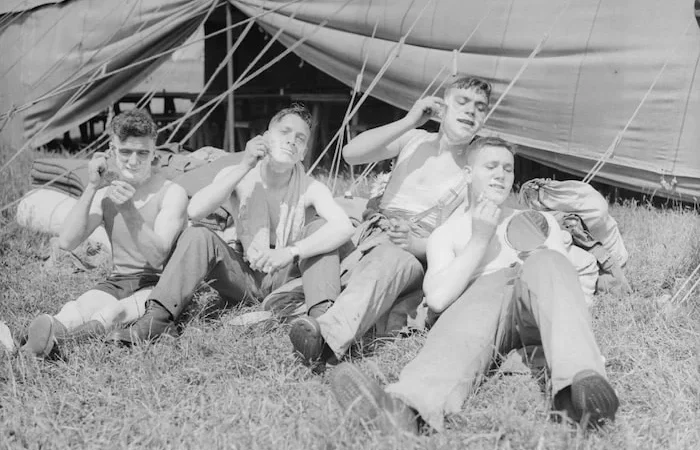
To address this, military command mandated that all soldiers be clean-shaven. This requirement coincided with a revolutionary business development by King Camp Gillette. In 1904, Gillette had patented the safety razor, a device that used a disposable, double-edged blade held at an angle that minimized the risk of deep cuts. While the product had seen modest success in the civilian market, the war provided an unprecedented opportunity for mass adoption.
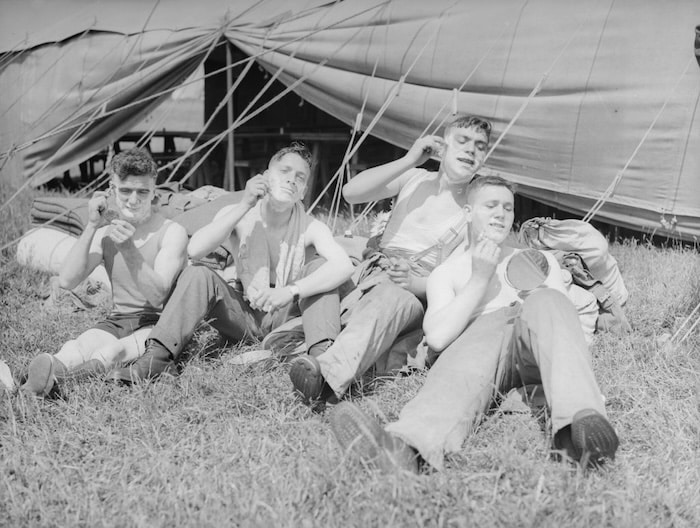
In 1917, when the United States entered the conflict, the U.S. government struck a deal with Gillette to include safety razors in the standard-issue kits for every soldier. By the end of the war, the military had purchased 3.5 million razors and 32 million replacement blades. This initiative achieved two goals: it ensured the safety of the troops in gas attacks and it introduced millions of young men to the convenience of self-shaving. When these soldiers returned to civilian life, they did not return to the barbershop for their primary grooming; they continued to use the safety razors they had carried in their kits, creating a massive, permanent market for disposable blades.
The Interwar Period and the Birth of the Dopp Kit
In the years following World War I, the habit of the daily shave became a symbol of modern masculinity and professional readiness. However, the organization of these grooming tools remained unstandardized until the late 1910s and early 1920s. In 1919, Charles Doppelt, a leather goods maker in Chicago, designed a compact, zippered leather case intended to hold a man’s grooming essentials.
Originally marketed as a "toilet kit," the bag struggled to find a foothold in the mass market during the Great Depression. It was not until the shadow of the second global conflict loomed that the "Dopp kit" would become a household name. The necessity of mobility during military service required a durable, organized way for soldiers to carry their razors, soap, and brushes, and Doppelt’s design proved to be the ideal solution for the modern soldier on the move.
World War II: Hygiene as Military Readiness
While World War I introduced the safety razor, World War II (1939–1945) served to institutionalize a comprehensive suite of hygiene practices. The U.S. military, having learned from the medical failures of previous conflicts, recognized that personal hygiene was directly linked to combat effectiveness. Infections and diseases caused by poor sanitation had historically killed more soldiers than enemy fire.
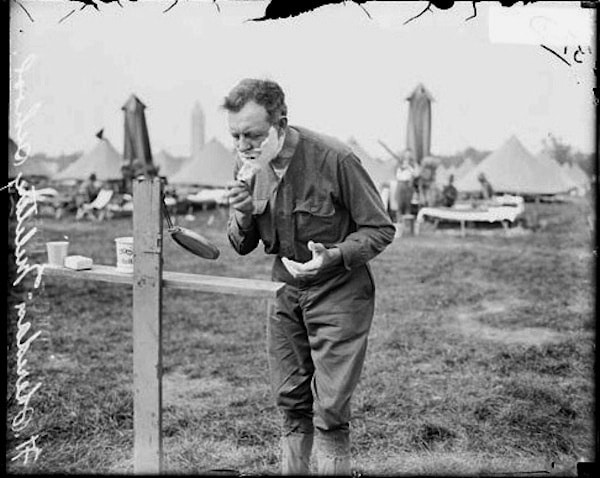
The military contracted with Charles Doppelt to produce millions of his leather kits, which were issued to recruits. Inside these bags, the military mandated a standardized inventory: a safety razor, shaving soap, a comb, a mirror, a bar of soap, and—crucially—a toothbrush and toothpaste.
Dental health was a significant concern for the Armed Forces. During World War I, "trench mouth" (Acute Necrotizing Ulcerative Gingivitis) had sidelined thousands of troops. To prevent a recurrence, the military made daily toothbrushing a requirement of service. Soldiers were issued brushes featuring the newly invented nylon bristles from DuPont, which were more sanitary and durable than traditional animal-hair brushes. By the time the war ended, over 16 million Americans had served in the military, each one having been conditioned through years of daily drills to brush their teeth and shave their faces every morning.
Innovation Under Pressure: Bakelite and Tactical Shaving
The pressures of "Total War" also drove technical innovations in grooming products. To conserve strategic metals like brass and aluminum for the production of shell casings and aircraft, the Gillette Safety Razor Company and other manufacturers shifted to using Bakelite—an early form of synthetic plastic—and light alloys for razor handles.
Even intelligence agencies recognized the ubiquity of grooming tools. The Office of Strategic Services (OSS) and British intelligence produced specialized shaving kits for Allied prisoners of war (POWs) and secret agents. These kits contained razors and brushes with hollowed-out handles or hidden compartments containing compasses, silk maps of enemy territory, and counterfeit currency to aid in escapes. This integration of grooming tools into the very fabric of military intelligence underscores how fundamental these items had become to the identity of the soldier.
Furthermore, soldiers often adapted their grooming supplies for survival. War correspondents, including the famed Ernie Pyle, noted that frontline troops used shaving cream to soothe fleabites and sunburn. Some even believed that massaging shaving cream into their feet could help prevent "trench foot," a condition caused by prolonged exposure to damp, cold conditions.
Post-War Implications: The Clean-Cut Corporate Era
The return of millions of veterans in 1945 and 1946 fundamentally reshaped the American domestic landscape. These men returned with a disciplined approach to personal presentation that would define the "clean-cut" aesthetic of the 1950s. The military-industrial complex had successfully transitioned into a consumer-goods powerhouse. Companies like Gillette, DuPont, and Colgate-Palmolive saw their profits soar as the habits forged in the barracks were brought into the newly built suburbs.
The psychological impact was equally profound. The daily grooming routine became a ritual of civilian reintegration and a marker of "the organization man." To be clean-shaven and to have fresh breath was to be employable, reliable, and patriotic. This cultural shift led to the decline of the traditional barbershop as a daily social hub and the rise of the multi-billion dollar home-grooming industry.
Analysis of Broader Impact
The standardization of male grooming represents one of the most successful examples of habit formation in history. By making hygiene a matter of military discipline and survival, the U.S. government effectively bypassed the slow process of cultural evolution.
- Economic Legacy: The "Razor and Blade" business model, popularized by Gillette during the wars, remains the dominant strategy for many modern tech and consumer goods companies.
- Public Health: The mandate for toothbrushing during WWII is credited by many dental historians as the single greatest factor in the improvement of American dental health in the 20th century.
- Gender Norms: The wars codified a specific version of masculinity that prioritized neatness and uniformity over the more rugged, bearded appearances of the 19th century.
Today, the "Dopp kit" remains a staple of travel, and the safety razor (or its multi-blade descendant) remains a fixture of the bathroom vanity. While contemporary trends have seen a resurgence in facial hair and artisan grooming, the foundational expectation of a daily, organized hygiene routine remains an enduring legacy of the two greatest conflicts in human history. The rituals performed in front of bathroom mirrors every morning are, in essence, a continuation of the discipline established in the trenches of France and the foxholes of the Pacific.

0 Comments