
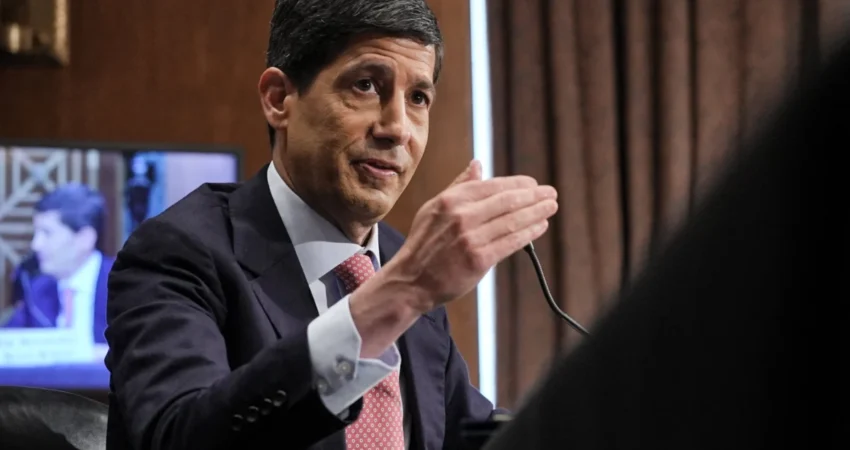
Federal Reserve Chairman Kevin Warsh’s pivotal keynote address at the central bank’s prestigious annual symposium in Jackson Hole, Wyoming, on August 28, 2026, has dramatically recalibrated investors’ outlook for an interest rate hike in September. His unequivocal commitment to combating persistent inflation, articulated with resolute language, sent immediate ripples through financial markets, prompting a swift and substantial adjustment in the perceived probability of a 25-basis-point increase at the upcoming Federal Open Market Committee (FOMC) meeting. This decisive shift underscores the enduring influence of the Jackson Hole forum as a critical barometer for future monetary policy and highlights Chairman Warsh’s determination to anchor inflation expectations amidst a complex economic landscape.
The Jackson Hole Imperative: A Hawkish Pivot
Chairman Warsh’s remarks, delivered against the majestic backdrop of the Teton Mountains, served as a potent declaration of the Federal Reserve’s unwavering focus on its price stability mandate. Before his speech, market participants, influenced by a recent spate of softer economic data, had largely tempered their expectations for a September rate hike. Prediction market platform Kalshi, a bellwether for investor sentiment, had pegged the odds of the central bank maintaining the status quo in September at nearly 70%. However, in the immediate aftermath of Warsh’s address, these odds plummeted, with traders now assigning a 48% probability to a 25-basis-point rate increase. This dramatic reversal of sentiment, almost a complete flip in market consensus, speaks volumes about the perceived hawkishness of Warsh’s tone and the markets’ interpretation of his commitment.
The shift was similarly pronounced across other key indicators. Traders of fed funds futures, a critical tool for discerning market expectations for short-term interest rates, now see a nearly 56% chance of a quarter-point hike in September, according to the CME’s FedWatch tool. This widely cited instrument, which derives probabilities from the pricing of futures contracts on the federal funds rate, provides a real-time gauge of market sentiment regarding the Fed’s next move. Concurrently, on Polymarket, another prominent prediction platform, speculators indicated 49% odds that the Fed would raise rates. The convergence of these diverse market indicators reinforces the notion that Warsh’s speech effectively reset expectations, compelling investors to reconsider the trajectory of monetary policy.
Understanding the Jackson Hole Symposium’s Significance
The Federal Reserve Bank of Kansas City’s Economic Symposium in Jackson Hole has, for decades, served as an unparalleled platform for central bankers, finance ministers, academics, and financial market participants from around the globe to discuss long-term policy issues. Established in 1978, the symposium gained international prominence in the mid-1980s and has since become a pivotal event on the global financial calendar. It is often a venue where Fed chairs and other influential policymakers signal potential shifts in monetary policy or offer new perspectives on economic challenges. The informal setting belies the profound impact these discussions can have, with speeches often meticulously parsed for clues about future policy direction. Chairman Warsh’s address in 2026 continues this tradition, underscoring the symposium’s enduring relevance as a bellwether for global monetary policy. The discussions typically revolve around a specific theme, with the 2026 symposium likely focused on persistent inflation, labor market dynamics, and the challenges of achieving a "soft landing" for the global economy.
A Volatile Pre-Speech Landscape: Data Dependency and Dissent
The lead-up to Warsh’s Jackson Hole speech was marked by considerable uncertainty and a visible tug-of-war between inflationary pressures and signs of economic deceleration. Following the Fed’s July FOMC meeting, investors had initially been fairly certain of a September rate hike. This conviction was bolstered by the notable dissent within the Federal Open Market Committee, where three members broke ranks with the majority’s decision to keep interest rates steady. These dissenting policymakers vociferously argued that rates needed to move higher without delay, citing elevated and entrenched inflation as a clear and present danger to economic stability. Their hawkish stance signaled an internal debate within the Fed about the appropriate pace and magnitude of monetary tightening, even as the majority opted for a temporary pause.
However, the narrative began to shift dramatically in the subsequent weeks. Odds for a rate hike in September tumbled following the release of a weaker-than-expected employment report for July. The U.S. economy, contrary to expectations, had lost jobs that month, signaling a potential cooling in the robust labor market that had characterized much of 2025 and early 2026. This unexpected contraction in employment, coupled with data indicating that inflation, while still remaining stubbornly above the Fed’s long-term 2% target, had shown signs of moderating, led many analysts to revise their projections. The July jobs report, initially seen as a potential reprieve from aggressive tightening, introduced a new layer of complexity to the Fed’s deliberations, prompting questions about the resilience of economic growth in the face of cumulative rate hikes. Market participants, accustomed to the Fed’s data-dependent approach, began to price in a higher probability of a sustained pause, betting that the central bank would prioritize supporting employment amidst emerging signs of weakness.
Warsh’s Unwavering Stance: Prioritizing Price Stability
It was against this backdrop of conflicting economic signals and shifting market expectations that Chairman Warsh delivered his Jackson Hole address. He directly acknowledged the recent data reports, including the cooler inflation readings and the softer employment figures, but his interpretation was notably cautious and forward-looking. "While this summer’s [inflation] readings were better than expected," Warsh stated, "they do not tell me that underlying trends have meaningfully improved." This crucial distinction highlighted his concern that recent disinflationary impulses might be transient or superficial, rather than indicative of a fundamental shift in the inflationary trajectory. His language suggested a deep-seated skepticism about declaring victory over inflation prematurely.
Further reinforcing his commitment, Warsh articulated the central bank’s mandate with stark clarity. "We must be confident that underlying inflation is moving to our objective, clearly and at sufficient speed. Otherwise, we have work to do. That’s our job, our mandate and our charge to keep." This statement served as a powerful reminder that the Fed’s primary objective, particularly in the current environment, remains achieving sustained price stability. The phrase "work to do" resonated strongly with markets, signaling that the Fed was prepared to endure further tightening, even if it meant risking some economic slowdown, to achieve its inflation target. It underscored the central bank’s determination to avoid the pitfalls of past eras where policymakers were perceived to have eased up too soon, allowing inflation to re-accelerate.
Market Repercussions: Rising Yields and a Stronger Dollar
The immediate market response to Chairman Warsh’s hawkish pivot was palpable and swift. Short-term Treasury yields, highly sensitive to expectations for Fed policy, surged. The 2-year Treasury yield, often considered a proxy for the market’s immediate outlook on the federal funds rate, hit its highest level since late July. This upward movement in short-term yields reflects investors demanding higher compensation for holding government debt, anticipating that the Fed will keep interest rates higher for longer. Longer-term yields also saw some upward pressure, albeit to a lesser extent, indicating that the market now expects a more sustained period of restrictive monetary policy.
Beyond bond markets, the U.S. dollar generally strengthened against a basket of major currencies, as higher prospective U.S. interest rates make dollar-denominated assets more attractive to international investors. Equity markets, particularly rate-sensitive sectors like technology and growth stocks, experienced some downward pressure as the prospect of higher borrowing costs and a potentially slowing economy weighed on valuations. The re-pricing across asset classes reflected the market’s rapid assimilation of Warsh’s message and the renewed expectation of a more aggressive Fed posture.
The Dual Mandate Dilemma: Balancing Inflation and Employment
Chairman Warsh’s speech implicitly addressed the Federal Reserve’s perennial challenge: navigating its "dual mandate" of achieving maximum employment and stable prices. For much of the period leading up to 2026, the Fed had grappled with an economy characterized by robust job growth but also persistent, elevated inflation. The July jobs report, which showed an unexpected contraction in employment, momentarily complicated this equation, suggesting a potential weakening on the employment front. However, Warsh’s Jackson Hole address made it clear that, at this juncture, the Fed views its inflation-fighting mandate as paramount. His emphasis on "underlying trends" in inflation, rather than fleeting monthly data points, suggests a strategic decision to err on the side of caution regarding price stability, even if it means potentially sacrificing some degree of short-term economic growth or labor market strength. This prioritizing of inflation control is a critical policy choice, signaling the Fed’s commitment to restoring its credibility as an inflation fighter.
Looking Ahead: The September 16 Decision
With Chairman Warsh’s Jackson Hole address firmly recalibrating market expectations, all eyes are now squarely fixed on the Federal Open Market Committee’s next meeting, scheduled for September 16. The decision that day will be pivotal, not only for the trajectory of interest rates but also for the Fed’s credibility and its ongoing battle against inflation. Market participants will be scrutinizing every piece of economic data released between now and mid-September, particularly the August jobs report and any new inflation readings, to gauge whether they reinforce or contradict Warsh’s hawkish stance.
Analysts will also be keen to observe any further communications from other FOMC members. While Warsh’s words carry immense weight as Chairman, a unified front from the Committee would solidify the market’s revised expectations. The September meeting will undoubtedly be a high-stakes affair, where the Fed will have to weigh the cumulative impact of past rate hikes, the latest economic data, and the commitment to price stability articulated by its Chairman. The potential for a 25-basis-point hike is now firmly back on the table, a testament to the enduring power of central bank communication and the gravity of the inflation challenge facing the global economy. The market’s dramatic shift underscores the profound influence of Chairman Warsh’s leadership and the Fed’s unwavering determination to achieve its mandate.
Disclosure: CNBC and Kalshi have a commercial relationship that includes customer acquisition and a minority investment.

0 Comments