
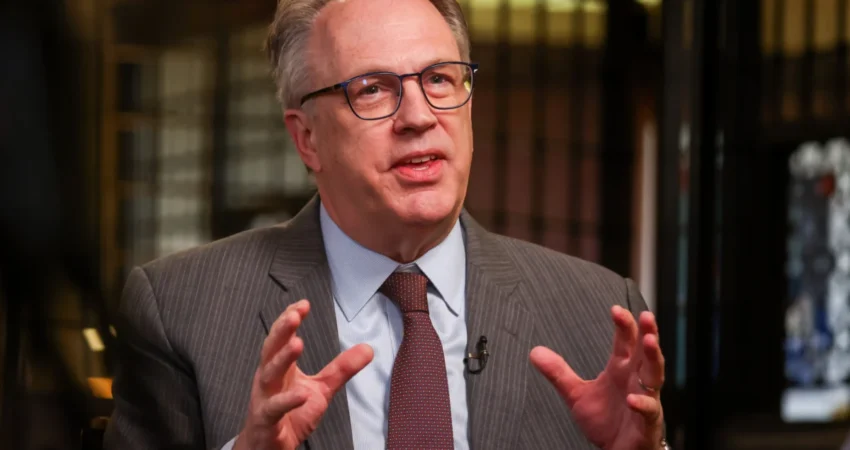
New York Federal Reserve President John Williams affirmed on Wednesday that the recent ascent in U.S. Treasury yields is a direct consequence of a robust national economy, rather than an indication of market instability or dysfunction. Speaking in a comprehensive interview, the influential central bank policymaker underscored his commitment to a data-dependent approach regarding future monetary policy adjustments, refraining from preemptively endorsing an additional interest rate hike. Williams emphasized that the Federal Reserve continues to assimilate a broad spectrum of economic intelligence before making any definitive judgments on the sufficiency of current monetary policy to achieve the central bank’s inflation target.
During his appearance on CNBC’s "Squawk Box" from the New York Fed’s headquarters in lower Manhattan, Williams articulated, "I think that we have to wait and see. There’s no clear signs right now whether monetary policy currently is sufficient to make sure we bring inflation back to target in the next year or two, or whether you need to see further action to do that." He acknowledged recent "encouraging" inflation data but cautioned against drawing conclusions from short-term trends, stressing the imperative of a holistic view encompassing all available economic indicators. This nuanced stance highlights the ongoing delicate balance the Fed must maintain as it navigates the path towards price stability amidst dynamic economic conditions.
The Surge in Treasury Yields: A Reflection of Economic Strength
The financial markets have been keenly observing a significant upward trend in U.S. Treasury yields, particularly at the longer end of the curve, which has climbed to multi-year highs. This phenomenon is critical as long-term yields typically reflect investors’ expectations for future economic growth and inflation. For instance, the benchmark 10-year Treasury yield, often seen as a bellwether for borrowing costs across the economy, has recently hovered around levels not seen in over a decade, crossing significant psychological thresholds and sparking widespread discussion among investors and analysts. The 30-year Treasury bond yield has also experienced a notable ascent, reflecting increased demand for compensation for holding longer-duration debt in an environment of anticipated higher inflation and sustained economic expansion.
Williams’ interpretation directly challenges alternative narratives that suggest the yield surge could be symptomatic of fiscal concerns, liquidity issues, or an impending economic slowdown. Instead, he posits that the primary driver is the underlying strength of the U.S. economy and its positive trajectory. "What’s driving it, in large part, is … really a strong U.S. economy and a strong economic outlook fueled by big investments in AI and data centers and technology in general," Williams elaborated. This perspective suggests a virtuous cycle where a robust economy fosters investor confidence, which in turn leads to higher demand for returns on long-term government debt, rather than higher yields being a drag on economic activity. "So, I think it’s not really about financial conditions affecting the economy. It’s more about the economy affecting financial conditions," he concluded, flipping the causal relationship often assumed in market analyses.

Inflation Dynamics and Monetary Policy Considerations
The Federal Reserve operates under a dual mandate from Congress: to achieve maximum employment and maintain price stability, typically defined as a 2% average inflation rate. The journey towards this target has been complex since the post-pandemic surge in prices. While recent data have shown signs of disinflation, with the Consumer Price Index (CPI) and the Fed’s preferred Personal Consumption Expenditures (PCE) price index moderating from their peaks, they largely remain above the 2% target. Core inflation, which excludes volatile food and energy components, has also shown persistence, prompting the Fed to maintain a cautious stance.
Williams’ remarks underscore the Fed’s commitment to evaluating a comprehensive set of data before making policy shifts. This includes not only inflation metrics but also labor market indicators such as the unemployment rate, job growth figures, and wage pressures, alongside consumer spending patterns, manufacturing output, and global economic developments. The policymaker’s emphasis on a "full picture" suggests that while recent monthly inflation reports might offer some solace, a sustained trend of declining inflation towards the target is required to instill confidence. He specifically mentioned that inflation expectations remain "well anchored," despite price pressures linked to tariffs and geopolitical events such as the Iran war. This stability in long-term inflation expectations is crucial for the Fed, as unanchored expectations can lead to a self-fulfilling prophecy of higher prices.
The Federal Open Market Committee and Future Rate Decisions
As President of the Federal Reserve Bank of New York, John Williams holds a pivotal position as a permanent voting member of the Federal Open Market Committee (FOMC), the principal monetary policymaking body of the U.S. central bank. His views carry significant weight and offer direct insight into the ongoing internal deliberations within the Fed. The FOMC has been engaged in an aggressive tightening cycle since early 2022, raising the federal funds rate from near zero to its current range to combat persistently high inflation.
Market participants have been closely tracking the probabilities of further rate hikes, particularly for the upcoming FOMC meetings. Prior to Williams’ comments, the CME Group’s FedWatch Tool, which gauges market expectations based on federal funds futures, indicated a substantial probability – around 66% on Wednesday morning – for another rate hike at the September 15-16 meeting. Such expectations reflect the market’s assessment of the Fed’s resolve to bring inflation under control, even if it entails further tightening. Williams’ measured approach, however, suggests that while the option of further tightening remains on the table, it is not a foregone conclusion and will be contingent upon the evolving economic data. This "wait and see" posture aims to provide the Fed with maximum flexibility, avoiding premature commitments that could limit its response to unforeseen economic shifts.
Background and Chronology of Economic Developments
The current economic landscape and the Fed’s policy stance are the culmination of several years of unprecedented challenges and responses. Following the severe economic disruption caused by the COVID-19 pandemic in early 2020, the Fed implemented highly accommodative monetary policies, including cutting interest rates to historic lows and engaging in large-scale asset purchases (quantitative easing) to support economic recovery. While these measures helped avert a deeper crisis, they also contributed to an eventual surge in demand that, coupled with supply chain disruptions, geopolitical events, and fiscal stimulus, fueled a significant rise in inflation starting in late 2021 and intensifying through 2022.

The Fed began its aggressive rate hiking cycle in March 2022, initiating a series of increases that saw the federal funds rate rise by hundreds of basis points in a relatively short period. This rapid tightening aimed to cool demand and bring inflation back down towards the 2% target. Throughout 2023, the FOMC continued to raise rates, albeit at a slower pace, while closely monitoring the impact of these actions on the broader economy. The labor market, surprisingly resilient despite higher interest rates, has been a key factor influencing the Fed’s deliberations, often cited as a sign of underlying economic strength. Recent data releases have been mixed: while inflation has shown signs of deceleration, the unemployment rate has remained historically low, and GDP growth has proven more robust than many economists initially predicted, leading to ongoing debates about the possibility of a "soft landing"—a scenario where inflation returns to target without triggering a severe recession.
The recent upward movement in Treasury yields has been particularly pronounced over the past few months. In the summer, as economic data continued to surprise on the upside, and with the understanding that the Fed remained vigilant against inflation, long-term yields began their ascent. This was further exacerbated by expectations of increased government borrowing and robust corporate investment. Williams’ comments on Wednesday provide a critical official interpretation of these market movements, linking them explicitly to fundamental economic vigor.
Broader Impact and Implications
The implications of persistently higher Treasury yields, driven by a strong economy or otherwise, are far-reaching. For consumers, higher long-term yields typically translate into increased borrowing costs for mortgages, auto loans, and other forms of credit, potentially cooling demand in interest-sensitive sectors like housing. Businesses also face higher costs for financing investments and operations, which could impact expansion plans and profitability, though a strong economic outlook might mitigate some of these concerns.
For the federal government, higher yields mean increased interest payments on the national debt, which could strain the federal budget and necessitate difficult fiscal policy choices. On the global stage, higher U.S. yields can attract foreign capital, strengthening the U.S. dollar, which can have mixed effects on international trade and capital flows. A stronger dollar makes U.S. exports more expensive but imports cheaper.
Williams’ analysis, emphasizing the strength of the economy, offers a more optimistic lens through which to view these developments. If higher yields are indeed a symptom of robust growth and productive investments, particularly in transformative technologies like AI and data centers, they could signal a period of sustained economic expansion and innovation. Such investments could boost productivity, which is a key long-term driver of non-inflationary growth. However, the challenge for the Federal Reserve remains to manage this strength without allowing inflationary pressures to re-emerge or become entrenched. The path ahead requires continued vigilance, data-driven decision-making, and clear communication to ensure that both price stability and maximum employment are achieved in a sustainable manner. The central bank’s next moves will be keenly watched by markets and policymakers worldwide, as they navigate an economic environment shaped by both resilience and uncertainty.

0 Comments