
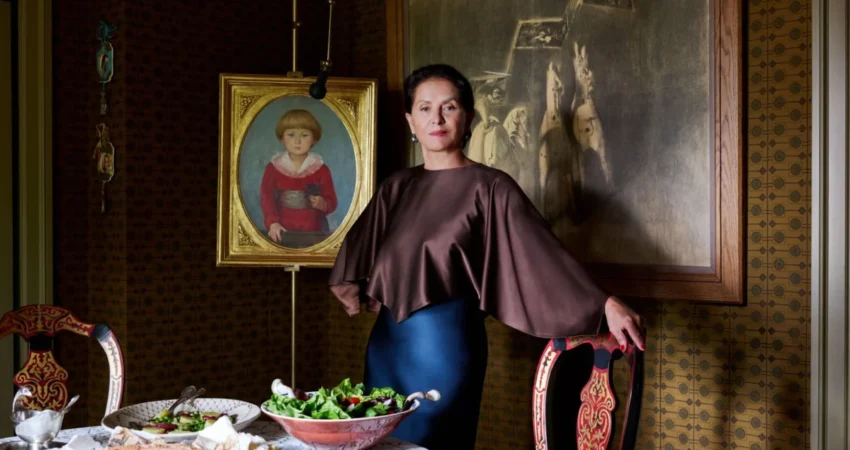
The East River shimmers, a constant, fluid presence against the Manhattan skyline, and within its embrace, a remarkable transformation has taken place. Muriel Brandolini, a designer renowned for her audacious and instinctual approach to interiors, has brought her signature blend of magic and meticulous craftsmanship to a prestigious Sutton Place residence. This two-floor apartment, formerly the domain of fashion magnate John Fairchild, has been reimagined from a garden-esque English townhouse into an exotic, jewel-toned floating world, a testament to Brandolini’s nearly three decades of fearless design exploration.

A Legacy of Style Reimagined
The history of this esteemed address at Sutton Place adds a layer of narrative depth to Brandolini’s intervention. The apartment was once the sanctuary of John Fairchild, the formidable figure who shaped the landscape of American fashion journalism. As the publisher of Women’s Wear Daily and the founder of W magazine, Fairchild was an arbiter of style, taste, and societal trends. His vision for the space was deeply rooted in classic English decorating: think abundant floral chintzes and plush, comfortable sofas, evoking the serene ambiance of a London townhouse. The contrast with Brandolini’s current design could not be more stark, yet both interpretations speak to a profound understanding of the power of interior spaces to reflect personality and era. Fairchild’s domain was grounded, a celebration of traditional aesthetics, while Brandolini’s is ethereal, a sophisticated vessel seemingly adrift on the river’s currents.
The Architect’s Vision: Light, Water, and Flow
Brandolini collaborated closely with architect Alice Tai to harness the apartment’s most compelling asset: its unparalleled connection to the East River. Recognizing the transformative potential of the waterfront location, they conceived an enfilade of rooms designed to maximize the natural light and the breathtaking river views. This architectural strategy creates an airy, expansive perspective that draws the eye eastward, blurring the lines between interior and exterior.

"The quality of the light here is extraordinary," Brandolini remarks, her words echoing the sentiment of anyone who has experienced the apartment. "It’s liquid and dappled in the morning, transforming into atmospheric chiaroscuro as dusk settles." This dynamic interplay of light is not merely an aesthetic choice but a fundamental element that guides the entire design. The unlined, block-printed silk curtains, identical throughout the enfilade from the library to the dining room, are a masterstroke in achieving this seamless flow. In a soft, palest pink, they filter the light beautifully, lending an ethereal quality to each space and reinforcing the sense of airiness.
The renovation itself was a complex undertaking, managed by contractors Wojtek Lusinski and Mark Los of New Path Contracting, with the intricate painting executed by Lukas Koszegi Andres. Wall upholstery and window treatments, crucial to establishing the apartment’s luxurious textures, were expertly handled by Pilar and Olivier Lhermite of Couture For Homes. Brandolini emphasizes the significance of these long-standing collaborations: "I’ve worked with this team for decades! Without them, I would not be able to be in AD!" This highlights the trust and synergy built over years, essential for executing such a nuanced and demanding project.

A Palette Inspired by India and the River’s Hues
Brandolini’s approach to color is famously bold, yet in this Sutton Place residence, her palette is both sophisticated and remarkably soothing. "My choices were based on fabrics I created in India while the apartment was under renovation," she explains. This creative gestation period in India, a land rich in textile traditions and vibrant hues, profoundly influenced the apartment’s chromatic identity. The result, bathed in that unique riverside light, is a symphony of muted, harmonious tones.
The dominant colors are peridot greens of varying intensity, the softest blush pinks, pale citrine, and opalescent silver. These are not colors that shout for attention; rather, they whisper, creating an atmosphere of tranquility and warmth. "I wanted to put one at ease," Brandolini states, "to be warm and uniting." This intention is palpable in every room, where the colors converge to create a cohesive and inviting environment, a sanctuary from the city’s frenetic pace.

The Library: A Prelude to Opulence
The initial entry into the apartment is the library, a space that masterfully preserves the original pale sandy oak paneling. This classic architectural element serves as a perfect, understated backdrop for the collection of precious objects and furniture that Brandolini has curated. The diversity and rarity of her taste are immediately apparent, evoking a sense of both mystery and luxurious indulgence.
Central to the library’s design are two original Madeleine Castaing tufted sofas, upholstered in a rich peridot silk damask by Claremont. These iconic pieces are flanked by two Sée et Mare pendants, hung at eye level to cast a magical, intimate glow. The interplay of the silk damask and the diffused light creates a captivating visual texture. Complementing these are Hella Jongerius tables, adding a contemporary, artistic flair.

A standout piece is an exquisite bespoke floor lamp by Hervé van der Straeten. Crafted from antique Coromandel panels, gilt bronze, and semiprecious stones, this lamp is a profound nod to Brandolini’s Vietnamese heritage, a cultural influence that subtly yet powerfully permeates her design philosophy. A candy-pink 1960s Venetian mirror hangs between the windows, its vibrant hue a playful counterpoint to the more subdued tones, drawing the eye towards the exterior vista. Nearby, a T.H. Robsjohn-Gibbings desk offers a touch of mid-century elegance.
On the opposite wall, a curved, tufted sofa invites repose. It is paired with a Mattia Bonetti iridescent Smarties table, its playful name belying its sophisticated materiality. Two slipper chairs, upholstered in Brandolini’s signature patchwork of antique embroideries, complete the ensemble. This signature element, showcasing her ability to meld disparate historical fragments into a harmonious whole, is a recurring motif throughout the apartment. The library, therefore, functions not just as an entrance but as a meticulously composed introduction to the apartment’s unique aesthetic.

The Living Room: A Symphony of Textures and Art
Moving into the living room, Brandolini continues to orchestrate a symphony of textures and art. The walls are enveloped in a block-printed silk, designed by Brandolini herself in a pattern that evokes the organic fluidity of Art Nouveau. This unifying element imbues the space with both coherence and a sense of expansive grandeur.
The room is dramatically divided by a massive pink marble table. Above it hangs a crystal-beaded chandelier, meticulously crafted in the shape of a galleon by Claire Cormier-Fauvel, a dazzling focal point that speaks to the apartment’s "floating world" theme. This chandelier visually cleaves the space into two perfectly mirrored seating areas, each designed for intimate conversation and refined relaxation.

At the heart of each seating area are identical sofas by Decour Décoration in Paris, inspired by Jean-Michel Frank designs. These are upholstered in a lustrous, silvered velvet, offering a subtle sheen that catches the light. Facing them are striking Chinese-style armchairs, draped in amethyst silk embellished with intricate embroidery. These elegant chairs are positioned across from black-lacquer, semicircular coffee tables by Madeleine Castaing, adding a touch of vintage glamour.
Beyond these anchor pieces, Brandolini allows her imagination to roam freely, integrating a curated selection of art and decorative objects. A precious Rateau table, with its distinctive sculptural form, finds its place here, alongside painted neoclassical chairs that offer a touch of classical refinement. Italian ceramic lamps add artisanal charm, and rare orchids, housed in Art Nouveau planters, bring a touch of the exotic. Each element, though diverse, contributes to an overall atmosphere of exoticism and unparalleled refinement.

The Art Collection: A Dialogue of Eras and Ideas
The art collection within the apartment is as thoughtfully curated as the furnishings, reflecting Brandolini’s evolving aesthetic sensibilities and her deep engagement with the art world. Her and her husband Nuno’s journey into art collection began in the early 1990s, a period of burgeoning contemporary art. They cultivated friendships with artists like George Condo, Donald Baechler, and Philip Taaffe, acquiring significant works from them. This early phase was characterized by an appreciation for bold, expressive contemporary pieces, often juxtaposed with 16th-century Italian paintings, demonstrating an early interest in historical dialogue.
The trajectory of their collection shifted with the influence of Vincent Risterucci, an erudite art advisor and a close friend. Risterucci guided them towards a more conceptual and intellectual aesthetic, one that demanded deeper contemplation and engagement. Brandolini embraced this evolution with characteristic passion and open-mindedness. "I admired how open-minded she was, brave and passionate—never questioning investment or resale value," Risterucci recalls. "It was really fascinating to work with her." This ongoing dialogue between collector and advisor has shaped a collection that is both personally resonant and intellectually stimulating.

The hanging of the art is itself an iconoclastic act. Brandolini describes her approach as intuitive: "It’s not thought-out—it’s simply how one piece leads to another. It can be an important painting next to a much less important one. It’s all about how it looks, and my own spontaneity in the moment of hanging." This approach results in a dynamic and unexpected salon-style arrangement, where works by Sol LeWitt, Paul Klee, Maurice Denis, Brion Gysin, and Max Ernst hang together in a compelling, conversational flow. The collection is not merely decorative; it is an active participant in the apartment’s narrative, a testament to Brandolini’s fearless embrace of artistic expression.
The Dining Room: An Intimate Jewel Box
At the culmination of the enfilade lies the dining room, an intimate space that functions as a jewel box. The walls are adorned with block-printed silk in sophisticated shades of cognac and green, creating a warm and inviting ambiance. An early-20th-century Swedish Grace console adds a touch of refined elegance, while a vast beaded chandelier, resembling trailing vines and flowers, hangs suspended above the dining table, its scale and delicate design enhancing the room’s enchanting atmosphere.

Entertaining is a central tenet of Brandolini’s life and design philosophy. "It’s about taking care of friends and giving them the best of you—from the food to the ambience," she explains. The dining room is clearly designed to facilitate these cherished gatherings. "I love mixing my guests, as each brings interesting conversation to the table. And I love it when they leave very, very late, because they’re having so much fun." This sentiment underscores the apartment’s purpose as a place of warmth, connection, and joyous conviviality.
The Kitchen and Beyond: Functional Elegance
Even the functional spaces within the apartment are imbued with Brandolini’s signature style. The kitchen features sleek stainless-steel cabinetry by Chemetal. However, the practical cabinet doors are softened by curtains of beige cotton by Brandolini for Holland & Sherry, adding a touch of luxurious texture and color. A BlueStar range and Wolf hood speak to the high-performance demands of a working kitchen, while a custom workstation sink by The Galley enhances its functionality. The walls are clad in classic Clé subway tile, a nod to timeless design, and a vibrant runner from Rugs USA adds a pop of color atop the floor of Clé cement tile.

This blend of high-end appliances and custom finishes, executed with Brandolini’s characteristic attention to detail, demonstrates that even the most utilitarian spaces can be elevated to a level of refined beauty.
A Haven of Serenity: The Private Quarters
Ascending a staircase, past a landing adorned with custom shelves housing Nuno’s extensive collection of rare films on DVD, one arrives at the private quarters. The guest bedroom, blessed with two large windows overlooking the river, features walls upholstered in a mossy green velvet. An extraordinary 17th-century Portuguese bed serves as the room’s centerpiece, its historical gravitas balanced by an unexpected, yet harmonious, rug by the mid-century designer Mathieu Matégot. This juxtaposition of antique and modernist elements is a hallmark of Brandolini’s ability to create spaces that feel both timeless and contemporary.

The primary bedroom, however, is the ultimate sanctuary. It is a haven of palpable serenity, eschewing overt opulence for a more subtle, feminine palette. Pale gray silk, block-printed with a delicate pattern of tiny scattered flowers, creates a soft, enveloping backdrop. A mauve Gio Ponti armchair, a classic piece reinterpreted through Brandolini’s lens, sits beside the bed, offering a comfortable perch. Pink opaline lamps cast a gentle glow, complemented by a pair of floral Art Nouveau mirrors and a luxurious pink cashmere throw. The beautifully embroidered sheets by Vis-A-Vis Paris add a final touch of exquisite detail. This is a room designed for ultimate comfort and repose, a space so inviting that, as the author notes, "I didn’t want to leave."
Conclusion: A Harmonious Convergence
Muriel Brandolini’s transformation of this Sutton Place apartment represents a remarkable achievement. It is a space where decades of fearless design exploration have converged into a singular, harmonious vision. The "magic carpet" has indeed flown full circle, landing not just on Manhattan’s shores but in a place of profound peace and exquisite beauty. Brandolini’s ability to mix improbable colors, combine antithetical styles, and reinvent narratives with each project has never been more evident. The result is an apartment that feels both deeply personal and universally alluring, a floating world on the East River, imbued with the magic of its creator.

0 Comments