
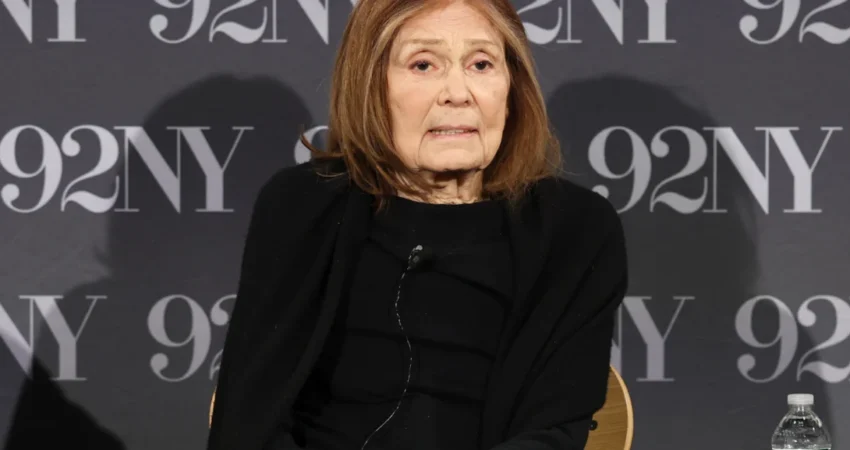
Gloria Steinem, the journalist, trailblazing activist, and globally recognized face of second-wave feminism, passed away on September 3, 2026, at the age of 92. Her death marks the end of an era for the American women’s movement, a crusade she helped lead for more than six decades. Known for her razor-sharp intellect, calm demeanor, and unwavering commitment to social justice, Steinem spent her final years reflecting on a life lived on her own terms—specifically her decisions regarding marriage and motherhood, which remained central to her personal philosophy until her final days.
In the year preceding her death, Steinem remained active in the public eye, continuing to advocate for the rights of women, the LGBTQ+ community, and marginalized groups. During a poignant March 2025 appearance on Bobbi Brown’s YouTube series, "I Am Me," Steinem addressed a question that had followed her for most of her adult life: whether she regretted her decision not to have children. Her response was a definitive "No, no, absolutely not." She explained that her choice was rooted in her childhood experiences, particularly the years she spent caring for her mother, Ruth Nace Steinem, who struggled with mental health issues.
“I’m not sure why except perhaps because when I was growing up, I was looking after my mother, who was not well,” Steinem told Brown. “I’ve noticed that other people who were small people looking after big people don’t want to do it again.” This admission highlighted a recurring theme in Steinem’s life: the reclamation of time and agency that had been denied to the generation of women before her.
A Legacy Rooted in Ancestral Sacrifice
Steinem’s perspective on motherhood and career was deeply influenced by the "sadness of what might have been" regarding her mother’s life. In a 2020 interview, Steinem revealed that she had not realized until her teenage years that her mother had been a successful journalist long before she was born. Ruth Nace Steinem had served as the editor of a newspaper in Toledo, Ohio, but eventually gave up her career to conform to the domestic expectations of the era, a transition that coincided with a mental breakdown.
For Gloria Steinem, her own career as a journalist—which famously included her 1963 undercover exposé on the working conditions at the Playboy Club—was in many ways a continuation of the path her mother was forced to abandon. By choosing not to have children, Steinem often suggested she was preserving the independence that her mother had lost. This personal narrative became a cornerstone of her advocacy, as she encouraged women to view childlessness not as a void, but as a valid and fulfilling life choice.
The Evolution of Marriage and the Bale Partnership
For decades, Steinem was one of the most vocal critics of the institution of marriage, which she viewed as a legal trap that stripped women of their autonomy. Throughout the 1960s and 70s, she famously noted that under the laws of the time, a married woman often lost her legal identity, her credit rating, and her right to a separate domicile.
However, in a move that surprised many of her followers, Steinem married David Bale, an environmental activist and the father of actor Christian Bale, in 2000. At the time, she was 66 years old. She defended the decision by pointing to the legal progress the feminist movement had achieved. “We spent 30 years in the United States changing the marriage laws,” she remarked. “If I had married when I was supposed to get married, I would have lost my name, my legal residence, my credit rating, many of my civil rights. That’s not true any more. It’s possible to make an equal marriage.”
Her marriage to Bale lasted until his death in 2003. During their time together, Steinem became a stepmother to his four children, a role she embraced with the same unconventionality that defined her other relationships. She maintained that being a stepmother allowed her to experience a form of parenting that was based on choice and mutual respect rather than the traditional societal mandates she had long resisted.
Chronology of a Trailblazing Career
Steinem’s life was punctuated by moments that fundamentally shifted the American cultural landscape:

- 1934: Born in Toledo, Ohio.
- 1956: Graduated from Smith College, after which she spent two years in India as a Chester Bowles Fellow, an experience that ignited her interest in grassroots organizing.
- 1963: Published "A Bunny’s Tale" in Show magazine, exposing the exploitation of women in Hugh Hefner’s Playboy Clubs.
- 1969: Published "After Black Power, Women’s Liberation," which brought her to national prominence as a feminist leader.
- 1971: Co-founded the National Women’s Political Caucus and launched Ms. magazine, the first national periodical to be owned and operated by women.
- 1977: Served as a commissioner for the National Women’s Conference in Houston, a landmark event for the feminist movement.
- 1992: Co-founded Choice USA (now URGE), a non-profit advocating for reproductive justice.
- 2000: Married David Bale in a private ceremony in Oklahoma.
- 2013: Awarded the Presidential Medal of Freedom by President Barack Obama.
- 2025: Final major public interview with Bobbi Brown, reaffirming her life choices.
- 2026: Passed away at age 92.
Supporting Data: The Changing Landscape of Autonomy
Steinem’s life reflected broader shifts in American sociology. According to data from the U.S. Census Bureau and Pew Research Center, the percentage of women choosing to remain childless has risen steadily since the 1970s. In 1976, approximately 10% of women aged 40–44 were childless; by the mid-2020s, that figure had nearly doubled to approximately 19%.
Furthermore, the legal changes Steinem fought for—such as the Equal Credit Opportunity Act of 1974, which allowed women to obtain credit cards without a husband’s signature—transformed marriage from a state of legal dependency to a partnership between equals. Her personal timeline mirrored these statistical trends, illustrating the transition from the "feminine mystique" of the 1950s to the diverse family structures of the 21st century.
Reactions from the Global Community
The news of Steinem’s passing triggered an outpouring of tributes from political leaders, activists, and celebrities.
A spokesperson for the National Organization for Women (NOW) stated, "Gloria Steinem did more than just advocate for women; she redefined what it meant to be a woman in the modern world. Her legacy is not found in a single piece of legislation, but in the millions of women who now feel empowered to choose their own paths, whether that includes marriage and children or not."
Contemporary feminist author Roxane Gay noted on social media that Steinem’s "grace and persistence" provided a roadmap for intersectional advocacy. Meanwhile, her stepson, actor Christian Bale, has previously spoken of her with high regard, describing her as a "formidable and kind" presence in their family who practiced the equality she preached.
Broader Impact and Implications
Steinem’s death prompts a reflection on the future of the feminist movement. She was often asked who would carry on her legacy, a question she answered with characteristic humility. In her 2025 interview, she stated that her legacy would be carried by "lots and lots and lots of people," ranging from modern artists and grassroots activists to single mothers, whom she cited as a major source of inspiration.
The implications of her work are visible in the ongoing debates over reproductive rights, workplace equity, and the representation of women in leadership. Steinem’s philosophy was never about excluding men or traditional family structures, but about ensuring that such structures were a matter of choice rather than coercion.
As the world looks back on her 92 years, it is clear that Steinem’s greatest contribution was the normalization of female agency. She lived as a testament to the idea that a woman’s worth is not tied to her marital status or her ability to procreate, but to her contributions to the collective human experience. Her refusal to feel "remorse" for her child-free life served as a final, powerful act of activism, giving permission to future generations to define success and happiness on their own terms.
Gloria Steinem’s life was a masterclass in the art of the possible. By refusing to be limited by the conventions of her birth era, she helped build a world where the next generation of "small people looking after big people" could grow up to be whoever they chose to be. Her voice, though now silent, remains echoed in the laws she helped change and the minds she helped open.

0 Comments