
BEIJING – China has forcefully accused other G20 nations of "promoting protectionism," staunchly rejecting their criticisms regarding economies that rely heavily on exports and contribute to global trade imbalances. This sharp retort from Beijing comes as the nation navigates a complex web of escalating trade disputes, ranging from accusations of "overcapacity" in key industrial sectors to punitive sanctions from the United States and new regulatory challenges in Europe. The confluence of these tensions underscores a critical juncture in global economic relations, challenging the established norms of multilateral trade and diplomacy.
The latest flashpoint emerged from recent G20 discussions where, according to U.S. Treasury Secretary Scott Bessent, 19 of the G20 members reached a consensus on the urgent need to address an "unsustainable equilibrium" stemming from what they described as a "stream of cheap exports." This collective concern points directly to China’s economic model, which has long been characterized by robust export growth, often facilitated by state support and perceived industrial overcapacity in certain sectors. China, however, stood as the sole G20 member to dissent from a joint statement that explicitly referenced these "imbalances," signaling a deep division on fundamental aspects of global economic governance.
The G20 Standoff: Protectionism vs. Unfair Practices
The G20, established in 1999 as a forum for finance ministers and central bank governors from 19 countries and the European Union, plays a crucial role in addressing major issues related to the global economy. Its recent discussions have increasingly focused on the structural imbalances in global trade, particularly the persistent trade surpluses of some nations, most notably China, and the corresponding deficits in others. Critics argue that China’s massive manufacturing capacity, often subsidized, leads to an inundation of global markets with low-cost goods, distorting competition and harming industries in importing countries. This phenomenon, labeled "overcapacity" by Western economies, is seen as a significant contributor to the "unsustainable equilibrium" highlighted by Secretary Bessent.
From China’s perspective, these accusations are thinly veiled attempts to curtail its economic growth and are inherently protectionist. Ling Huang, spokesperson for China’s Commerce Ministry, articulated Beijing’s position with unequivocal clarity during a weekly press conference. "China believes that taking advantage of the G20 and other multilateral mechanisms to hype up so-called ‘economic imbalances’ and ‘overcapacity’ is essentially promoting protectionism," Huang stated, as translated by CNBC. She added, "China is firmly opposed. This will only disrupt the global economic and trade order, and harm the healthy development of the global economy."
This ideological clash extends beyond mere rhetoric. The G19’s stance reflects a growing frustration, particularly in the United States and Europe, over what they perceive as unfair trade practices, including state-backed subsidies, intellectual property theft, and non-tariff barriers that hinder market access for foreign companies in China. The concept of "overcapacity" is particularly contentious in sectors like steel, solar panels, and more recently, electric vehicles (EVs), where China has become a dominant global producer. Western nations fear that a surge of low-cost Chinese EVs, for instance, could undermine their nascent domestic industries, which are still struggling to scale up production. The G20’s implied pressure is a bid to encourage China to shift its economic model towards greater domestic consumption and market-oriented reforms, thereby reducing its reliance on exports and alleviating global imbalances.
Escalating Sanctions: US Pressure on China Over Iran
Adding another layer of complexity to the already strained U.S.-China relationship are the persistent U.S. sanctions against Iran, which increasingly ensnare Chinese entities. U.S. Treasury Secretary Bessent had earlier announced that any entity, including Chinese banks, found facilitating money laundering or sanctions evasion on behalf of Iran, could face severe repercussions, potentially being cut off from the U.S. financial system. This extraterritorial application of U.S. law has long been a point of contention for China, which views such measures as infringements on its sovereignty and legitimate business dealings.
China is a major importer of Iranian oil, and its state-owned banks and companies often play a critical role in facilitating this trade. Despite repeated appeals from Beijing, the U.S. has continued to impose sanctions on Chinese companies and citizens, citing their alleged involvement in supporting Iran’s economy. "Despite repeated requests from China, the U.S. has used Iran as an excuse for repeatedly imposing sanctions on Chinese companies and citizens, to which China is strongly dissatisfied and firmly opposes," Huang asserted. She demanded that the U.S. "immediately correct its wrong practices and lift sanctions against relevant Chinese companies and citizens."
The threat of being cut off from the U.S. financial system, often referred to as "secondary sanctions," carries significant weight. Given the dollar’s preeminent role in global finance, such measures can severely impede a bank’s ability to conduct international transactions, impacting its liquidity and reputation. China has been actively developing alternative financial messaging systems, such as the Cross-Border Interbank Payment System (CIPS), to reduce its reliance on the U.S.-dominated SWIFT system. However, for now, the threat remains potent, forcing Chinese entities to weigh the risks of doing business with Iran against access to the global financial system. This situation not only highlights the economic leverage of the U.S. but also underscores the broader geopolitical competition between Washington and Beijing, with Iran serving as a critical proxy in this rivalry.
European Front: France’s Fast Fashion Law and EU Trade Deficit
The trade tensions are not confined to the U.S. sphere; Europe is also emerging as a significant front. On Thursday, Huang urged France to reconsider a newly implemented law designed to curb the aggressive pricing strategies of Chinese e-commerce giants like Temu and Shein, often referred to as "fast fashion" retailers. This French legislation aims to address the environmental impact and unfair competition posed by these ultra-low-cost, high-volume business models. Critics argue that the rapid production and consumption cycles encouraged by these platforms contribute significantly to waste and carbon emissions, while their pricing makes it impossible for local retailers to compete.
Huang’s warning was stark: "If France persists in its course of action, China will take necessary measures to safeguard the legitimate rights and interests of Chinese enterprises, and France will bear all consequences." This statement signals China’s readiness to retaliate against what it perceives as discriminatory trade barriers, potentially opening a new chapter in trade disputes focused on environmental regulations and consumer protection.
This French initiative is part of a broader European effort to rebalance its economic relationship with China. The European Union has expressed deep concerns over its burgeoning trade deficit with China, which has reached record levels, estimated to be in the hundreds of billions of euros annually. EU Trade Commissioner Maroš Šefčovič recently warned in an interview with Euronews that Beijing must deliver "concrete results" by October to address these imbalances, or face "harsher measures." These potential measures could include tariffs, anti-subsidy investigations, or other trade defense instruments.
The EU’s concerns mirror those of the U.S. regarding market access, intellectual property protection, and state subsidies. European businesses frequently report difficulties in operating in China compared to the relative openness of European markets to Chinese goods and investments. The EU is particularly focused on sectors such as green technologies, telecommunications, and high-tech manufacturing, where it believes China’s industrial policies create an unfair competitive advantage. While China has expressed willingness to work with the EU, Huang reiterated that "demands should not be made unilaterally, and threats should not be made to close markets," emphasizing Beijing’s preference for dialogue over coercion. The October deadline set by the EU signifies a critical period for negotiations, with the potential for a significant escalation of trade friction if an agreement is not reached.
The Broader Geopolitical Tapestry: A Flurry of Meetings and Anticipated Summits
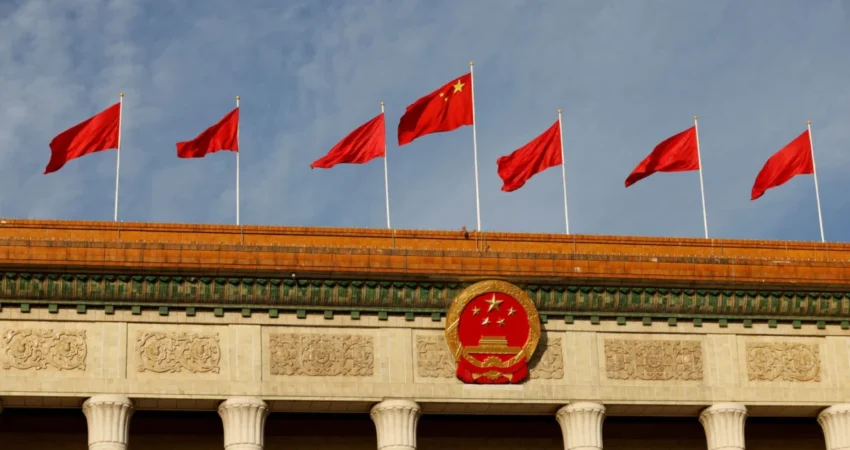
These distinct but interconnected trade disputes unfold against a backdrop of intense geopolitical activity and growing anticipation for key diplomatic engagements. Earlier, a Chinese flag fluttered atop the Great Hall of the People in Beijing, heralding the opening ceremony of the Belt and Road Forum (BRF), a significant event marking the 10th anniversary of China’s ambitious Belt and Road Initiative (BRI). The BRF served as a platform for China to showcase its global connectivity projects and rally support for its vision of a more interconnected world, even as Western nations scrutinize the initiative for its debt implications and geopolitical influence.
Amidst this flurry of multilateral meetings, including discussions at the G20, BRICS, and Shanghai Cooperation Organization (SCO), the diplomatic spotlight is increasingly turning towards the highly anticipated trip of Chinese President Xi Jinping to Washington, D.C., later this month. This summit with President Trump is poised to be a pivotal moment, offering a rare opportunity for direct high-level dialogue between the leaders of the world’s two largest economies. The agenda is expected to be packed with contentious issues, ranging from trade imbalances and economic competition to regional security concerns and the aforementioned sanctions against Iran. The outcomes of this summit could significantly influence the trajectory of global trade relations and geopolitical stability for the foreseeable future.
Implications and Outlook: Navigating a Fractured Global Economy
The current landscape of global trade is characterized by a palpable sense of unease and a growing fragmentation of economic blocs. China’s firm stance against what it terms "protectionism" reflects its determination to defend its economic model and assert its sovereign interests on the international stage. Conversely, the unified front presented by 19 G20 nations, coupled with the explicit warnings from the EU and the direct actions by the U.S. and France, signals a concerted effort by developed economies to address perceived unfair trade practices and rebalance global economic power.
The implications of these escalating tensions are far-reaching. Continued trade disputes risk disrupting global supply chains, increasing production costs, and potentially stifling economic growth worldwide. The weaponization of financial systems through sanctions could lead to a further de-dollarization trend and the emergence of alternative payment mechanisms, fundamentally altering the global financial architecture. Furthermore, the pushback against China’s export-led growth model could compel Beijing to accelerate its pivot towards domestic consumption and innovation, though such a transition would be complex and time-consuming.
The challenges to multilateralism are also evident, as nations increasingly resort to unilateral actions or form smaller, like-minded blocs to address grievances. The G20, once seen as a robust forum for global economic cooperation, appears increasingly divided, particularly on issues related to trade and economic models. As President Xi Jinping prepares for his critical visit to Washington, the world watches to see if diplomacy can bridge these widening gaps, or if the global economy is destined for a period of sustained friction and strategic competition. The resolution, or escalation, of these disputes will profoundly shape the international economic order in the coming years, testing the resilience of global institutions and the adaptability of major economic powers.

0 Comments