
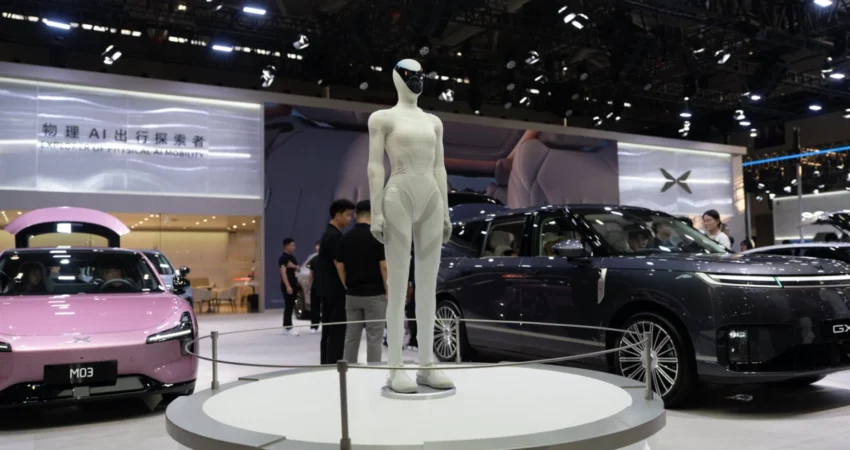
Shenzhen, Guangdong – A striking display at the 2026 Guangdong-Hong Kong-Macao Greater Bay Area International Auto Show on May 31, 2026, saw XPeng’s advanced humanoid robot, IRON, captivate attendees, symbolizing a profound strategic shift underway within China’s automotive industry. Just a decade after their initial aggressive foray into the electric vehicle (EV) sector, Chinese companies are now channeling significant resources and ambition into the nascent field of humanoid robotics. This strategic pivot comes at a critical juncture for the EV market, which is experiencing a notable slowdown and intensifying competition, prompting a re-evaluation of growth strategies and capital valuation narratives among leading players.
The rush into humanoid robotics, while still facing scrutiny regarding its immediate commercial viability, has not deterred major automakers like Xpeng. The company recently announced robust robot production plans, even as China’s overall EV sales trajectory points towards its worst year since 2021, underscoring the urgency of this diversification. This move is largely driven by a dual objective: to reshape "capital valuation narratives" and bolster the perception of these companies as cutting-edge technology firms, thereby establishing a crucial second growth curve. Kevin Li, an associate director at Counterpoint Research, highlights this strategic intent, noting the desire to transcend traditional manufacturing labels.
The EV Market’s Shifting Sands and the Impetus for Diversification
The current landscape for Chinese EV manufacturers starkly contrasts with the boom period of the early 2020s. Xpeng, once a high-flying innovator, has seen its shares tumble by over 45% this year, positioning it as the worst performer among major EV players. Even industry titan BYD has not been immune, with its shares down more than 13% amidst a broader slump in sales. This downturn is symptomatic of a maturing market characterized by fierce price wars, an overabundance of manufacturers, and a cooling of consumer demand following the phased withdrawal of government subsidies that initially fueled the sector’s explosive growth.
The financial pressures are palpable. Data from the China Association of Automobile Manufacturers, cited by Counterpoint, indicates that the average profit margin in China’s vehicle manufacturing sector plummeted to a mere 1.5% in the first half of 2026. This razor-thin profitability underscores the unsustainable nature of current market dynamics for many participants and serves as a powerful catalyst for seeking alternative revenue streams and technological leverage.
Chinese automakers have emerged as global leaders in this new frontier. According to Counterpoint, Chinese companies account for over half of the nearly 20 car manufacturers worldwide that have entered the humanoid robotics sector through various avenues, including in-house development, direct investment, or incubation initiatives as of August 2026. This collective push signifies a national strategic alignment with advanced manufacturing and artificial intelligence.
Key Players and Their Robotics Strategies
Beyond Xpeng, other prominent EV players are actively carving out their niche in the robotics domain. Nio, another premium EV manufacturer, has channeled its investment arm into several promising humanoid robotics startups, including LimX Dynamics and Acorn Robot, as revealed by PitchBook data. This venture capital approach allows Nio to tap into specialized expertise and accelerate development without committing entirely to in-house R&D from the ground up.
Xiaomi, initially a consumer electronics giant that only launched its first electric car in 2024, has rapidly integrated robotics into its operational strategy. The company began testing humanoid robots within its own EV factories this year, showcasing a practical application of the technology to optimize manufacturing processes. Similarly, Li Auto and Geely are also making strategic moves into the robotics sector, albeit with differing approaches that reflect their broader corporate strategies.
Jing Yang, Director of Asia-Pacific corporate ratings at Fitch Ratings, articulates the strategic rationale clearly: "Given the slowing growth and weakening profitability in the EV market—particularly domestically—it is a natural strategic move for EV companies to diversify into new applications such as robotics." She further elaborates that this diversification allows them to "pursue alternative growth drivers, achieve economies of scale for shared advanced technologies, and potentially improve profitability over the medium term." The synergy between autonomous driving technology and humanoid robotics, particularly in areas like sensor fusion, AI algorithms, and motor control, is a compelling factor.
Investor Sentiment and Valuation Challenges
Despite the ambitious plans and potential synergies, investors remain cautiously optimistic, if not outright skeptical, about the immediate financial returns from these robotics ventures. Xpeng’s shares, for instance, experienced a dip following its announcement last month of raising $900 million for its robotics business. While this round marked the largest single funding in China’s "embodied AI" industry—a term referring to hardware-connected artificial intelligence—the market’s reaction underscored a wait-and-see attitude.

Remarkably, this fundraising round valued Xpeng’s robotics unit at over $6.3 billion, a figure nearly on par with the estimated $6.5 billion valuation of Xpeng’s core EV business, according to Citi analysts. This parity highlights the substantial capital being directed towards robotics and the significant expectations attached to this nascent sector, yet it also suggests a potential overextension or a speculative bubble in the eyes of some market observers.
Chinese Automakers’ Unique Advantages in the Robotics Race
While comparisons with Tesla’s Optimus humanoid project in the U.S. are inevitable, Chinese automakers possess distinct advantages that could accelerate their progress in the robotics field, according to Xiaoyi Lei, a senior research analyst at Jefferies Hong Kong.
A primary advantage lies in the remarkable reusability of their existing supply chains and technological assets. Xpeng, for example, estimates that up to 85% of its motors, chips, and smart driving software developed for EVs can be repurposed for humanoid robots. This significantly reduces R&D costs and accelerates time-to-market. Moreover, these robots can be immediately deployed within the automakers’ own extensive networks of stores and factories. This internal deployment strategy bypasses the immediate need for consumer adoption, providing invaluable real-world testing environments and opportunities for rapid iteration and data collection—a critical factor for the commercialization of humanoid robots.
Xpeng has already laid out a clear roadmap: mass production of its robots is slated to begin by the end of this year, with initial deployments targeting its own retail outlets and business venues. By next year, the company plans to launch these robots to the broader market, both within China and internationally.
Furthermore, Chinese automakers bring unparalleled expertise in manufacturing at scale. The ability to produce thousands, if not millions, of complex machines that are reliable, serviceable, and cost-effective is a daily reality for these companies. Lei emphasizes, "Chinese players are the ones actually pushing it into daily use." This in-house deployment strategy facilitates a continuous feedback loop, making it easier and cheaper for automakers to collect the vast amounts of data essential for refining humanoid capabilities and achieving true commercial viability.
Xiaomi’s strategic deployment of humanoid robots in its EV factories exemplifies this practical approach. Similarly, BYD, with its expansive manufacturing footprint, possesses a natural environment for deploying robots in its production facilities. However, Counterpoint’s Kevin Li suggests that over the medium-to-long term, companies like Geely and Xpeng might be better positioned to capitalize on the broader benefits of diversifying beyond cars, particularly given Xpeng’s pronounced emphasis on a holistic "physical AI" strategy.
Navigating the Uncharted Waters: Challenges and Future Outlook
Despite the enthusiasm and strategic investments, fundamental questions about the commercial viability of humanoid robots beyond automakers’ internal operations persist. Jefferies’ Lei admits that her firm has yet to observe firm external orders from the automakers they cover, nor clear guidance on external customers or projected robotics revenue for the coming year. This indicates that the market for general-purpose humanoid robots is still nascent and largely unproven.
The recent market performance of Unitree, a leading Chinese humanoid robotics company, offers a cautionary tale. Its shares soared upon its debut in Shanghai last month but subsequently declined for 12 of the 16 sessions following its listing. Unitree’s founder, Wang Xingxing, has candidly cautioned that widespread commercialization could still be years away, suggesting that the humanoid sector’s "ChatGPT moment"—a transformative breakthrough that sparks rapid adoption—is likely a decade in the future.
Technological hurdles also remain significant. While reusing car technology for robots offers advantages, the transition is not always straightforward. "The real challenge is how they are going to make the algorithm and software stack that is used to be applied to the smart driving system also viable to the humanoid scenario, which is more difficult and more challenging," Lei points out. Humanoid robots operating in diverse, unstructured environments require far more sophisticated perception, decision-making, and manipulation capabilities than an autonomous vehicle navigating predefined roads. The nuances of human interaction, object handling, and complex task execution present formidable AI and engineering challenges.
The long-term implications of this pivot are substantial. Should Chinese automakers succeed in scaling humanoid robot production and deployment, it could revolutionize industries ranging from logistics and manufacturing to elder care and retail. It would also solidify China’s position as a global leader in advanced robotics and AI, fostering new ecosystems and potentially creating entirely new economic sectors. However, the journey is fraught with technological complexities, high development costs, and an uncertain return on investment, making it a high-stakes gamble with potentially transformative rewards. The world watches as these EV giants navigate this intricate new frontier, attempting to build not just the cars of tomorrow, but the autonomous workforce of the future.

0 Comments