
Before birth, the human brain embarks on an extraordinary journey of construction, orchestrated by an intricate cascade of cellular decisions. At the very heart of this developmental marvel are radial glia, a specialized class of stem cells that play a pivotal role in shaping the unique features distinguishing the human brain from those of other species. These remarkable cells are the primary progenitors of the vast majority of neurons and crucial support cells that constitute the cerebral cortex, the brain’s command center responsible for higher cognitive functions such as thought, memory, and language. Furthermore, radial glia are widely believed to be instrumental in the disproportionately large expansion of the human cortex, a hallmark of our species. While most of these progenitor cells naturally disappear before birth, a puzzling phenomenon occurs: similar cells can re-emerge later in life within brain cancers, a recurrence whose underlying mechanisms remain a significant area of scientific inquiry.
"Radial glia are the coolest cells that have ever existed," remarked Aparna Bhaduri, an assistant professor of biological chemistry at the David Geffen School of Medicine at UCLA. "They’re really key to making us human. But they’re also at the center of many neurodevelopmental and neuropsychiatric disorders, as well as cancer — so understanding how they make their decisions is one way to start understanding how those conditions arise."
Recent groundbreaking research, detailed in two separate studies published in the prestigious journals Cell and Science, is now illuminating the intricate decision-making processes employed by radial glia. Bhaduri and her collaborators have uncovered that these versatile cells integrate and respond to two fundamentally distinct types of environmental cues: the metabolic state of their cellular environment and direct physical signals emanating from other developing brain regions. Collectively, these findings offer unprecedented insights into the mechanisms by which the human cortex achieves its astonishing diversity of cell types.
Metabolic Pathways Fueling Cortical Development
The Cell study, a monumental undertaking, has produced a highly detailed metabolic atlas of the developing human cortex. This ambitious project, a synergistic collaboration between Bhaduri’s laboratory and that of Heather Christofk, was spearheaded by co-first authors Jessenya Mil and Jose Soto. By meticulously analyzing donated human brain tissue alongside advanced brain organoids cultivated from stem cells, the research team arrived at a profound and unexpected conclusion: metabolism is far from a passive background process in brain development. Instead, it actively dictates the types of cells that are generated.
A key discovery from the study is the critical reliance of radial glia on the pentose phosphate pathway (PPP). This metabolic pathway is essential for rapidly dividing cells, as it efficiently converts glucose into the molecular building blocks required for cell proliferation. When the researchers experimentally reduced glucose availability or disrupted the function of the PPP, they observed a significant shift in the output of these neural stem cells. Specifically, the radial glia began producing a greater abundance of inhibitory neurons and other cell types that are typically generated at later stages of cortical development.
"What was surprising is that metabolism isn’t just a passive thing that happens in the background," explained Bhaduri, who is also affiliated with the UCLA Broad Stem Cell Research Center and the UCLA Health Jonsson Comprehensive Cancer Center. "It can really control how stem cells make decisions."
The implications of this discovery are far-reaching. It provides a novel framework for investigating how factors such as maternal nutrition, metabolic disorders, and broader environmental influences can profoundly impact the developing human brain. The comprehensive metabolic atlas itself stands as a valuable resource for the scientific community, offering one of the most detailed maps available for understanding metabolic processes during human brain development.
Early Thalamic Signals Shape Cortical Identity
Complementing the metabolic insights, the second study, published in Science and led by first author Claudia Nguyen, delves into a distinct yet equally critical source of developmental information: the influence of signals originating from the thalamus. This subcortical structure, nestled deep within the brain, serves as a crucial relay station for sensory and motor information, transmitting signals to and from the cerebral cortex.
For years, neuroscientists have understood that neurons within the thalamus extend long projections, or axons, that reach out towards the developing cortex. These axonal fibers are the precursors to the intricate neural circuitry that will eventually facilitate communication. Anatomical studies have revealed that in humans, these thalamic projections arrive at the cortical surface significantly earlier than the establishment of functional synaptic connections. This observation posed a compelling question: what is the purpose of this early arrival?
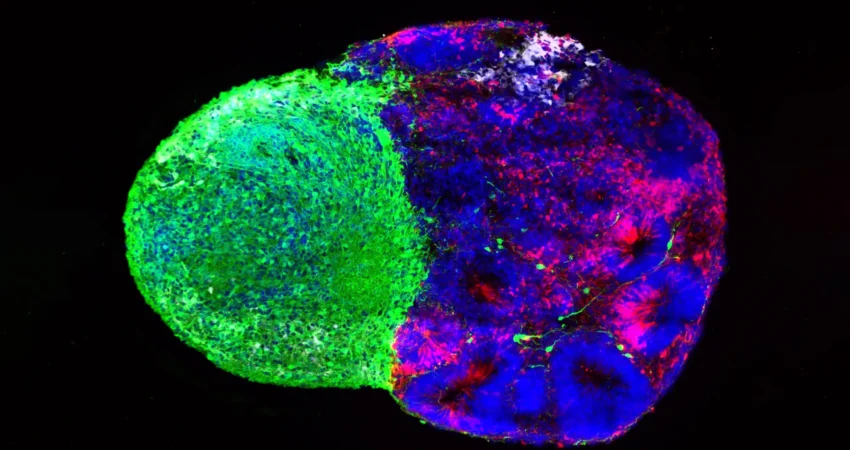
Employing sophisticated human stem cell-derived brain "assembloids" – three-dimensional cultures that mimic early brain development – the UCLA researchers uncovered a crucial piece of the puzzle. They demonstrated that these nascent thalamic projections physically come into contact with radial glia during the critical period of brain development.
This direct physical interaction proved to be a potent stimulus, profoundly altering the behavior of the radial glia. The contact triggered these stem cells to produce a greater proportion of excitatory neurons, the primary cell type responsible for transmitting signals within the cortex. This effect was particularly pronounced in the generation of upper-layer neurons, a class of neurons that is notably expanded in the human brain, contributing to its enhanced computational power.
"We already knew that these projections influence how the cortex develops," Bhaduri stated. "What we specifically found is that this influence comes through an actual physical connection between the projections and the radial glia — a point of contact that just hasn’t been identified before, and one that very likely does not exist in rodents." This suggests a divergence in developmental mechanisms between species, highlighting the unique aspects of human brain evolution.
The NRXN1 Gene: A Link to Neurodevelopmental Disorders
Further investigation into the physical interaction between thalamic projections and radial glia revealed a connection to NRXN1, a gene with a well-established role in facilitating neuronal connections. Mutations in NRXN1 have previously been linked to an increased risk of autism spectrum disorder (ASD), a neurodevelopmental condition characterized by challenges in social interaction and communication.
To explore this link, the research team utilized assembloids derived from patient cells carrying a specific NRXN1 mutation. In these experimental models, the altered thalamic signals originating from cells with the mutated gene exhibited different communication patterns compared to signals from unaffected cells. These subtle but significant changes in signaling were found to disrupt the delicate balance between the self-renewal of radial glia and the differentiation of new neurons. This finding offers a potential avenue for understanding how early disruptions in brain development, potentially stemming from genetic predispositions like NRXN1 mutations, can influence the intricate architecture of the cerebral cortex.
A Unified Vision: The Developing Brain in Constant Dialogue
While the two studies investigated distinct mechanisms – one focusing on cellular metabolism and the other on physical neural connections – they converge on a powerful, unifying principle: radial glia are not solitary decision-makers. Their fate and the types of cells they produce are continuously and dynamically shaped by a complex interplay of internal metabolic states and external environmental signals. The developing brain, therefore, emerges not as a pre-programmed entity, but as a highly interactive and communicative system.
These research breakthroughs also underscore the transformative impact of organoid technology on the study of human brain development. Just a decade ago, direct investigation into the behavior of uniquely human neural stem cells was severely limited by a lack of appropriate experimental models. Today, the advent of brain organoids and related advanced cellular models allows researchers to recapitulate critical aspects of human brain development in a laboratory setting. These systems provide unparalleled opportunities to test hypotheses that are intractable in animal models, which often exhibit fundamental differences in brain structure and development.
Bhaduri expressed her hope that these findings will prompt a paradigm shift in how scientists perceive the drivers of development. She advocates for viewing metabolic processes and physical cellular interactions not as passive background elements, but as active and potent regulators of developmental trajectories.
"Ultimately, these studies give us a glimpse under the hood of how these cells make decisions," she concluded. "Understanding those decisions is a first step toward understanding normal brain development, disease vulnerability and, potentially, how similar stem-cell programs operate in brain cancer."
This groundbreaking research was generously supported by a consortium of esteemed organizations, including the National Institutes of Health, the National Science Foundation, the Brain & Behavior Research Foundation, the Alfred P. Sloan Foundation, the Rose Hills Foundation, the Esther A. & Joseph Klingenstein Fund, the Simons Foundation, the Chan Zuckerberg Initiative, the NIH BRAIN Initiative Cell Atlas Network, the International Foundation for Ethical Research, the UCLA Broad Stem Cell Research Center’s Stem Cell Research Training Program, and the UCLA Health Jonsson Comprehensive Cancer Center and UCLA Broad Stem Cell Research Center Ablon Scholars Program. Their collective investment in fundamental scientific inquiry has yielded insights that promise to advance our understanding of human brain development and its associated disorders for years to come.

0 Comments