
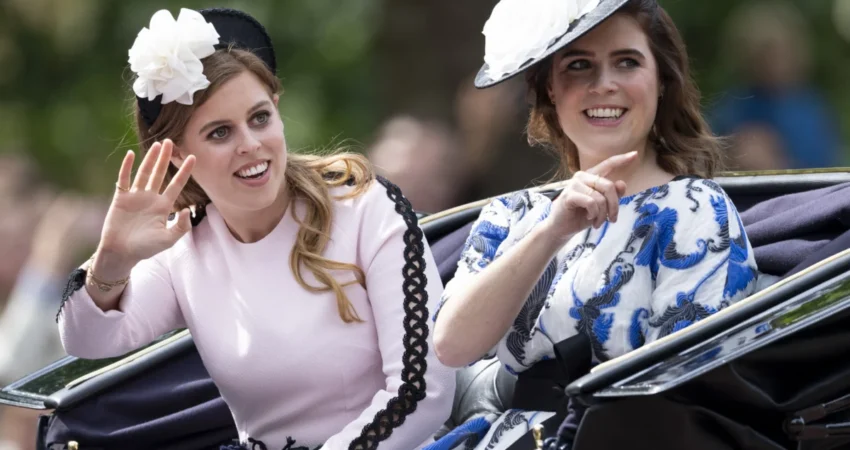
The internal dynamics of the British Royal Family have undergone a profound transformation over the last several years, particularly for the daughters of the Duke and Duchess of York. Princess Beatrice and Princess Eugenie, once viewed as a unified front within the House of Windsor, are now navigating the persistent fallout of their father Prince Andrew’s public disgrace in markedly different ways. While Princess Eugenie has established a life of relative seclusion and geographic distance in Portugal, Princess Beatrice remains tethered to the epicenter of the family’s institutional challenges in London. This divergence has created a significant shift in public perception and personal freedom for the two sisters, as they balance their roles as private citizens with their status as members of the blood royal.
The Geography of Reputation: Portugal vs. London
The decision by Princess Eugenie and her husband, Jack Brooksbank, to relocate to Portugal in May 2022 is increasingly viewed by royal observers as a masterstroke of reputation management, whether intentional or incidental. The couple divides their time between London and the exclusive Costa Terra Golf and Ocean Club in Melides, south of Lisbon. This move occurred just as the legal and social repercussions surrounding Prince Andrew’s association with Jeffrey Epstein reached a critical juncture, including the stripping of his military affiliations and Royal Highness (HRH) status.
Royal expert Richard Fitzwilliams noted that this physical distance has acted as a buffer for Eugenie. The recent birth of her third child, daughter Adelaide, in a non-British jurisdiction further emphasizes this separation. By raising her family abroad and engaging in a professional life that allows for remote work—Eugenie maintains her role as a director at the London-based art gallery Hauser & Wirth—she has successfully "de-coupled" her personal brand from the daily headlines surrounding the York estate at Royal Lodge.
In contrast, Princess Beatrice remains based in the United Kingdom, where she lives with her husband, Edoardo Mapelli Mozzi, and their children. Her proximity to the Royal Family’s administrative hub and her father’s residence has made it nearly impossible for her to escape the shadow of the ongoing controversies. As the elder sister, Beatrice is often perceived as being more closely integrated into the family’s internal crises, a position that carries significant social and psychological weight.
The Newsnight Legacy and the Burden of Advice
A pivotal factor in the differing public perceptions of the two sisters lies in their historical involvement in their father’s attempts at crisis management. It has been widely reported, and subsequently dramatized in media productions such as the film Scoop, that Princess Beatrice played a central role in the discussions leading up to Prince Andrew’s disastrous 2019 Newsnight interview with Emily Maitlis.
At the time, Beatrice reportedly accompanied her father to a meeting with BBC producers, allegedly hoping that the interview would provide a platform for him to clear his name. The interview is now regarded as one of the greatest public relations catastrophes in the history of the modern monarchy. Fitzwilliams points out that while this involvement was not immediately emphasized by the public, the subsequent dramatization of the event has solidified the image of Beatrice as a key advisor to her father. This association has made it difficult for her to claim the same "neutral" ground that Eugenie occupies.

Eugenie, conversely, was largely absent from the tactical decision-making surrounding the Newsnight fallout. Her relative distance from the immediate strategic failures of the Duke of York’s legal and PR teams has allowed her to maintain a "cleaner" public profile, untainted by the perception of having enabled or facilitated her father’s ill-fated public defense.
Chronology of the York Family Fallout (2019–2026)
To understand the current predicament of the York sisters, it is necessary to examine the timeline of events that have reshaped their standing within the monarchy:
- November 2019: Prince Andrew’s Newsnight interview airs, leading to immediate public outcry and his subsequent withdrawal from public duties.
- July 2020: Princess Beatrice marries Edoardo Mapelli Mozzi in a private ceremony at Windsor, overshadowed by the ongoing Epstein investigation.
- January 2022: Queen Elizabeth II strips Prince Andrew of his military titles and royal patronages. He stops using the style "His Royal Highness" in an official capacity.
- February 2022: Prince Andrew reaches an out-of-court settlement with Virginia Giuffre in her civil sexual assault lawsuit, though he makes no admission of liability.
- May 2022: Princess Eugenie and Jack Brooksbank announce their partial move to Portugal, citing Brooksbank’s work with a high-end real estate development.
- May 2023: The coronation of King Charles III sees the York sisters relegated to the third row, signaling their status as non-working royals in a "slimmed-down" monarchy.
- 2024–2025: Increasing pressure from the Palace for Prince Andrew to vacate Royal Lodge in favor of more modest accommodations, such as Frogmore Cottage. Beatrice is reportedly caught in the middle of these negotiations.
- September 2026: Princess Eugenie welcomes her third child, Adelaide, while reports surface regarding the strain on Princess Beatrice’s marriage due to the relentless "York fatigue" in the British press.
Professional Autonomy and the Non-Working Royal Dilemma
Both Beatrice and Eugenie are "non-working royals," meaning they do not receive funding from the Sovereign Grant and are expected to earn their own livings. This status was intended to provide them with independence, but in practice, it has created a complex "gray zone."
Princess Beatrice serves as the Vice President of Strategic Partnerships at Afiniti, a multinational data and software company. Her role requires her to operate in high-level corporate circles where reputation is paramount. Sources close to the family suggest that the "collateral damage" from her father’s scandals has occasionally complicated her professional endeavors, as business partners remain wary of the York association.
Princess Eugenie’s career in the art world has been more shielded. The international nature of the art market and her residence in Europe provide a layer of insulation. Furthermore, Eugenie has maintained a notably close relationship with her cousin, Prince Harry, and Meghan Markle. By positioning herself as a bridge between the various factions of the fractured Royal Family, Eugenie has carved out a unique diplomatic niche that is independent of the Duke of York’s standing.
The Impact of Marital and Personal Pressures
Recent reports from sources close to the family indicate that the persistent scandal has begun to take a toll on the sisters’ private lives, particularly for Beatrice. Her husband, Edoardo Mapelli Mozzi, an Italian property developer and member of the aristocracy, is said to be "at the end of his tether" regarding the constant media scrutiny and the social stigma attached to the York name.
The pressure of maintaining a dignified public presence while her parents, Andrew and Sarah Ferguson, continue to make headlines—whether for legal battles or health struggles—has reportedly placed a strain on Beatrice’s marriage. Unlike Eugenie, who can retreat to the privacy of a Portuguese estate, Beatrice’s daily life in London involves navigating a social circle that is intimately connected to the monarchy and the British establishment, where the "Andrew problem" remains a frequent topic of hushed conversation.

Institutional Standing within the House of Windsor
Under the reign of King Charles III, the institutional role of the York sisters has been further diminished. The King’s vision for a smaller, more cost-effective monarchy has left little room for the daughters of the Duke of York to take on official duties, even as the Royal Family faced a "manpower shortage" in 2024 and 2025 due to the health crises of the King and the Princess of Wales.
While there were initial suggestions that Beatrice and Eugenie might be called upon to assist with royal engagements, the Palace ultimately leaned on the Duke and Duchess of Edinburgh and Princess Anne. This decision was largely interpreted as a move to avoid the optics of re-integrating the York family into the core of royal life. For Beatrice, who remains in London and is often present at family events, this "in-between" status—being royal enough to be scrutinized but not official enough to be protected—is particularly grueling.
Broader Impact and Future Implications
The divergent paths of Beatrice and Eugenie serve as a case study in the challenges facing the next generation of royals who lack a defined constitutional role. As the monarchy continues to evolve, the "Portugal Model" adopted by Eugenie may become a blueprint for other junior royals seeking to live a life of privilege without the crushing weight of the British tabloid machine.
For the House of Windsor, the "York Problem" remains an unresolved tension. As long as Prince Andrew resides at Royal Lodge and Beatrice remains his primary domestic support system, her public identity will be inextricably linked to his. Meanwhile, Eugenie’s successful transition to a continental lifestyle suggests that for the children of disgraced public figures, the best path to freedom may indeed be a well-timed exit.
Ultimately, the story of the two princesses is one of resilience in the face of institutional collapse. While Eugenie has found a way to breathe in the salt air of the Portuguese coast, Beatrice continues to walk the fine line of duty and daughterly loyalty in the rain of London, proving that even within the same family, the price of a royal title can vary wildly depending on where one chooses to stand.

0 Comments