
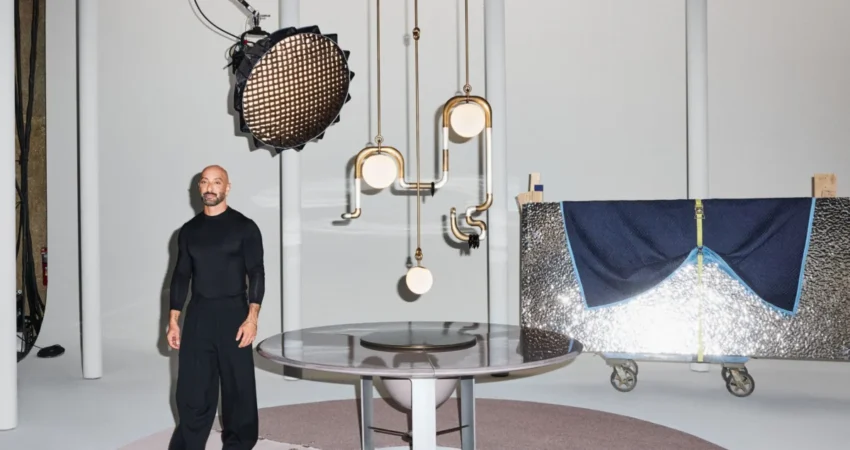
Last March, at a Persian New Year celebration he co-hosted with chef Andy Baraghani, a fellow Iranian American, Gabriel Hendifar experienced a profound moment of reconnection. The event, held to honor the traditions of Nowruz, became a catalyst for his latest creative endeavor. Hendifar, the artistic director and CEO of the renowned New York City design studio Apparatus, found himself in a familiar yet newly significant tableau: his mother singing, his own fingers finding melodies on the piano, and his sister, Nic, providing the rhythmic pulse on a tombak, a traditional Persian hand drum. This spontaneous ensemble, echoing the sounds of his childhood home in Los Angeles, where his mother had immigrated from Tehran, served as a powerful revelation. "That night shifted everything for me," Hendifar shared. "I felt like this cornerstone in the foundation just slipped back into place." This deeply personal experience, a rediscovery of his roots and the sonic tapestry of his upbringing, became the genesis of Apparatus’s newest collection.
The Genesis of Afsaneh: A Fable of Heritage and Feminine Divinity
The new collection, titled "Act V: Afsaneh," draws its name from the Persian word for "fable" and, coincidentally, Hendifar’s mother’s given name. It marks a significant return for Hendifar, who co-founded Apparatus 14 years ago, to the exploration of the "ultimate divine feminine" – his mother and the women within his family, whom he reveres as "goddesses." These women, he explained, imparted crucial life lessons: "They taught me what it means to honor a guest and what it means to share your space." The collection, a meticulously crafted range of furniture, lighting, and rugs, serves as a narrative of how knowledge is held, transmitted, and honored across generations.

Symbolism Woven into Design: From Seed to Cosmos
Hendifar translated core symbols and concepts from Persian culture and mythology into tangible design elements. The collection’s foundational motif, the "seed" or "Esfand," is represented by ovoid lamps and incense holders, symbolizing potential and the beginning of growth. The "blooming flower," or "Gol," is evoked in diaphanous pendant lights, capturing the ephemeral beauty of a blossom. The serpent, "Rahvi," a traditional symbol of wisdom and the collector of knowledge, is reimagined as segmented light fixtures that possess a sinuous, almost serpentine quality, appearing to elegantly traverse space. Finally, the "world," or "Jahaan," is embodied in globe-like tables with shimmering cast-glass tops, reminiscent of celestial bodies and the vastness of the cosmos.
"It felt like these shapes were coming to me from a dream," Hendifar remarked about the design process. "There was a lot of trust in waiting for things to appear." This approach underscores a belief in intuitive creation, allowing the forms and inspirations to manifest organically.
Expanding Horizons: New Materials and Typologies
The development of the "Afsaneh" collection, which spanned four years, also served as an opportunity for Hendifar to innovate with materials and expand Apparatus’s design repertoire in both scale and typology. The use of fiberglass, for instance, enabled the creation of a substantial 40-inch-wide "Gol" pendant, a testament to the material’s structural capabilities and aesthetic potential. Wool bouclé has been introduced to lend a new textural dimension to Apparatus’s existing modular rug designs, offering a richer tactile experience.

The color palette employed throughout the collection is deliberately evocative, conjuring images of an "earthly garden of delights." Specific pieces, such as the "Esfand" sconces and the "Jahaan" dining tables, are available in custom speckled-lacquer finishes, including "sky," "honey," "pomegranate," "milk," "night," and "dusk," each hue chosen to resonate with natural beauty and sensory richness. Further elevating the collection, the "Rahvi" light fixtures are adorned with unique, jewelry-like amulets crafted from semiprecious stones, adding an element of preciousness and intricate detail.
Unexpected Inspirations: From Ponytails to Drums
The creative process for "Afsaneh" was informed by both deeply personal memories and keen observations of the world. Hendifar found inspiration for the distinctive curvature of the "Rahvi" light fixtures in the elegant, tightly banded ponytail of a friend, a style that evoked a fusion of "Alaïa meets Sade." The "Jahaan" tables, offered in both dining and drinks sizes, were directly inspired by the tombak drum, a nod to his father’s musical past and the rhythmic foundations of his home.
A SoHo Sanctuary: Designing Living Spaces with Intention
Concurrently with the development of the "Afsaneh" collection, Hendifar was engaged in furnishing his new apartment in SoHo. This parallel process allowed him to integrate his design philosophy into his personal living environment, creating a space that reflects his aspirations for how one lives, feels, and offers hospitality. "Part of me is addicted to the process," he admitted, now comfortably situated in his airy loft. "I was able to think through how I want to live, how I want to feel, and how I can offer that to other people."

Echoes of Cultural Flourishing: A Historical Lens
Hendifar’s research for both the collection and his apartment frequently led him to periods of intense cultural vibrancy that were tragically cut short. His mood boards featured references to Weimar Germany, 1970s Iran, Cuba in the 1950s, and New York City prior to the AIDS crisis. Rather than viewing these eras solely through the lens of loss, Hendifar interprets them as moments of immense creative potential, imagining what could have been. "It’s less about a tragic turn and more about the cycle," he explained. "That’s where I find hope." This perspective reframes historical narratives, emphasizing resilience and the enduring spirit of human creativity.
Apparatus: A Legacy of Design and Innovation
Since its founding, Apparatus has established itself as a prominent design studio known for its distinctive aesthetic, which often blends historical references with contemporary sensibilities. The studio’s work is characterized by its meticulous craftsmanship, innovative use of materials, and a deep engagement with narrative. Hendifar, as co-founder and artistic director, has been instrumental in shaping this identity, consistently pushing the boundaries of what is possible in lighting, furniture, and interior design.
The "Afsaneh" collection represents a particularly personal chapter in Apparatus’s ongoing story. It is a testament to Hendifar’s ability to translate deeply personal experiences and cultural heritage into objects of enduring beauty and significance. The collection’s success is not only measured by its aesthetic appeal but also by its capacity to evoke emotion and connect viewers to a rich tapestry of history, family, and artistic expression.

Broader Implications for Design and Cultural Dialogue
The "Afsaneh" collection’s focus on Iranian heritage and the universal themes of family, knowledge, and cultural transmission has significant implications for the broader design landscape. In an increasingly globalized world, such collections serve as vital bridges, fostering understanding and appreciation for diverse cultural narratives. By weaving personal stories into universally resonant design principles, Hendifar and Apparatus are contributing to a richer, more inclusive dialogue about identity, memory, and the enduring power of art and design to connect us. The collection’s ability to draw parallels between disparate historical periods of cultural efflorescence also speaks to a timely message of hope and the cyclical nature of creativity, even in the face of adversity.
This story appears in the October issue. Never miss a story when you subscribe to AD.

0 Comments