
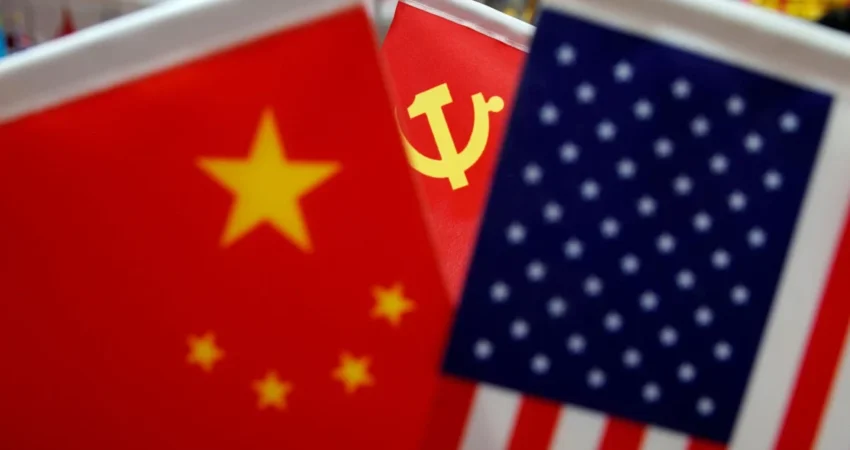
Beijing, China – China on Monday firmly rejected calls from prominent U.S. artificial intelligence executives to deliberately decelerate the rapid development of cutting-edge AI technologies, arguing that such measures would impede global governance efforts and foster an atmosphere of unnecessary competition. The rebuttal underscores a growing divergence in approaches to AI regulation and development between the world’s two largest economies, transforming the field into a primary battleground for technological supremacy and strategic rivalry.
Guo Jiakun, a spokesperson for China’s Foreign Ministry, articulated Beijing’s position, stating, "Fear mongering, confrontation, competition will just disrupt [the] process of global AI governance." His remarks, conveyed via an English translation published by Reuters, were a direct response to a recent chorus of warnings from influential U.S. AI leaders, including Anthropic CEO Dario Amodei, OpenAI CEO Sam Altman, and Tesla and X owner Elon Musk. These figures have collectively urged the industry to consider a more measured pace in AI development, citing potential existential dangers and societal disruptions posed by unchecked and rapid advancements.
The Chinese stance, however, is not a complete dismissal of AI-related risks. Just a day prior to Guo’s statement, Chen Yixin, China’s Minister of State Security, published an article on Sunday advocating for the "acceleration of construction" of a comprehensive AI security risk prevention and control system. This call, detailed in an article posted on the official WeChat account of the Ministry of State Security, acknowledges the inherent challenges and potential vulnerabilities within AI. Minister Chen further emphasized that the domain of AI has become "the main battleground for global technological competition and a new arena for strategic rivalry among major powers," underscoring the necessity for "healthy and orderly" development of the technology within a secure framework. This seemingly nuanced position suggests China’s focus is on secure and controlled acceleration, rather than a slowdown, particularly in the context of international competition.
A Chronology of Mounting Concerns and Divergent Strategies
The recent flurry of high-level statements and policy positions has quickly drawn a stark line in the sand regarding the future trajectory of AI. The timeline of events reveals a rapid escalation of the debate:
- Saturday: Dario Amodei, CEO of Anthropic, a leading AI research company, published a thought-provoking essay titled "We Must Pace the Frontier." In it, Amodei articulated the dilemma facing humanity: "Not building the technology deprives humanity of benefits or simply places AI in the hands of authoritarian powers, while building it too fast is reckless." His essay specifically highlighted national security concerns, noting that any significant slowdown by U.S. companies could allow "unpaced CCP-associated projects to pull ahead, creating significant national security risk."
- Sunday: China’s Minister of State Security, Chen Yixin, released his article, signaling Beijing’s strategic recognition of AI’s critical role in national security and global power dynamics, while simultaneously pushing for robust internal control mechanisms.
- Weekend (BRICS Summit): Chinese President Xi Jinping, addressing the BRICS bloc summit in New Delhi, announced China’s intent to "take the lead" in fostering AI collaboration and development among developing nations. This move positions China as a potential leader in shaping AI norms and technological standards for a significant portion of the global south, potentially creating an alternative AI ecosystem to one dominated by Western powers.
- Monday: The ripple effects of these developments were immediately felt in global markets. AI-related stocks experienced a slump, with SoftBank, a major investor in OpenAI, notably declining by 10% in Japan. This market reaction reflects investor sensitivity to regulatory uncertainty and the potential for geopolitical tensions to impact the lucrative AI sector.
- Monday: Following the weekend’s discussions and the U.S. executives’ public appeals, China’s Foreign Ministry spokesperson Guo Jiakun issued Beijing’s official rejection of a slowdown, framing it as counterproductive to global AI governance.
- Monday (Ireland Trip): In a parallel development, former U.S. President Donald Trump, during a trip to Ireland, vocally dismissed the AI bosses’ calls for a slowdown. Trump asserted, "Look, we’re leading China in AI… and, frankly I want to keep it that way because whoever wins AI, wins." His comments underscore the perceived zero-sum nature of the AI race from a national security perspective within certain U.S. political circles.
These events collectively paint a picture of a rapidly evolving technological landscape, where national interests, economic ambitions, and existential fears are inextricably intertwined.

The Intensifying AI Arms Race and the "Closing Gap" Narrative
The concept of an "AI arms race" is not new, but the recent exchanges have brought its implications into sharp focus. For years, experts have debated the strategic advantage held by the United States in advanced AI research and deployment. However, the narrative of a widening or closing gap is central to the current debate.
Helen Toner, executive director of the Georgetown Center for Security and Emerging Technology and a former OpenAI board member, offered insights into this competitive dynamic on "Squawk Box" Monday. Toner stated, "The best estimates tend to say China’s very best models are something like six to nine months behind the very best U.S. models." This assessment, if accurate, suggests a lead that, while significant in a fast-moving field, is not insurmountable. Toner further elaborated on the strategic dilemma: "If that means that we slow down and they just rip past us because they’re pretty close behind – that’s a problem."
The fear among some U.S. policymakers and industry leaders is that a self-imposed slowdown would cede this critical advantage, allowing China to catch up or even surpass the U.S. in key AI capabilities. This concern is amplified by the observation that Chinese AI models are increasingly gaining traction among Western companies, a testament to their improving capabilities and the sheer volume of research and development happening within China. This "fast following" capability, where China can rapidly integrate and build upon foundational research pioneered elsewhere, is a crucial factor. Toner noted, "It’s actually not clear how much of their advancements are sort of fast following. Where if the U.S. frontier slows, perhaps China also slows somewhat." This uncertainty complicates strategic planning, as it’s unclear whether a U.S. slowdown would unilaterally benefit China or if the global pace of innovation is more interconnected.
The Broader Context: Geopolitical Stakes and Global Governance Challenges
The debate over AI’s pace and safety is not merely a technical or ethical discussion; it is deeply embedded in the broader geopolitical contest between the U.S. and China. Both nations view AI as a foundational technology that will redefine economic power, military capabilities, and global influence in the 21st century.
From a U.S. perspective, the drive to maintain a lead in AI is seen as crucial for national security, economic competitiveness, and the preservation of democratic values. Concerns range from the potential for AI-powered autonomous weapons systems to the misuse of AI for surveillance, disinformation campaigns, and cyber warfare. The calls for a slowdown by U.S. executives often stem from a desire to establish robust safety protocols, ethical guidelines, and international regulatory frameworks before AI reaches a point of uncontrollable complexity or destructive potential. They fear that without a pause, the industry risks creating powerful technologies that humanity may not be equipped to manage, potentially leading to unforeseen catastrophic outcomes.

China, on the other hand, views AI as a cornerstone of its national rejuvenation strategy and a critical component of its ambition to become a global technological superpower by 2049. Beijing’s strategic documents, such as the "Next Generation Artificial Intelligence Development Plan," explicitly outline goals for leading the world in AI theory, technology, and application. The emphasis on "healthy and orderly" development, coupled with calls for accelerated construction of security systems, suggests a strategy of rapid innovation under state control. This approach prioritizes national strength and technological self-sufficiency, often viewing external calls for slowdowns as attempts to hinder its progress or maintain existing power imbalances.
The differing philosophies pose significant challenges for global AI governance. Establishing common international standards for AI safety, ethics, and deployment becomes incredibly difficult when leading nations have fundamentally different strategic imperatives. China’s initiative to foster AI collaboration among developing countries, as announced by President Xi at the BRICS summit, could lead to the formation of alternative AI standards and ecosystems, further fragmenting the global technological landscape. This could create a world where AI is developed and deployed under vastly different ethical and regulatory regimes, complicating interoperability, data sharing, and collective risk mitigation efforts.
Implications for Innovation, Investment, and Society
The current standoff has profound implications across multiple sectors. For the technology industry, the uncertainty surrounding potential regulatory actions and international cooperation could dampen investment in high-risk, frontier AI research. While a slowdown might address immediate safety concerns, it could also stifle innovation and allow other nations or entities with less stringent ethical frameworks to forge ahead. The recent slump in AI-related stocks is an early indicator of this market sensitivity.
For national security, the "winner-takes-all" mentality, as articulated by former President Trump, highlights the intense competition for AI dominance. The nation that achieves superior AI capabilities could gain significant advantages in military intelligence, logistics, cybersecurity, and even strategic decision-making, potentially altering the global balance of power. This competition makes a coordinated global slowdown incredibly difficult, as no single nation wants to be perceived as falling behind.
Societally, the rapid advancement of AI without adequate safety measures raises legitimate concerns about job displacement, algorithmic bias, the spread of misinformation, and the potential for autonomous systems to make critical decisions without human oversight. These are the very issues that motivate the calls for a pause or slowdown from U.S. AI executives. However, China’s response suggests that it believes these risks can be managed through internal control systems and responsible development, rather than through a blanket deceleration that might compromise national strategic goals.
In conclusion, the emerging division between the U.S. and China on AI development reflects a deeper ideological and geopolitical struggle. While U.S. executives call for caution and collective responsibility in the face of potentially transformative and dangerous technology, China emphasizes rapid, controlled advancement to secure its strategic position in the global arena. This fundamental disagreement portends a future where the path of artificial intelligence may diverge significantly, creating distinct technological ecosystems and complicating the already formidable challenge of establishing unified global governance for one of humanity’s most powerful creations. The world watches as these two titans navigate the promises and perils of the AI age, each charting a course that could profoundly reshape the future of technology and international relations.

0 Comments