
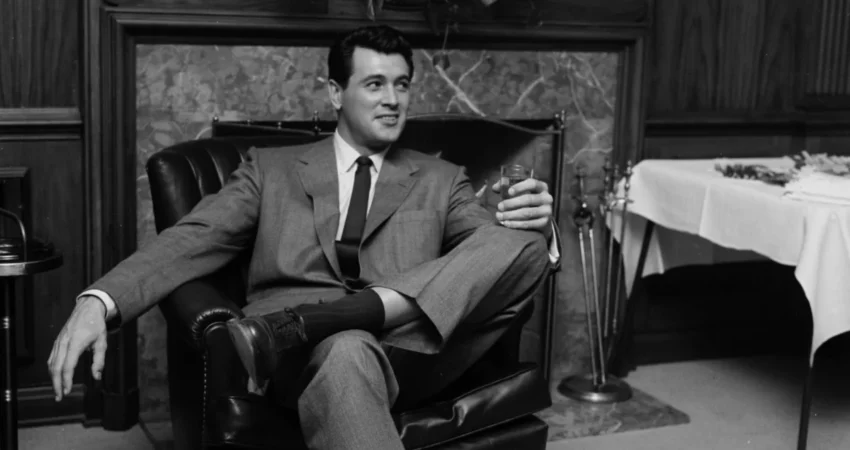
Though he is without a doubt one of the most famous faces of Tinseltown’s Golden Age, Rock Hudson’s journey to stardom began from remarkably humble beginnings. Born Roy Harold Scherer Jr. on November 17, 1925, the future movie icon spent a portion of his formative years living with his maternal grandparents in suburban Chicago. Their modest one-bedroom bungalow at 719 Center Street, a dwelling that, according to Sara Davidson’s comprehensive biography Rock Hudson: His Story, was shared by six adults and five children in its single bathroom, served as the backdrop for his early life. This stark contrast between his early environment and the opulent mansions he would later inhabit underscores the extraordinary transformation of his life.

Hudson’s meteoric rise in Hollywood was propelled by a string of critically acclaimed and commercially successful films, including the epic drama Giant, the sophisticated comedies Pillow Talk and Lover Come Back, and the poignant melodrama All That Heaven Allows. As his public profile swelled, so too did his appreciation for his various residences, which he increasingly viewed as personal refuges. “My house is the only place I really have any privacy,” Hudson once confessed in Rock Hudson: His Story. “Outside the house, everything I do is watched and talked about, but once I come in those gates, I can relax and let go. I love to work on my house; to tear down walls and lay bricks.” This profound connection to his homes offers a unique lens through which to explore the life of a man who navigated the intense glare of celebrity while seeking solace and self-expression within his private spaces. This exploration delves into ten of the film legend’s personal sanctuaries, tracing his evolution as a homeowner and revealing glimpses into his life away from the silver screen, culminating with the sprawling estate that remained his haven until his passing in 1985.
Early Residences and Shared Living
The early 1950s marked a significant period in Hudson’s burgeoning career and personal life, with his living arrangements reflecting his growing status and evolving relationships. In 1952, a photograph captured Hudson alongside actor Bob Preble outside their shared home in North Hollywood. As detailed in Rock Hudson: His Story, this period saw Hudson and Preble cohabiting across four different residences over three years. Their final shared dwelling, situated on Avenida del Sol, was a testament to forward-thinking design, featuring futuristic glass fixtures and offering breathtaking panoramic views of the valley and the surrounding mountains. This period of shared living was not without its complexities, as rumors circulated regarding the nature of their relationship. Preble himself offered a nuanced perspective in Rock Hudson: His Story, admitting to "a little experimenting" but characterizing it as nothing that could be defined as a "definite relation." He further elaborated on the intense personal boundaries he maintained, stating, "I guess he hoped the barriers would come down. The situation did come close to spilling over to something that would have been foreign to my whole being, my whole behavior. But before that happened, I left and married Yvonne." Preble eventually moved out when he married actress Yvonne Rivero, marking the end of this particular chapter in Hudson’s domestic life.

9151 Warbler Place: A Marriage and a Refuge
In 1955, Rock Hudson married Phyllis Gates, his agent Henry Willson’s former secretary and an aspiring interior designer. Their union, pictured at their Los Angeles home that same year, became a focal point of public scrutiny and private negotiation. Hudson had purchased the modest two-bedroom ranch-style house at 9151 Warbler Place, located near Sunset Boulevard, in 1954, shortly before their marriage. Gates was invited to move in with him, and the home became a shared space. Despite its relatively humble size, the house boasted a warm brick-and-wood kitchen, reflecting Gates’s noted culinary skills. Ironically, due to Hudson’s significant financial investment in acquiring the property, the living room was initially furnished with redwood lawn chairs. The focus, however, was on the heart of the home where Gates’s talents shone, with specialties like pork chops, meatloaf, and mashed potatoes with gravy reportedly delighting their guests.
The marriage itself was widely understood to be a strategic alliance, a well-orchestrated effort to conceal Hudson’s homosexuality from a public still largely unreceptive to LGBTQ+ identities. Years later, Gates spoke candidly about their union in Rock Hudson: His Story, maintaining that her affection for Hudson was genuine. "I was very much in love," she stated. "He was charming, his career was red hot, he was gorgeous, six foot six inches tall. How many women would have said no? If I had heard things about his being homosexual, I just put them in the back of my mind. So what if it was true?" The marriage, however, proved unsustainable, and the couple divorced in 1958. Gates was awarded alimony of $250 per week for ten years and retained ownership of the Warbler Place residence, then valued at $35,000, a significant sum at the time.

The Malibu Beach House: Coastal Charm and Camaraderie
Following his divorce, Hudson sought a change of scenery and relocated to a distinctive beach house in Malibu in 1958. This coastal abode, perched precariously atop stilts, became his primary residence during the filming of the 1959 hit Pillow Talk. The unique architecture meant that at high tide, the ocean waves would surge directly beneath the structure, creating a constant, visceral connection to the sea. This unconventional living situation fostered a close-knit community among its inhabitants. As recounted in Rock Hudson: His Story, Hudson formed friendships with a group of actors and stuntmen who lived nearby. Actor Don Burnett painted a vivid picture of their idyllic Malibu lifestyle, reminiscing, "We went swimming in the ocean without wetsuits all year round. We did a lot of running in the Malibu hills, then we’d come down to the beach and jump in the ocean. We went sailing and scuba diving—we taught Rock." This period of outdoor adventure and close camaraderie offered Hudson a welcome respite from the pressures of Hollywood. In the summer of 1959, he briefly moved his residence to Newport Beach before ultimately returning to the Los Angeles area.
9402 Beverly Crest Drive: A Spanish-Style Masterpiece
During the filming of the 1961 romantic comedy Lover Come Back, Universal Studios arranged for Hudson to lease a residence located conveniently close to the studio lot: 9402 Beverly Crest Drive. This property, which belonged to agent and producer Sam Jaffe, became the backdrop for photographs of Hudson at home in 1963. The exterior of the house was a striking example of classic Spanish-style architecture, characterized by its red-tile roof, stucco walls, and rich dark wood beams. Nestled on a substantial three-and-a-half-acre property, the home was dramatically situated amidst imposing cliffs.

Hudson was so enamored with the estate that he expressed a strong desire to purchase it. However, despite his burgeoning career and substantial earnings, the asking price was beyond his immediate reach. This desire became a key element in contract negotiations when Hudson’s contract with Universal expired in 1962. The studio, recognizing Hudson’s value and his attachment to the property, utilized the house as a significant bargaining chip. They proposed a deal wherein they would purchase the home from Jaffe, with the title eventually transferring to Hudson in exchange for his re-signing with the studio. Hudson readily agreed, and Universal subsequently acquired the property from Jaffe for $167,000. The title was officially transferred to Hudson five years later, solidifying his ownership of this magnificent estate.
The Transformation of "The Castle": A Personal Sanctuary
Upon acquiring 9402 Beverly Crest Drive, Rock Hudson embarked on an ambitious renovation project to transform the leased property into his personal sanctuary. Drawing inspiration from his extensive travels and his deep appreciation for architecture, Hudson immersed himself in the process. According to Rock Hudson: His Story, he diligently studied books on Mexican colonial architecture, which he referred to as his "Bibles," guiding him in realizing his vision. His design philosophy incorporated elements reminiscent of homes throughout Mexico and the American Southwest, including features such as stone archways, hand-painted tiles, robust wooden doors, and ceilings constructed from natural tree limbs.

The interior of the house became a curated reflection of Hudson’s eclectic tastes and his fascination with the exotic and the artistic. He filled the home with distinctive pieces, including striking zebra skins, captivating African masks, and imposing four-foot-tall pewter candlesticks. He affectionately dubbed the estate "The Castle," a moniker that perfectly captured its grand and imposing presence. The decorative themes extended to a notable appreciation for the natural world and the human form. The grounds were adorned with giant statues of eagles and horses, and a lion’s head fountain added a dramatic flourish. In the primary bedroom, mounted brass elephant heads served a dual purpose, their trunks ingeniously functioning as towel racks.
A recurring motif throughout the residence was the celebration of the nude male form. Hudson showcased bronze nude male sculptures by the acclaimed Mexican artist Victor Salmones on the grounds, adding an artistic and sensual dimension to the landscape. A carved nude male figure, inspired by Spanish mythology, was integrated into the headboard of his bed, serving as a personal and artistic statement. Beyond its artistic embellishments, the estate offered resort-like amenities, including a sprawling 40-foot swimming pool, a luxurious spa, a private theater for cinematic enjoyment, and an inviting outdoor fireplace, creating an environment of unparalleled comfort and entertainment.

An Open-Door Philosophy and a Green Thumb
Despite the grand scale and elaborate design of "The Castle," Hudson reportedly maintained an unusual "open-door policy," notably refusing to lock the doors of his residence. This unconventional approach to security was explained by actor George Nader in Rock Hudson: His Story. Nader suggested that Hudson’s philosophy stemmed from a desire for serendipitous encounters and a welcoming spirit: "There was always the chance of an encounter that way. He wanted the world to enter. He liked the excitement of the unknown." This sentiment extended to his enthusiastic engagement with his fans. His housekeeper, Joy, recalled Hudson’s eagerness to receive fan mail, stating he would be "at the door faster than the dogs. When the phone rang, he’d grab it. I used to say, ‘That cat will answer the phone from the casket.’” This anecdote highlights Hudson’s approachable nature and his genuine appreciation for the connection he shared with his admirers, even amidst the isolating nature of stardom.
Beyond his social inclinations, Hudson possessed a profound passion for gardening, a hobby that offered him a unique form of relaxation and creative outlet. At "The Castle," he inherited the services of Clarence Morimoto, the estate’s former gardener, and enthusiastically cultivated his own green thumb. The greenhouse was a vibrant display of botanical diversity, filled with an array of orchids, tulips, zinnias, and roses. His gardening extended to practical applications; he grew limes for his signature frozen daiquiris, mint for refreshing mint juleps, and peaches that he transformed into homemade peach ice cream each summer. The bounty of his garden also included staples like corn, squash, and tomatoes, providing fresh produce for his table.

Hudson reflected on the therapeutic nature of his horticultural pursuits, stating in Rock Hudson: His Story, "For real relaxation, there’s nothing like gardening. When I’m thinking about career decisions and working out new roles in my head, I like to go out in the garden and sweat! Where’s my nippers? Where’s my pruners? I’ll prune and water and plant, sometimes I’ll just pull weeds for hours, and be totally lost in my thoughts. If I had it all to do over again, I’d probably be a landscape architect.” This heartfelt reflection underscores the deep connection he felt to the earth and his considerable talent for cultivating beauty and sustenance.
The Final Chapter: "The Castle" as Legacy
"The Castle" served as Rock Hudson’s cherished home until his death from AIDS-related complications on October 2, 1985. A poignant photograph from January of that year captures him seated beside his pool, a serene image against the backdrop of his beloved estate. His final memorial service was held at his home, a testament to its significance as his sanctuary and a place where he felt most at ease. The service was attended by approximately 300 guests, including his esteemed Giant co-star Elizabeth Taylor, a close friend and advocate for AIDS awareness.

In the year of his passing, the property was appraised at $3 million, reflecting its substantial value and prime location. The estate later entered a new phase of ownership when Microsoft co-founder Paul Allen purchased it in 1997 for $9 million. Allen retained ownership until his death in 2018. Three years later, Allen’s estate placed the residence on the market for an impressive $55.5 million, highlighting the enduring desirability and historical significance of the property that once belonged to one of Hollywood’s most iconic figures. The journey of Rock Hudson’s homes, from a shared bungalow in Chicago to the sprawling grandeur of "The Castle," offers a compelling narrative of a life lived in the spotlight, yet deeply rooted in the personal solace and self-expression found within the walls of his private domains.

0 Comments