
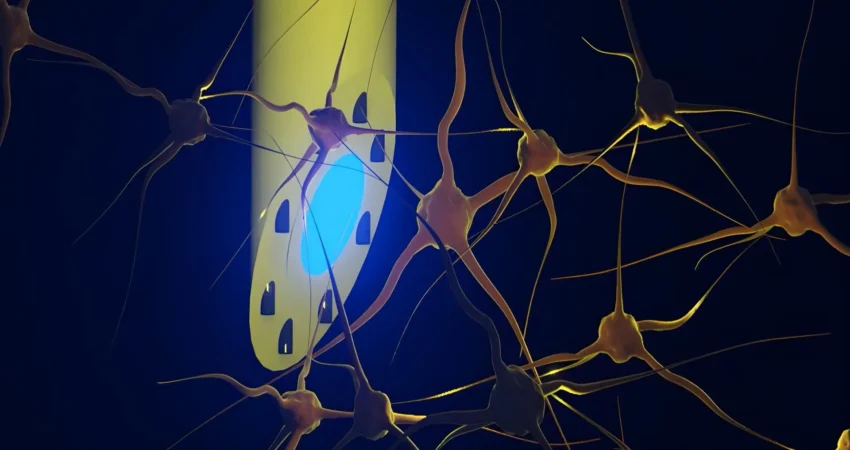
Researchers from leading institutions, including the Technical University of Denmark (DTU), the University of Copenhagen, and University College London, have unveiled a groundbreaking brain implant that promises to revolutionize the study of the brain. This innovative device, dubbed the microfluidic Axialtrode (mAxialtrode), is a slender, needle-thin electrode meticulously engineered with microscopic channels. Its unique design allows for multiple functional points along its entire length, enabling scientists to simultaneously record neural activity and precisely deliver medication to discrete locations within the brain. This advancement holds significant promise for a deeper understanding of neurological processes and may pave the way for novel treatments for conditions such as epilepsy.
The seminal findings detailing the mAxialtrode’s design and capabilities have been published in the prestigious journal Advanced Science, marking a significant milestone in neurotechnology.
A Multifaceted Tool for Unlocking Brain Mysteries
Initially, the mAxialtrode is poised to serve as an indispensable research instrument. Its ability to interact with the brain at multiple points along its axis will empower neuroscientists to investigate the intricate pathways of neural signals during complex cognitive functions. Researchers can now meticulously examine how information flows through different brain layers during processes like memory formation, decision-making, and crucially, during epileptic seizures. This granular level of observation was previously unattainable with conventional implants, which typically operate at a single point.
Looking beyond its immediate research applications, the development team envisions substantial therapeutic potential for the mAxialtrode in the long term. The implant’s capacity to deliver therapeutic agents to highly specific brain regions, coupled with its ability to simultaneously administer electrical or light-based stimulation, opens up new avenues for targeted treatments. This dual functionality could be particularly beneficial for conditions requiring precise intervention, such as chronic pain management, the modulation of mood disorders, or the precise control of aberrant neural activity in epilepsy.
Dr. Kunyang Sui, a postdoctoral researcher and one of the primary architects of the mAxialtrode concept alongside Associate Professor Christos Markos, highlighted the device’s inherent advantage: the integration of multiple capabilities within a single, minimally invasive implant. "The ability to combine several functionalities in one device is a significant leap forward," Dr. Sui stated. "This not only allows for more precise and comprehensive experiments but also dramatically reduces the number of insertions required, thereby minimizing potential trauma to brain tissue."
He further elaborated on the material science innovation: "Most existing brain implants are constructed from rigid materials like silicon. While effective for some applications, these can cause irritation and trigger inflammatory responses in the delicate brain tissue over time. The mAxialtrode, in contrast, is fabricated from soft, plastic-like optical fibers. Furthermore, its specially angled tip is designed to be smaller and less disruptive during insertion, significantly reducing mechanical damage to the neural environment."
Despite the groundbreaking nature of this technology, Dr. Sui emphasized a cautious outlook regarding its immediate clinical deployment. "We are still in the early stages of development," he cautioned. "Extensive preclinical testing, further refinement of the technology, and rigorous regulatory approvals will be necessary before the mAxialtrode can be considered for routine use in patients."
Advancing Beyond the Limitations of Conventional Optogenetics
Current brain research frequently relies on conventional optical fibers, which are typically flat-ended and made of glass or plastic. These fibers are adept at transmitting light into deep brain structures, a critical capability for optogenetics, a revolutionary technique that allows scientists to control specific neurons using light. However, these standard fibers possess a fundamental limitation: their interaction with brain tissue is largely confined to their distal tip. This means researchers can typically stimulate or monitor neural activity at only one specific location at a time.
This singular point of interaction, often referred to as the "nose" of the fiber, restricts experimental designs. For many complex brain functions, which rely on intricate communication networks spanning multiple neural layers and deeper subcortical structures, this limitation proves significant. Scientists might be able to stimulate a superficial layer of the cortex, for instance, but struggle to simultaneously monitor or influence a deeper structure like the hippocampus, even though their interplay is crucial for memory encoding. The mAxialtrode directly addresses this deficit by providing a distributed functionality along its entire length.
The Ingenious Design and Fabrication of the mAxialtrode
The creation of the needle-thin mAxialtrode begins with a much larger polymer rod. Through a carefully controlled process of heating and drawing, researchers transform this initial material into an extremely fine fiber, akin to the meticulous creation of spun sugar, but executed with unparalleled scientific precision.
At the core of this fiber lies a light-conducting channel, designed to efficiently transmit light. Encircling this central core are eight microscopic fluidic channels. These channels are not merely conduits for liquids; they are ingeniously designed to house ultra-thin metal wires. These wires are integral to the device’s functionality, enabling the measurement of electrical activity directly within the brain.
The finished mAxialtrode is remarkably slender, measuring less than half a millimeter in diameter. Its inherent flexibility is another critical design feature. Unlike rigid implants that can exert sustained pressure on brain tissue, the mAxialtrode is designed to move in concert with the brain’s natural pulsations and subtle shifts. This adaptability is crucial, as prolonged mechanical stress from stiffer implants can indeed trigger inflammatory responses and glial scarring, potentially impacting long-term device performance and tissue health.
In Vivo Validation: Demonstrating Efficacy in Living Organisms
To rigorously test the mAxialtrode’s capabilities, the research team conducted extensive "in vivo" experiments, meaning the device was implanted and tested within living animal models – specifically, mice. These studies were meticulously designed to mimic real-world research scenarios. The implanted electrodes were connected to various external systems, including light sources for optogenetic stimulation, sophisticated recording equipment for neural activity, and miniature pumps for the controlled delivery of fluids.
The results from these in vivo trials were highly encouraging. The mAxialtrode successfully demonstrated its ability to stimulate nerve cells using both blue and red light wavelengths, essential for a wide range of optogenetic experiments. Simultaneously, researchers were able to capture electrical activity from distinct brain regions, encompassing both superficial layers of the cerebral cortex and deeper structures like the hippocampus. This ability to record from multiple depths with a single implant marks a significant advancement in neurophysiological monitoring.
Furthermore, the microfluidic channels proved highly effective for drug delivery. The researchers were able to inject different substances into separate brain depths, with delivery points spaced as close as three millimeters apart. Remarkably, all these complex operations – optical stimulation, electrical recording, and multi-point fluid delivery – were performed using a single, lightweight fiber. The mice tolerated the implant and the associated apparatus with apparent ease, showing no obvious signs of discomfort or behavioral impairment, suggesting a high degree of biocompatibility and minimal impact on animal welfare.
Unlocking New Frontiers in Epilepsy Research and Broader Neuroscience
The in vivo validation and neurophysiological assessments were conducted in close collaboration with Associate Professor Rune W. Berg from the University of Copenhagen and Associate Professor Rob C. Wykes from University College London. Their specialized expertise in analyzing neural circuits and developing computational models relevant to epilepsy was instrumental in interpreting the experimental data and understanding the potential of the mAxialtrode for epilepsy research.
Epilepsy, a chronic neurological disorder characterized by recurrent seizures, arises from abnormal electrical activity in the brain. Understanding the precise origin and propagation of this aberrant activity is critical for developing effective treatments. The mAxialtrode’s ability to simultaneously record neural activity and deliver localized neuromodulatory agents at multiple depths offers an unprecedented opportunity to map seizure dynamics with exceptional fidelity and to test targeted interventions.
The research team is actively pursuing patent protection for the innovative technology behind the brain electrode. Concurrently, they are diligently exploring the necessary steps and regulatory pathways required to initiate clinical trials and eventually translate this promising technology from the laboratory bench to the patient bedside.
The Broader Impact and Future Trajectory
The development of the mAxialtrode represents a significant paradigm shift in neurotechnology. By overcoming the limitations of single-point interaction inherent in conventional brain implants, this new device empowers researchers with a level of precision and multiplexed functionality previously unimaginable.
Potential Implications for Neurological Disorders:
Beyond epilepsy, the mAxialtrode’s capacity for precise neuromodulation and drug delivery could have profound implications for a wide array of neurological and psychiatric conditions. These include:
- Parkinson’s Disease: Targeted delivery of dopamine agonists or neurotrophic factors to specific basal ganglia nuclei, combined with precise deep brain stimulation, could offer more effective symptom control with fewer side effects.
- Alzheimer’s Disease and Dementia: The implant could facilitate the study of amyloid plaque formation and tau pathology in real-time across different brain regions, and potentially enable the localized delivery of experimental therapies designed to clear these pathological proteins.
- Chronic Pain: Precise neuromodulation of pain pathways in the spinal cord or brain could offer a more targeted and less addictive alternative to current pain management strategies.
- Mental Health Disorders: The ability to precisely stimulate or inhibit specific neural circuits implicated in depression, anxiety, or addiction could lead to more personalized and effective therapeutic interventions.
Advancements in Fundamental Neuroscience:
The mAxialtrode will undoubtedly accelerate our understanding of fundamental brain processes. Researchers can now:
- Map Neural Networks with Unprecedented Resolution: Observe the flow of information and the precise timing of neuronal firing across multiple interconnected brain regions simultaneously.
- Investigate Brain Plasticity: Track how neural connections change over time in response to learning, injury, or disease.
- Develop More Sophisticated Computational Models: Provide richer, more detailed data to refine and validate computational models of brain function.
Challenges and Future Directions:
While the future appears bright for the mAxialtrode, several hurdles remain. Long-term biocompatibility studies will be crucial to assess any potential chronic immune responses or tissue degradation. Miniaturization of the external control and recording equipment will be necessary for practical clinical application. Ethical considerations surrounding the implantation of such advanced devices will also require careful deliberation and public discourse.
The successful patenting and subsequent clinical translation of the mAxialtrode will depend on continued collaboration between academic institutions, funding bodies, and potentially, commercial partners in the burgeoning field of neurotechnology. The journey from laboratory innovation to widespread clinical adoption is often lengthy, but the potential rewards – a deeper understanding of the human brain and the development of transformative treatments for debilitating neurological conditions – make this an exceptionally promising endeavor. The mAxialtrode stands as a testament to human ingenuity and a beacon of hope for millions affected by brain disorders.

0 Comments