
In 1949, fresh from a transformative tour of Scandinavia, the visionary French designer Jean Royère meticulously documented his observations for the esteemed magazine Le Décor d’Aujourd’hui. His dispatch from Stockholm offered a particularly vivid portrayal of the botanical-rich atmosphere within Svenskt Tenn, a renowned design emporium under the astute direction of Josef Frank. Royère’s prose painted a picture of an immersive, almost wild, environment: "One must lift aside vines and branches to select a candy dish," he wrote, captivated by the serendipitous integration of nature into the retail space. He further elaborated on a charming custom prevalent in Nordic countries, where climbing plants were artfully woven into interior décors. His accounts described living rooms adorned with ivy that snaked around artworks and mirrors, creating dynamic, verdant narratives across the walls. Dining rooms, he noted, featured Virginia creeper that cascaded dramatically down from chandeliers, blurring the lines between the natural world and meticulously crafted interiors. This profound appreciation for organic forms and their integration into domestic and public spaces would soon manifest in one of Royère’s most iconic and enduring creations: the Liane collection.
The Genesis of the Liane Collection: A Scandinavian Inspiration Blooms
Royère’s Scandinavian sojourn proved to be a significant catalyst for his design philosophy, particularly his embrace of natural elements. The experience in Stockholm, specifically at Svenskt Tenn, ignited an imaginative spark that would lead to the development of the Liane series. The "jungle atmosphere" he encountered was not merely an aesthetic observation; it represented a deeper exploration of how living, growing forms could be integrated into design to create environments that felt both vibrant and deeply personal.

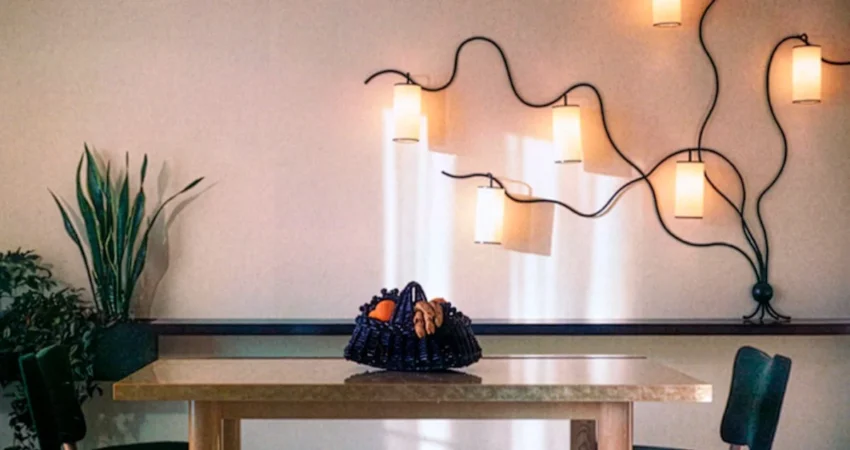
Following his return, Royère began conceptualizing designs that would embody this newfound inspiration. The Liane collection, with its French name translating to "vine" in English, was the direct artistic progeny of this experience. These were not static decorative objects; they were dynamic, sculptural pieces that mimicked the organic growth patterns of climbing plants. Crafted from hand-forged tubular steel, the lamps featured sinuous, squiggly forms that appeared to crawl across walls, their stems anchored by a base that resembled a bouquet of foliage.
Evolution of a Botanical Motif: From Wall Pieces to Chandeliers
The Liane collection did not emerge fully formed. Its development spanned several years, reflecting Royère’s iterative design process and his continuous exploration of the motif. Initially conceived as site-specific wall pieces in the mid-1950s, these designs gradually evolved into a broader range of lighting fixtures. This expansion included elaborate chandeliers, elegant sconces, and even a striking, tangled floor lamp.
What distinguished the Liane collection was not just its organic form but also its distinctive use of color and texture. Royère applied household paint in bold hues such as coral, blue, and black to the metalwork. This unconventional approach lent a unique, aged texture to the pieces, imbuing them with a sense of history and character that contrasted with the industrial nature of the material. A few select pieces were even finished in gold leaf, adding a touch of opulence to their organic structure. The cylindrical shades, an essential component of the lamps’ functionality, were meticulously crafted from cellulose acetate and often featured color-matched paper trim, further integrating them into the overall design aesthetic.

Bauhaus Echoes and Royère’s Playful Ingenuity
The use of tubular steel in Royère’s work naturally invites comparisons to the functionalist principles of the Bauhaus movement. However, Royère was never one to adhere strictly to any single design dogma. While he likely drew inspiration from the industrial material’s potential, he infused it with his signature playful and exuberant touch. His approach to tubular steel was far from austere; instead, he manipulated the material to evoke a sense of fluidity and organic movement.
Jonathan Wray, the creative director at the revived Jean Royère brand, offers insightful commentary on this aspect of Royère’s work. He notes that the decorative elements in Royère’s designs are "always structural." This statement underscores the fact that the Liane collection, despite its seemingly whimsical appearance, is rooted in sound design principles. The "wiggle" of the metal, which became progressively freer and more naturalistic over the decades, was a deliberate artistic choice that enhanced both the form and the function of the lighting. The collection’s evolution from more controlled curves in the 1930s to the unrestrained, vine-like tendrils of later pieces demonstrates a designer in constant creative dialogue with his materials and inspirations.
The revival of the Jean Royère brand in 2018 by Vladimir Markovic, the grand-nephew of Royère’s partner Micha Djordjevic, has played a crucial role in reintroducing these iconic designs to a contemporary audience. This revival ensures that Royère’s innovative spirit and his unique approach to integrating nature into design continue to be appreciated and celebrated.

The Enduring Legacy and Contemporary Relevance of Liane
The Liane collection stands as a testament to Jean Royère’s remarkable ability to blend artistic expression with functional design. His mastery of transforming industrial materials into organic forms, inspired by the natural world, has left an indelible mark on the history of interior design.
Today, as with many iconic designs, the market can be flooded with imitations. However, true connoisseurs and collectors recognize the distinctiveness and craftsmanship of original Jean Royère pieces. The brand currently offers a catalog of 35 original Liane varietals, re-fabricated in powder-coated steel with shades made from Japanese paper. While bespoke commissions are no longer offered, the availability of these authentic reproductions allows individuals to bring a piece of Royère’s artistic vision into their own spaces.
Wray’s description of a Liane piece as feeling "like a wall drawing" encapsulates the collection’s artistic merit. Each fixture is not merely a source of light; it is a sculptural statement, an expression of the designer’s hand, and a unique piece of art that brings the vitality of nature indoors. The Liane collection continues to resonate with designers and homeowners seeking to imbue their environments with a sense of organic beauty, artistic flair, and a touch of playful sophistication. It serves as a powerful reminder of how art, nature, and design can converge to create spaces that are not only functional but also deeply evocative and inspiring. The enduring appeal of the Liane collection lies in its timeless ability to capture the essence of growth and movement, transforming interiors into living sculptures.

0 Comments