
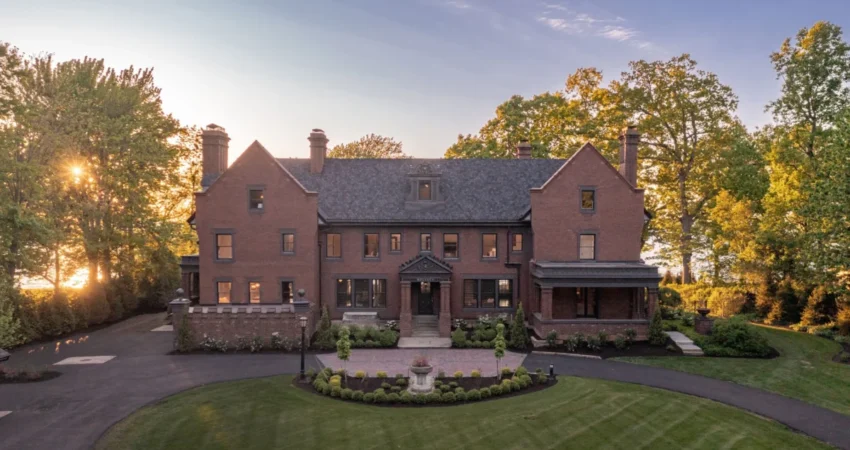
The whispers surrounding Travis Kelce’s recent acquisition of a magnificent Gilded Age mansion in the Cleveland area have ignited a fascinating narrative, one that intertwines NFL stardom, architectural grandeur, and the prolific songwriting prowess of his girlfriend, Taylor Swift. This sprawling 21,000-square-foot Tudor-style dwelling, known as Moyenage, is far more than just a lavish residence; it’s a veritable repository of history, character, and potential inspiration, much like Swift’s own Rhode Island home which famously served as the muse for her hit song "The Last Great American Dynasty."
Kelce reportedly purchased the estate for $5.35 million this spring, a move that occurred shortly after reports surfaced of the power couple actively seeking a "forever home" in the Cleveland vicinity. The property’s distinguished character and storied past have immediately drawn comparisons to Swift’s own artistic explorations of her residences. The mansion’s allure lies not only in its imposing architecture but also in the rich tapestry of stories woven into its very foundations, offering a compelling parallel to Swift’s proven ability to translate the essence of a place into chart-topping music.

David Ayers of The Agency Cleveland, one of the listing agents for the property, described Moyenage as "a real testament to a time that doesn’t exist anymore," underscoring its significance as a preserved piece of architectural history. This sentiment resonates deeply when considering Swift’s lyrical talent, which often delves into the nuances of place and time, imbuing them with emotional depth and narrative power. The prospect of Kelce’s new home becoming a backdrop for future Swiftian storytelling is a captivating one for fans and cultural observers alike.
Architects of an Era: Crafting a Gilded Age Masterpiece
The genesis of Moyenage dates back to 1902, when prominent industrialist Jay Morse commissioned the renowned Chicago architect Jarvis Hunt to design his grand estate. Jarvis Hunt, nephew of the illustrious Richard Morris Hunt, the architect behind the iconic Biltmore Estate, brought a distinguished pedigree to the project. While Hunt was not licensed to practice in Cleveland, he wisely partnered with Charles Schweinfurth, a pivotal figure in Cleveland’s architectural landscape. Angelina Bair, an architectural historian who has dedicated three years to researching the house and serves on the board of Western Reserve Architectural Historians, attests to Schweinfurth’s considerable influence, stating he was "one of the most influential architects of Cleveland."
This collaboration between two prominent architects ensured that Moyenage would be a testament to the opulence and craftsmanship characteristic of the Gilded Age. Their combined expertise resulted in a structure that not only possessed aesthetic grandeur but also adhered to the functional demands of a wealthy industrialist’s estate. The fusion of Hunt’s national reputation and Schweinfurth’s local mastery likely contributed to the mansion’s unique and enduring appeal.

A Sibling Estate and a Departure from the Norm
Interestingly, Moyenage is not the sole architectural marvel attributed to Jarvis Hunt for the Morse family. Its "older sister," the 10,000-square-foot Jacobean mansion known as the Seven Gable House in Wheaton, Illinois, was also designed by Hunt for Morse’s daughter. This estate, currently on the market for $1.75 million, served as a significant inspiration for Moyenage, with Morse reportedly cherishing the Illinois property so much that he desired a similar grandeur for his Cleveland residence.
According to Bob Goldborough, a scholar specializing in Jarvis Hunt’s work, both Moyenage and the Seven Gable House represent a notable departure from Hunt’s typical design aesthetic. While Hunt was known for his stucco-finished homes, these two brick mansions showcase a different facet of his architectural vocabulary, demonstrating his versatility and willingness to adapt his style to client preferences and regional building materials. The choice of brick for these substantial estates likely contributed to their robust and timeless appearance, further enhancing their historical significance.
A Legacy of Influence: Titans of Industry and Philanthropy
The history of Moyenage is intrinsically linked to a succession of influential figures who have called it home. Jay Morse, the original commissioner, tragically passed away from health complications just one year after the house’s completion. The estate then passed to his wife, Seville Morse. Seville was not merely the widow of a prominent industrialist; she was a formidable businesswoman in her own right, appointed as a partner at her late husband’s iron mining and shipping firm, Pickands Mather & Co. Thomas Matowitz, an architectural historian and board director of the Cleveland Architecture Foundation, highlights Seville’s business acumen, describing her as "a very skilled businessperson."

Seville Morse capably led Pickands Mather & Co. for over two decades, a remarkable achievement for a woman of that era. Beyond her corporate leadership, she was also a dedicated philanthropist. Upon her death in 1927, she bequeathed a substantial sum of $410,000 to Cleveland charities, a figure that translates to nearly $8 million in today’s currency, underscoring her profound commitment to the community. Her stewardship of Moyenage cemented its status as a residence of significant social and economic importance.
Following Seville Morse, the mansion was acquired by another industrialist of note, George Martin. Martin would go on to assume the presidency of the renowned paint and coatings company, Sherwin-Williams. His influence extended beyond the business world; during his tenure on the board of the Cleveland Indians (now the Guardians), he played a pivotal role in signing Lou Boudreau, a future Hall of Fame shortstop, a testament to his diverse interests and impact on Cleveland’s cultural landscape.
The Speakeasy Rumor: Separating Fact from Fiction
One of the most persistent and intriguing rumors surrounding Moyenage is that its third-floor ballroom once served as a clandestine speakeasy during the Prohibition era (1920-1933). This period of American history, characterized by the nationwide ban on alcohol, fostered a culture of illicit bars and hidden establishments. The timing of Seville Morse’s and George Martin’s residencies at Moyenage aligns with this era, leading to speculation about the mansion’s potential involvement in Prohibition-era activities.

However, Thomas Matowitz of the Cleveland Architecture Foundation casts doubt on this tantalizing narrative. He suggests that given the social standing and public profiles of Seville Morse and George Martin, it is highly unlikely they would have been involved in operating a speakeasy. Matowitz’s assessment, based on historical context and the known activities of the mansion’s prominent residents, points towards the speakeasy story being more of a captivating legend than a documented historical fact. He firmly states, "I doubt [Seville] was running a liquor establishment, I find that very far-fetched." While the romantic notion of a Prohibition-era speakeasy adds a layer of mystique to Moyenage, historical analysis suggests a more conventional, albeit equally distinguished, past.
A Glimpse of Hollywood: ‘Route 66’ and Cinematic Appearances
Beyond its architectural and historical significance, Moyenage has also made a brief but memorable appearance on the small screen. The mansion’s grand entryway was featured in the popular 1960s television series Route 66. A poignant scene depicts a couple sharing a kiss in the doorway, framed by the home’s stately carved pediment. This cinematic cameo offers a tangible link between the mansion’s physical presence and the cultural touchstones of its time, perhaps even echoing the romantic narratives that Taylor Swift so masterfully crafts in her music. The lyrics from Swift’s "The Last Great American Dynasty," "Well, you stood there with me in the doorway / My hands shake, I’m not usually this way," resonate with the evocative imagery of this scene, further fueling the connection between Swift’s artistry and the historical resonance of significant architectural spaces.
A Feline Fancy: Decor Touches That Might Charm Swift’s Cats
Taylor Swift’s well-documented affection for her cats is a widely known aspect of her public persona. She has described herself as "obsessed" with felines, admiring their "dignified," "independent," and "very capable" nature. This personal affinity for cats may find a surprising resonance within the opulent decor of Moyenage. While it’s uncertain if Swift’s appreciation for felines extends to a particular fondness for lions, the mansion does feature prominent lion motifs. A striking lion’s head door knocker adorns the front entrance, and a series of eight carved lions stand sentinel atop the newel posts of the grand entrance hall’s stairway. These regal embellishments add a touch of fierceness and historical gravitas to the home, and while not directly cat-related, they speak to a certain majestic aesthetic that might appeal to a lover of dignified creatures.

Further adding to the home’s historical inscriptions is the Latin phrase "In Deo solo confido," meaning "In God alone I trust," subtly carved into the structure, offering a glimpse into the philosophical underpinnings of its past inhabitants. These details, from the grand architectural elements to the subtle inscriptions, contribute to the rich narrative potential of the property, a narrative that a songwriter of Swift’s caliber might find endlessly inspiring.
Broader Implications: The Intersection of Celebrity, Real Estate, and Culture
The acquisition of a historically significant mansion like Moyenage by a celebrity couple as prominent as Travis Kelce and Taylor Swift carries several implications. Firstly, it shines a spotlight on the preservation and appreciation of Gilded Age architecture. By investing in and potentially revitalizing such a property, Kelce and Swift are contributing to the ongoing legacy of these architectural marvels, ensuring their survival for future generations.
Secondly, the association with Swift’s songwriting amplifies the cultural significance of the property. Her ability to transform personal experiences and surroundings into universally relatable narratives has a profound impact on how her fans and the wider public perceive the places she inhabits. This phenomenon, often referred to as the "Swift effect," can draw attention to historical sites and encourage a deeper engagement with local history and culture.

Furthermore, the union of sports and music royalty in the real estate market highlights the evolving landscape of celebrity influence. Beyond their respective professional domains, these figures are increasingly shaping trends in lifestyle, fashion, and even historical preservation. The story of Travis Kelce’s Gilded Age mansion is not just about a luxury purchase; it’s a narrative that bridges diverse cultural spheres, demonstrating the enduring power of place, history, and the captivating stories that emerge when they intersect with contemporary icons. The potential for this magnificent estate to inspire new lyrical narratives further solidifies its place as a property of significant cultural interest.

0 Comments