
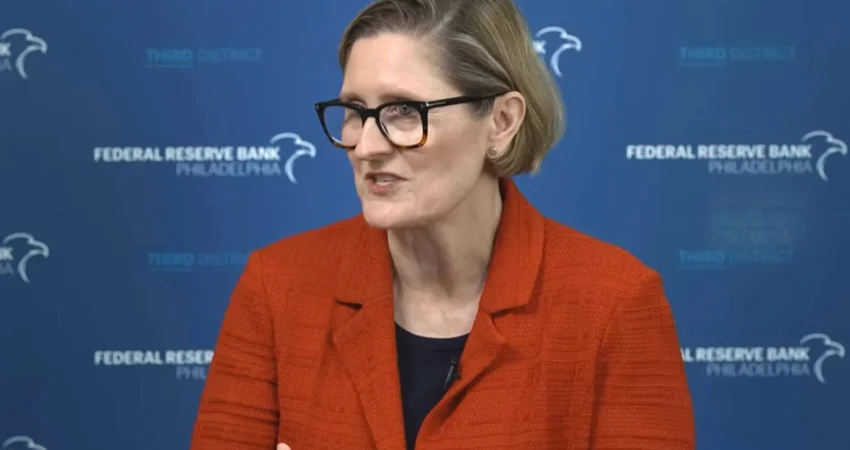
Philadelphia Federal Reserve President Anna Paulson delivered a clear message on Thursday, indicating that she and her Federal Open Market Committee (FOMC) colleagues foresee the necessity of further interest rate increases to decisively steer inflation back towards the central bank’s long-term target of 2%. Her remarks, made just a week after the FOMC implemented its latest quarter-percentage-point hike, underscore the Federal Reserve’s unwavering commitment to price stability even as signs of economic resilience persist.
The Fed’s Stance: A Call for Further Tightening
Speaking at a fintech conference within her district, Paulson articulated a cautious but firm outlook on monetary policy. She emphasized that while the recent rate hike, which elevated the benchmark federal funds rate to a target range of 3.75%-4%, moved policy "closer to what I believe is needed," it was not the final step. "Looking ahead, if conditions evolve as I expect, some modest further tightening may be warranted," Paulson stated, signaling that the current policy stance might still be insufficient to fully rein in inflationary pressures. Her comments align with a growing consensus among Fed officials that while the pace of hikes may slow, the terminal rate—the peak level of interest rates—could still be higher than initially projected.
Paulson’s assessment focused intently on the stubborn nature of underlying inflation. Despite some headline price moderation observed over the summer months, she highlighted that core inflation metrics continue to hover persistently around 2.5%-3%. This figure, significantly above the Fed’s 2% target, remains a primary concern for policymakers. "The gap has shown little signs of closing," Paulson observed, expressing palpable frustration with the slow pace of disinflation in core components. She conceded, "The best I can say about underlying inflation this year is that it hasn’t gotten worse," a remark that implicitly acknowledges the challenge of entrenched price pressures even outside of volatile energy and food sectors. She specifically noted that inflation has held higher even outside of the oil supply shocks stemming from the Iran war and associated tariffs, indicating broader economic drivers.
Chronology of Recent Monetary Policy and Economic Context
Paulson’s remarks come at a critical juncture in the Federal Reserve’s aggressive tightening cycle, which began in early 2022 to combat the highest inflation rates seen in decades. The journey from near-zero interest rates to the current range has been marked by a series of significant hikes, including multiple 75-basis-point increases, as the Fed moved swiftly to address an economy overheated by robust demand, supply chain disruptions, and substantial fiscal stimulus.
The most recent quarter-point rate hike, implemented at the FOMC meeting a week prior to Paulson’s speech, was a testament to the Fed’s continued vigilance. This adjustment brought the cumulative increase in the federal funds rate to nearly four percentage points over the past 18 months, representing one of the most rapid tightening cycles in modern economic history. The committee’s decision, while smaller in magnitude than previous moves, underscored its commitment to its dual mandate of maximum employment and price stability, with the immediate focus overwhelmingly on the latter.
Historical context is crucial to understanding the current inflationary landscape. The early 2020s witnessed unprecedented economic disruptions. Global supply chains, already strained by pandemic-induced lockdowns and shifts in consumer demand, were further exacerbated by geopolitical events. The conflict in Ukraine, while not directly referenced by Paulson, significantly impacted global energy and food prices, adding to inflationary pressures. Paulson’s mention of "oil supply shocks from the Iran war and tariffs" serves as a reminder that geopolitical factors have historically played, and continue to play, a role in shaping energy costs and, consequently, broader inflation. This complex interplay of domestic demand, supply-side constraints, and international events has made the task of inflation targeting particularly challenging for central banks worldwide.
Understanding Persistent Inflation: Beyond Headline Numbers
The distinction Paulson drew between headline inflation and underlying inflation is central to the Fed’s current strategy. Headline Consumer Price Index (CPI) and Personal Consumption Expenditures (PCE) inflation, which include volatile food and energy components, have indeed shown some signs of moderating from their mid-2022 peaks (e.g., CPI hitting a high of 9.1% in June 2022, subsequently decelerating to around 4-5% by the time of Paulson’s speech). This moderation offered a glimmer of hope that the worst of the inflationary surge might be behind us.
However, Paulson’s focus on "underlying inflation" – often measured by "core" PCE, which strips out food and energy – highlights a more stubborn problem. Core PCE, hovering around 2.5%-3% according to her assessment, indicates that price increases are broad-based and embedded across various sectors of the economy, including services, housing, and durable goods. This stickiness suggests that inflation is no longer solely a function of external shocks but is also influenced by domestic factors such as strong wage growth, tight labor markets, and robust consumer demand. For instance, while energy prices might ease, the cost of services like healthcare, education, and rents continue to climb, contributing to persistent core inflation. The "summer showed some moderating" likely refers to a period where headline inflation dipped, but core measures remained elevated, preventing the overall inflation rate from converging quickly to the Fed’s target.
Economic Resilience Amidst Tightening

Despite the significant tightening of monetary policy, Paulson offered an optimistic assessment of the broader economy. She noted that economic output "has been solid," indicating that the economy has thus far weathered the higher interest rates without falling into a deep recession. Recent GDP reports, for instance, might have shown modest but positive growth (e.g., 1-2% annualized growth), defying many earlier predictions of an imminent downturn.
The labor market, a critical component of the Fed’s dual mandate, also received a positive appraisal from Paulson, who described it as "holding steady." This assessment likely reflects continued low unemployment rates (e.g., around 3.5%-3.8%) and consistent job creation, albeit at a slower pace than the post-pandemic surge. While job openings might have decreased slightly, and wage growth showed signs of normalizing, the overall picture remained one of robust employment, providing some buffer against economic contraction. This resilience in output and employment provides the Fed with the necessary room to continue its fight against inflation without immediately jeopardizing the labor market. The ongoing debate among economists regarding a "soft landing" versus an eventual "hard landing" (recession) underscores the delicate balancing act the Fed is attempting. Paulson’s comments suggest a leaning towards the possibility of achieving a soft landing, where inflation is tamed without triggering a significant economic downturn.
Market Reactions and Forward Expectations
The implications of Paulson’s hawkish stance, combined with similar sentiments from other Fed officials, resonated immediately across financial markets. Expectations for future Fed tightening, which had already been on an upward trajectory, surged dramatically following her remarks.
One of the most visible reactions was in the Treasury market, where longer-duration bond yields climbed to highs not seen since 2004. For instance, the yield on the 10-year Treasury note, a benchmark for various lending rates including mortgages, might have surpassed 4.5% or even 5%, reflecting investors’ anticipation of higher rates for longer. This move signifies that bond market participants are increasingly convinced the Fed will need to maintain a restrictive policy for an extended period.
The CME Group’s FedWatch tool, a widely followed indicator of market-implied probabilities for future Fed actions, quickly adjusted to reflect these heightened expectations. Traders are now pricing in a 64% chance that the FOMC will implement another rate hike as early as October, following the latest meeting. Furthermore, expectations for an additional move in January have also solidified. Fed funds futures contracts are implying a terminal rate of approximately 4.8% by the end of 2027, which would suggest the market is anticipating as many as four additional quarter-point increases beyond the current level, depending on the exact timing and magnitude of future adjustments. This is a significant shift from earlier in the year when many analysts had expected the Fed to begin cutting rates by early to mid-2024.
Paulson’s comments were reinforced by New York Fed President John Williams, who earlier on the same Thursday stated that he considers it "reasonable" to expect another rate hike before the end of the year. The alignment of views among key Fed officials amplifies the market’s conviction that the central bank remains resolute in its inflation-fighting mission, even if it means enduring higher interest rates for longer than previously anticipated. The equity markets, while perhaps not experiencing an immediate dramatic sell-off, likely reacted with increased volatility, as higher interest rates can dampen corporate earnings and make equities less attractive compared to fixed-income investments. Sectors sensitive to interest rates, such as technology and real estate, would likely face particular headwinds.
Broader Economic Implications
The prospect of sustained higher interest rates, as signaled by Paulson, carries significant implications across various sectors of the economy:
- For Consumers: Higher interest rates directly translate to increased borrowing costs. Mortgage rates, already elevated, would likely climb further, impacting housing affordability and demand. Similarly, rates on credit cards, auto loans, and personal loans would see upward adjustments, potentially constraining consumer spending and increasing the financial burden on households. This could lead to a slowdown in big-ticket purchases and a more cautious approach to household budgeting.
- For Businesses: Companies face a higher cost of capital, making it more expensive to borrow for investment, expansion, and even day-to-day operations. This could lead to a slowdown in capital expenditure, reduced hiring, and potentially tighter profit margins, particularly for businesses reliant on debt financing or with significant expansion plans. Small and medium-sized enterprises (SMEs) might be particularly vulnerable to these pressures.
- Housing Market: The housing sector is acutely sensitive to interest rate changes. Higher mortgage rates dampen demand, leading to slower sales volumes, increased inventory, and potentially a cooling or even decline in home prices in some regions. Builders might also face challenges with financing new projects and selling existing inventory, impacting construction activity.
- Global Economy: A stronger U.S. dollar, often a consequence of higher U.S. interest rates, can create challenges for other economies. It makes U.S. exports more expensive and imports cheaper, potentially widening trade deficits. More significantly, it can lead to capital outflows from emerging markets as investors seek higher returns in dollar-denominated assets, putting pressure on their currencies and financial stability. Countries with significant dollar-denominated debt could face increased repayment burdens.
The Road Ahead: Balancing Act for the Fed
The Federal Reserve’s path forward remains a delicate balancing act. While Paulson’s remarks underscore the Fed’s commitment to achieving its 2% inflation target, it must simultaneously navigate the risks of over-tightening. Pushing rates too high or keeping them elevated for too long could tip the economy into a recession, leading to job losses and economic hardship. Conversely, prematurely easing monetary policy risks allowing inflation to become entrenched, necessitating even more aggressive and painful measures down the line.
The Fed’s approach will continue to be data-dependent, with each upcoming inflation report, jobs report, and GDP release scrutinized for clues about the economy’s trajectory. Policymakers will be keenly watching for sustained evidence that underlying inflation is indeed moving convincingly towards the 2% target, alongside signs that the labor market remains healthy but is cooling sufficiently to ease wage pressures. The potential for further geopolitical shocks or unexpected economic developments adds layers of complexity to this already challenging environment. The central bank’s communication strategy will also be vital in managing market expectations and guiding the economy through this period of uncertainty.
In conclusion, Anna Paulson’s latest commentary serves as a robust affirmation of the Federal Reserve’s resolute focus on combating persistent inflation. While acknowledging the economy’s current resilience, the Fed remains prepared to implement "modest further tightening" to ensure price stability. This stance reinforces market expectations for a higher-for-longer interest rate environment, with significant implications for consumers, businesses, and the broader global economy as the central bank meticulously navigates its mission to restore equilibrium.

0 Comments