
The surge in outdoor recreation across North America has brought the critical issue of camping etiquette to the forefront of environmental and social policy. As millions of individuals seek refuge in national parks, state forests, and backcountry wilderness areas, the balance between human enjoyment and ecological preservation has become increasingly precarious. Camping etiquette, often dismissed as a set of informal suggestions, actually comprises a rigorous framework designed to mitigate the "tragedy of the commons" in shared natural spaces. This framework addresses two primary pillars: the biological integrity of the ecosystem and the social harmony of the camping community.
The Ecological Imperatives of Modern Camping
The fundamental principle of wilderness preservation is the "Leave No Trace" (LNT) philosophy, which provides a data-driven approach to minimizing human impact. One of the most common misconceptions among novice campers involves the use of biodegradable soap. While marketed as environmentally friendly, these products do not break down instantaneously upon contact with water. According to the United States Geological Survey (USGS), even biodegradable surfactants require soil bacteria to facilitate decomposition. When introduced directly into streams or lakes, these chemicals can disrupt the surface tension of the water, harming aquatic insects and contributing to nitrogen loading, which fuels harmful algal blooms. Experts recommend that all washing—whether of dishes or the body—occur at least 200 feet away from any water source, allowing the soil to act as a natural filter.
Furthermore, the physical footprint of a campsite has lasting implications for local flora and fauna. The practice of pitching tents on established or durable surfaces, such as rock, gravel, or dry grasses, is a necessity driven by the slow recovery rates of trampled vegetation. In alpine or desert environments, a single footstep can destroy biological soil crusts or delicate wildflowers that may take decades to regrow. Data from the National Park Service (NPS) suggests that "social trails"—unauthorized paths created by campers—lead to significant soil erosion and the fragmentation of wildlife habitats, which can drive sensitive species away from vital water sources.
The Proliferation of Invasive Species via Firewood Transport
One of the most significant threats to North American forests is the transport of invasive insects and diseases through firewood. The United States Department of Agriculture (USDA) Animal and Plant Health Inspection Service (APHIS) has identified the movement of firewood as a primary vector for the spread of the Emerald Ash Borer, the Asian Longhorned Beetle, and Spongy Moths. These pests have caused the death of hundreds of millions of trees across the continent, leading to billions of dollars in economic losses for the timber industry and municipal management.
To combat this, camping etiquette and local regulations dictate a "buy it where you burn it" policy. Moving firewood more than 10 to 50 miles from its origin is often prohibited by state law. By utilizing local firewood or heat-treated bundles, campers prevent the introduction of pathogens into previously uninfected areas, thereby preserving the canopy for future generations.
Chronology of the Outdoor Ethics Movement
The formalization of camping etiquette has evolved over several decades in response to increasing human pressure on public lands.
- 1964: The passage of the Wilderness Act in the United States established the legal framework for protecting lands "untrammeled by man," setting the stage for strict behavioral guidelines in backcountry areas.
- 1970s: The U.S. Forest Service (USFS), Bureau of Land Management (BLM), and NPS began developing educational pamphlets in response to a 400% increase in wilderness visitation following World War II.
- 1987: A formal "Leave No Trace" program was developed through a partnership between the USFS and the National Outdoor Leadership School (NOLS).
- 1994: The Leave No Trace Center for Outdoor Ethics was established as a non-profit organization to spearhead education and research on outdoor impact.
- 2020-2022: The COVID-19 pandemic saw a historic spike in outdoor participation. According to the Outdoor Industry Association (OIA), over 7 million more Americans took up camping during this period, many of whom were unfamiliar with traditional etiquette, leading to a renewed national push for education.
Social Etiquette and the Management of Communal Space
Beyond environmental stewardship, camping etiquette governs the social interactions that allow diverse groups to coexist in close proximity. Noise pollution is a primary concern for land managers. Most established campgrounds enforce "quiet hours," typically between 10:00 PM and 6:00 AM. However, the impact of sound in the wilderness is more than a social nuisance; it is a biological stressor. Research published in Science indicates that anthropogenic noise can interfere with wildlife communication, mating rituals, and predator-prey dynamics.
Light pollution is another emerging concern. The rise of high-intensity LED lanterns and decorative string lights in campgrounds has prompted the "Dark Sky" movement to advocate for reduced artificial illumination. Excessive light not only diminishes the stargazing experience for fellow campers but also disrupts the circadian rhythms of nocturnal animals.

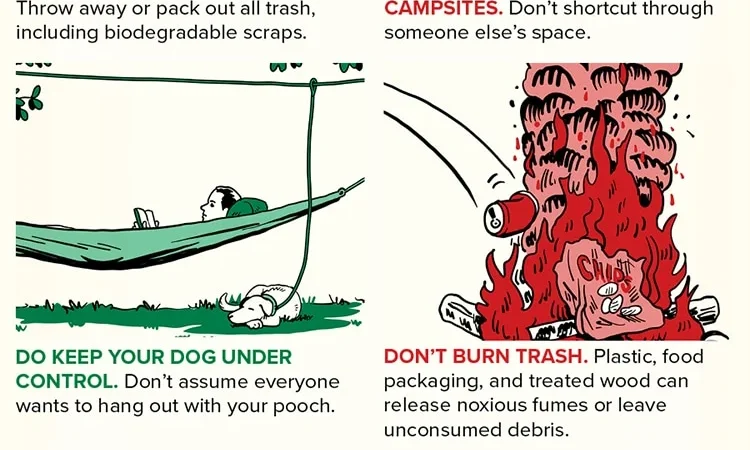
The management of pets also falls under the umbrella of social etiquette. While many campers enjoy the company of dogs, unrestrained pets can harass wildlife, contaminate water sources with waste, and cause anxiety for other visitors. Statistics from the NPS indicate that off-leash dog incidents are among the top five reasons for visitor conflict in high-traffic national parks.
Statistical Trends in Outdoor Participation
The urgency of adhering to camping etiquette is underscored by the sheer volume of participants. The 2023 Outdoor Participation Trends Report by the OIA revealed that 54% of Americans aged six and older participated in at least one outdoor activity in 2022. Camping specifically saw a diversification of its demographic, with a 22% increase in participation among minority groups and a significant rise in "urban campers" who utilize local and state parks.
This growth has a massive economic impact, with the outdoor recreation economy accounting for approximately $862 billion of the U.S. Gross Domestic Product (GDP). However, the cost of maintenance and restoration due to improper etiquette is also rising. The NPS currently faces a maintenance backlog exceeding $22 billion, a portion of which is dedicated to repairing landscapes damaged by improper use and "over-tourism."
Official Responses and Regulatory Measures
In response to the challenges of increased usage, federal and state agencies have shifted from purely educational models to more robust management strategies. Many popular destinations, such as Yosemite National Park and Glacier National Park, have implemented timed-entry reservation systems to limit the number of daily visitors and reduce the strain on infrastructure.
"Education is our first line of defense," stated a spokesperson for the National Park Service in a recent briefing on land management. "But when education fails, we must move toward regulation to ensure the resource is not lost. Etiquette is essentially the voluntary adherence to rules that keep these places open and accessible without the need for heavy-handed enforcement."
Agencies are also leveraging technology to promote etiquette. Mobile apps now provide real-time updates on trail conditions, fire bans, and campsite availability, while social media campaigns like #RecreateResponsibly aim to reach younger demographics with short-form educational content.
Broader Impact and Long-Term Implications
The implications of camping etiquette extend far beyond the boundaries of a single campsite. The collective behavior of the camping public determines the long-term viability of public lands as both ecological refuges and economic drivers. When campers fail to follow established protocols, the result is often the closure of sensitive areas, the implementation of restrictive permit systems, and the degradation of biodiversity.
Furthermore, the "human-wildlife interface" is becoming increasingly dangerous. Improper food storage—a major breach of etiquette—leads to wildlife habituation. When bears or other large mammals associate humans with food, they often become aggressive, necessitating their relocation or euthanasia. The phrase "a fed bear is a dead bear" remains a grim reminder of the consequences of poor campsite management.
In conclusion, the practice of camping etiquette is a vital component of modern environmentalism. It represents a social contract between the individual and the environment, and between the individual and the community. As the global population continues to urbanize, the psychological and physical necessity of nature becomes more pronounced. Adhering to the principles of respecting the ecosystem and fellow humans is not merely a matter of politeness; it is a prerequisite for the survival of the wilderness experience in the 21st century. Through continued education, data-driven management, and personal accountability, the tranquility and integrity of the natural world can be preserved for the generations of campers yet to come.

0 Comments