
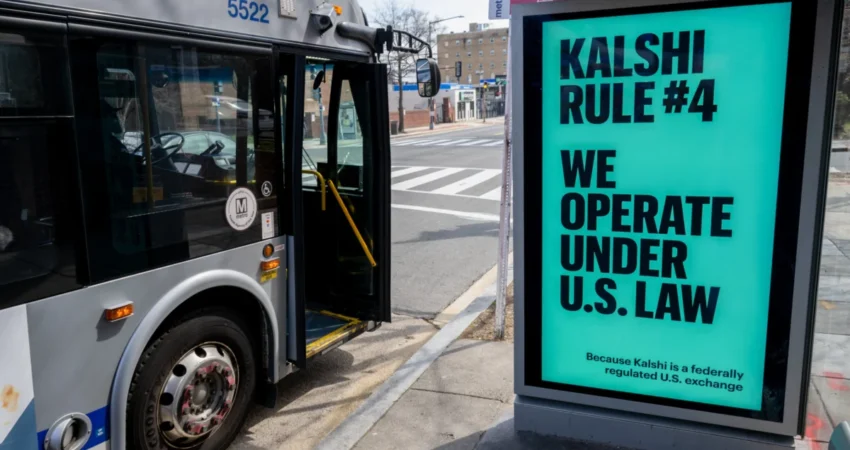
The Sixth U.S. Circuit Court of Appeals delivered a significant blow to the burgeoning prediction market industry on Friday, ruling unanimously that states possess the authority to regulate sports-related event contracts offered on platforms like Kalshi. This decision marks the second major legal defeat for the industry at the appellate level and dramatically heightens the likelihood of the U.S. Supreme Court intervening to resolve a growing federal-state jurisdictional conflict. The ruling specifically affirmed the rights of Ohio and Tennessee to apply their state gambling laws to Kalshi’s sports-related offerings, directly challenging the industry’s assertion that such contracts fall under the exclusive purview of federal financial regulators.
At the heart of this complex legal battle is the fundamental disagreement over the nature of "event contracts." Prediction market platforms, including Kalshi, contend that these contracts are a type of financial derivative known as a "swap," which, under the Commodity Exchange Act (CEA), falls within the exclusive regulatory jurisdiction of the Commodity Futures Trading Commission (CFTC). This interpretation would effectively shield them from state-level gambling regulations, allowing them to operate across state lines under a unified federal framework. States, however, vehemently disagree, arguing that sports-related event contracts are, in essence, thinly disguised forms of sports betting or gambling, and therefore should be subject to their long-established and often lucrative state gambling laws.
The Sixth Circuit’s Definitive Stance on State Sovereignty
The three-judge panel of the Sixth Circuit unequivocally rejected Kalshi’s arguments, issuing a two-pronged decision that both denied the classification of the contracts as swaps and upheld state regulatory power. "We hold that Kalshi has not shown that its sports-event contracts satisfy the statutory definition of a ‘swap’ so as to fall within the scope of the CFTC’s ‘exclusive jurisdiction,’" the court’s opinion stated. This initial finding directly undermines the foundational premise of prediction markets’ federal regulatory strategy.
However, the court went a crucial step further, addressing the broader question of federal preemption. Even if Kalshi’s sports-event contracts were to be considered swaps, the panel ruled that the CEA neither expressly nor impliedly preempts Ohio’s or Tennessee’s gambling laws. This part of the decision is particularly impactful, as it directly challenges the CFTC’s long-held assertion of "exclusive jurisdiction" over all event contracts under the CEA. The CFTC has been an active participant in this legal saga, suing nine states in an effort to defend what it perceives as its exclusive regulatory domain. The Sixth Circuit’s decision directly contradicts this federal agency’s stance, asserting that states retain significant regulatory authority over activities they deem to be gambling, irrespective of potential federal financial classifications.
The ruling has immediate practical consequences for Kalshi’s operations in the affected states. It overturns a previous decision by a federal district court in Tennessee that had sided with Kalshi, while reaffirming an earlier decision by a federal district court in Ohio that had supported the states’ argument. This legal back-and-forth underscores the deep divisions and uncertainties plaguing the prediction market landscape.
States’ Assertions and Consumer Protection Concerns
Jonathan Skrmetti, Tennessee’s Attorney General, lauded the Sixth Circuit’s decision, articulating the core concerns driving state opposition to unregulated prediction markets. "Kalshi attempted an end run around Tennessee law to avoid any of the rules or taxes associated with sports gambling. They failed," Skrmetti stated, highlighting the economic and regulatory implications for states. He further emphasized the consumer protection aspect, a cornerstone of state gambling regulations: "Sports wagering is heavily regulated because it can do a lot of harm, and I’m glad we thwarted Kalshi’s efforts to remove every safeguard and put Tennessee sports bettors at risk."
These statements reflect a broader consensus among state attorneys general and gaming commissions, who view the entry of prediction market platforms into sports-related events as a direct threat to established regulatory frameworks designed to protect consumers from addiction, fraud, and illicit financial activities. States derive substantial tax revenues from regulated sports betting, which often involves strict licensing requirements, responsible gaming initiatives, and robust oversight mechanisms. The prospect of these markets operating outside such frameworks represents both a loss of potential revenue and a perceived increase in consumer vulnerability.
At the time of reporting, neither Kalshi nor the CFTC had immediately responded to requests for comment. However, their legal filings and public statements in other cases consistently argue for the innovative nature of prediction markets, their utility as hedging tools, and the importance of a uniform federal regulatory environment to foster financial innovation. They typically maintain that event contracts, by allowing participants to hedge against future outcomes or express nuanced views on economic or political events, offer a distinct value proposition that differentiates them from traditional gambling.
A Patchwork of Rulings: A Developing Legal Landscape
The Sixth Circuit’s decision does not exist in a vacuum; it contributes to an increasingly complex and contradictory legal landscape, making Supreme Court intervention almost inevitable. The ruling aligns with a decision delivered just last month by the Ninth U.S. Circuit Court of Appeals. In that case, the Ninth Circuit ruled that Nevada also has the right to regulate sports-related event contracts, similarly concluding that they constituted sports bets rather than swaps. These two appellate court decisions establish a strong precedent for states within their respective circuits to assert regulatory authority over these types of contracts.
However, the legal picture is further complicated by an earlier ruling from the Third U.S. Circuit Court of Appeals in April. In a case involving New Jersey, the Third Circuit took an opposing view, ruling against the state and asserting that the CFTC has the exclusive right to regulate all swaps, irrespective of the specific contract type. This decision directly contradicts the fundamental conclusions reached by both the Sixth and Ninth Circuits, creating a clear "circuit split" – a scenario where different federal appellate courts arrive at conflicting interpretations of federal law.
Such a split is a primary criterion for the U.S. Supreme Court to grant a writ of certiorari, indicating its willingness to hear a case and provide a definitive, nationwide ruling. Recognizing this, New Jersey appealed the Third Circuit’s decision in a petition to the Supreme Court earlier this month. The latest ruling from the Sixth Circuit now further strengthens the case for the Supreme Court to take up the issue, as it underscores the urgent need for a unified legal standard across the country. It remains unclear whether the Supreme Court will choose to hear New Jersey’s appeal immediately, or if it will wait for additional circuit court decisions, particularly on the specific issue of sports-related event contracts, before stepping in. Given the significant implications for federalism, financial regulation, and a rapidly evolving industry, many legal observers anticipate the high court will not delay for long.
Broader Implications: Federalism, Innovation, and Consumer Protection
The ongoing legal battles and the recent appellate court decisions carry profound implications for various stakeholders.
For Prediction Market Platforms: The rulings create significant operational uncertainty and regulatory hurdles. If the Sixth and Ninth Circuit’s interpretations become the prevailing legal standard, platforms like Kalshi may be forced to either cease offering sports-related event contracts in a majority of states or dramatically restructure their offerings to comply with diverse and stringent state gambling regulations. This could entail applying for state gambling licenses, paying substantial taxes, and adhering to strict advertising and operational guidelines, potentially undermining their business model built on federal financial regulation. It might also push them to focus exclusively on non-sports events, such as those related to economic indicators, politics, or general news, where the "gambling" classification might be harder for states to apply.
For States: The decisions are a resounding victory for state sovereignty and their right to regulate activities within their borders, particularly those involving public health, safety, and welfare, traditionally areas of state concern. If states can successfully classify sports-related event contracts as gambling, it opens up a potentially significant new revenue stream through taxation, similar to the multi-billion dollar legal sports betting market that has exploded across the U.S. since the 2018 Supreme Court ruling overturning the federal ban on sports wagering. This empowers states to enforce consumer protection measures they deem necessary, ensuring responsible participation and mitigating potential societal harms.
For Federal Regulators (CFTC): The Sixth Circuit’s ruling, particularly its finding on preemption, represents a notable setback for the CFTC’s ambition to exert exclusive jurisdiction over all event contracts. If the Supreme Court ultimately sides with the states, it could significantly curtail the CFTC’s regulatory reach in emerging financial product categories, especially those that border on traditional gambling. This could lead to a more fragmented regulatory environment and necessitate closer coordination, or even competition, between federal and state agencies. It also raises questions about how the CFTC will adapt its approach to overseeing innovative financial products that challenge traditional classifications.
For the Future of Financial Innovation: The outcome of this legal dispute will undoubtedly shape the landscape for financial innovation. Proponents of prediction markets argue that these platforms offer valuable tools for price discovery, risk management, and hedging against various future events, thus promoting market efficiency. However, critics argue that without robust oversight, such markets can be susceptible to manipulation, fraud, and could encourage speculative behavior akin to problem gambling, potentially harming consumers and financial stability. The Supreme Court’s decision will determine the balance between fostering innovation under a unified federal framework and protecting consumers through state-level oversight.
The Road Ahead: Awaiting Supreme Court Intervention
The current legal climate, characterized by conflicting appellate court decisions and the increasing involvement of both state and federal authorities, strongly suggests that the Supreme Court will take up this case. The existence of a clear circuit split on such a fundamental question of federal law and state power makes it a prime candidate for review. A decision from the nation’s highest court would provide much-needed clarity on the regulatory status of prediction markets and their event contracts, offering a uniform legal standard that is currently lacking.
The process of Supreme Court review, however, is not swift. Even if the court grants certiorari, arguments would likely not be heard until the next term, with a decision following many months later. In the interim, prediction market platforms will continue to navigate a fractured regulatory environment, making business decisions under a cloud of legal uncertainty. The outcome will ultimately define the boundaries between financial derivatives and gambling, with profound implications for the future of digital markets, state revenues, and the division of regulatory authority in the United States.
Disclosure: CNBC and Kalshi have a commercial relationship that includes customer acquisition and a minority investment.

0 Comments