
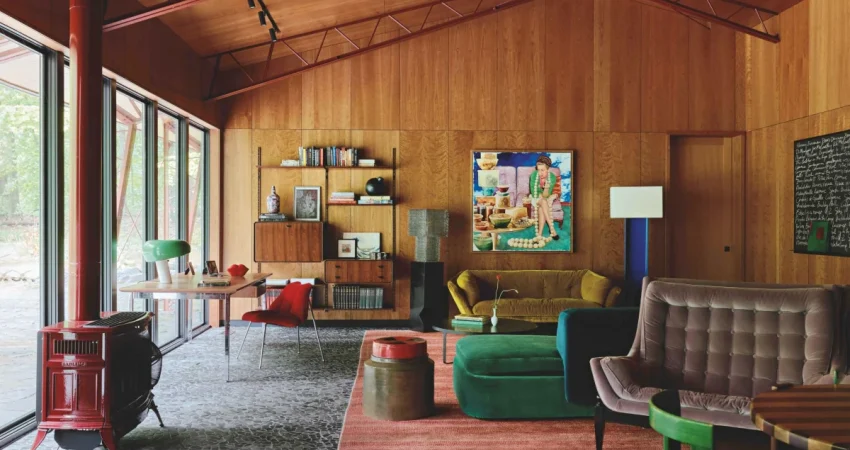
The artistic journey of internationally renowned ceramicist Sunshine Thacker has culminated in the realization of a deeply personal architectural vision—a home nestled in the verdant landscape of New York’s Hudson Valley. This dwelling, born from a vivid dream, is a testament to Thacker’s unique ability to translate abstract inspiration into tangible form, creating a space that is both resolutely contemporary and imbued with a profound sense of history and personal meaning. The house stands as a "treasure chest full of meaning," as Thacker describes it, a place where her definition of safety and belonging has been meticulously constructed from glass, iron, and wood, all oriented to capture the southern light.

"I remember closing my eyes and thinking about my definition of a safe place," Thacker shared, reflecting on the genesis of her architectural endeavor. "I imagined an elongated space with wooden walls, warm and welcoming, illuminated by a diffuse, golden light. At that moment, I had no clear architectural references, but I knew it was a place that was both modern and nostalgic." This dream, evocative in its simplicity yet profound in its emotional resonance, guided Thacker’s hands and mind as she embarked on the creation of her sanctuary.
The architectural foundation of Thacker’s home draws inspiration from significant movements and figures in 20th-century design. The structure itself, featuring a painted steel skeleton, serves as both a structural element and a decorative motif, a deliberate homage to the innovative work of French designer Jean Prouvé. Prouvé’s pioneering approach to prefabricated and demountable housing, exemplified by projects like the "Demountable House" (1944) and the "House of Better Days" (1956), resonated deeply with Thacker’s desire for practicality and elegant engineering. This influence is evident in the home’s modular grid, rendered in a striking garnet red, which rhythmically defines the exterior and interior spaces. This industrial aesthetic is juxtaposed with the warmth of cherry wood panels that clad the gabled ceiling, creating a harmonious blend of the manufactured and the organic.

Further informing Thacker’s design philosophy were the iconic Case Study houses, primarily built in California between the 1940s and 1960s. These houses, characterized by their experimental use of industrially produced materials and their pragmatic assembly methods, offered Thacker a framework for her own aspirations. "Among my earliest sources of inspiration were the Case Study houses built mainly in California," Thacker explained. "What I admire about them is their use of common, industrially manufactured components and the practicality of their assembly." This admiration translates into a home that is both structurally sound and visually coherent, where every element serves a purpose while contributing to the overall aesthetic.
The house’s construction was remarkably swift, a testament to the clarity of Thacker’s vision and the efficient execution of her design. The steel skeleton, acting as both support and ornament, was assembled with an almost effortless ease, allowing the structure to rise quickly from its woodland setting. This speed of construction, while not explicitly detailed with a timeline, suggests a well-planned and streamlined process, likely involving a dedicated team that understood and could execute Thacker’s precise specifications.

A Symphony of Materials and Influences
Thacker’s design ethos is firmly rooted in the interplay of color, material, and spatial generosity. Her home is a curated collection of elements, both found and created, that speak to her personal narrative and artistic sensibilities. The living room, for instance, is a masterclass in chromatic harmony, drawing its palette directly from the painting "The Party’s Over Darling" by artist Kim Dreyer. The colors and forms of the artwork permeate the space, influencing the choice of velvet for the seating and the selection of lighting fixtures. This creates a dynamic dialogue between absence and presence, between matte and gloss, imbuing the room with a sophisticated and layered feel.
The integration of existing furniture, pieces with sentimental value that might otherwise have been displaced, was a crucial aspect of the design. Thacker refers to this process as being orchestrated by "Mrs. Darling," a creative persona that facilitated the harmonious coexistence of disparate items. "Mrs. Darling, as we call her, was able to bring together the existing pieces of furniture that we didn’t want to part with but couldn’t figure out where to place—whether it was my mother-in-law’s Chippendale-style chair or the vermilion rug," Thacker recounted. "Mrs. Darling managed to harmonize these elements, leaving room for imagination and a play of contrasts." This approach underscores a design philosophy that prioritizes personal history and emotional connection over rigid adherence to stylistic uniformity.

The influence of Japanese art and design is subtly woven throughout the home, adding another layer of cultural richness. In the dining area, an Akari lamp by Isamu Noguchi, renowned for its delicate paper construction and ethereal glow, hangs above a custom-designed table crafted from mahogany and oak. The presence of this iconic piece, alongside two prints that echo Japanese aesthetic principles, demonstrates Thacker’s appreciation for minimalist elegance and functional artistry. Furthermore, the primary bedroom features a striking ceramic mural by Thacker herself, which serves as a headboard. This artwork is a deliberate homage to the Edo period painter Hokusai, celebrating fidelity and the warmth of the family hearth, symbolized by the motif of two cranes. This personal interpretation of Japanese art underscores Thacker’s ability to infuse her surroundings with deeply personal symbolism.
Personal Touches and Artistic Expressions
Beyond the broad architectural influences, Thacker’s home is adorned with numerous pieces of her own creation and those of artists she admires, transforming the dwelling into a living gallery. In the entryway, a custom staircase leads to a small loft space, a design element that maximizes verticality and adds an architectural focal point. The rug in this area, designed by Thacker, was meticulously crafted in Nepal, showcasing her global artistic reach. The felt bench by Liam Lee and the eclectic selection of artworks on the walls, including pieces by Ali Wiesse and James Smolleck, contribute to a vibrant and eclectic atmosphere. The Murano glass wall sconce by LA Studio adds a touch of artisanal brilliance.

The kitchen backsplash features handmade tiles also designed by Thacker, complementing the rich Rosso Lepanto marble countertop. On the shelves, she displays treasured terracotta pieces by Ron Meyers, further highlighting her connection to the ceramic arts. The living room showcases a velvet daybed designed by Thacker, demonstrating her versatility in furniture design. These handcrafted elements are not merely decorative; they are integral to the narrative of the home, each piece carrying its own story and contributing to the overall sense of lived-in authenticity.
Even the bathrooms are imbued with personal significance. The walls are entirely clad in tiles inspired by her son Ace’s childhood drawings, transforming a functional space into a canvas of familial memory. This intimate detail speaks volumes about Thacker’s desire to create a home that reflects not just her artistic vision but also the cherished relationships within her life. The floor in the primary bathroom, a three-dimensional terrazzo made of lava stone, adds a unique textural element, further emphasizing the home’s commitment to material innovation and sensory experience.

Broader Impact and Enduring Significance
Sunshine Thacker’s Hudson Valley home is more than just a residential structure; it is a profound statement about the power of dreams to shape our physical environment and the enduring connection between art, memory, and place. The house stands as a beacon of personalized design, demonstrating that a home can be a sanctuary that is both aesthetically compelling and deeply resonant with the occupant’s identity. In an era where architectural trends can often feel ephemeral, Thacker’s approach emphasizes a timeless quality, prioritizing emotional connection and personal narrative.
The implications of such a design extend beyond the individual dwelling. It serves as an inspiration for others seeking to create spaces that are not merely functional but are also extensions of their inner selves. The seamless integration of art, design, and personal history within Thacker’s home offers a compelling model for how contemporary living can embrace nostalgia and create environments that foster a profound sense of belonging. As Thacker herself states, this is a home "designed not to impress, but to reaffirm that rare sense of familiarity that, at times, even precedes memory." This sentiment encapsulates the ultimate triumph of her architectural dream—a space that feels both new and deeply, comfortingly familiar, a true reflection of the soul that built it. The successful realization of this vision, a harmonious blend of industrial modernism, personal artistry, and deep-seated nostalgia, solidifies Sunshine Thacker’s position not only as an internationally renowned ceramicist but also as a visionary architect of personal spaces.

0 Comments