
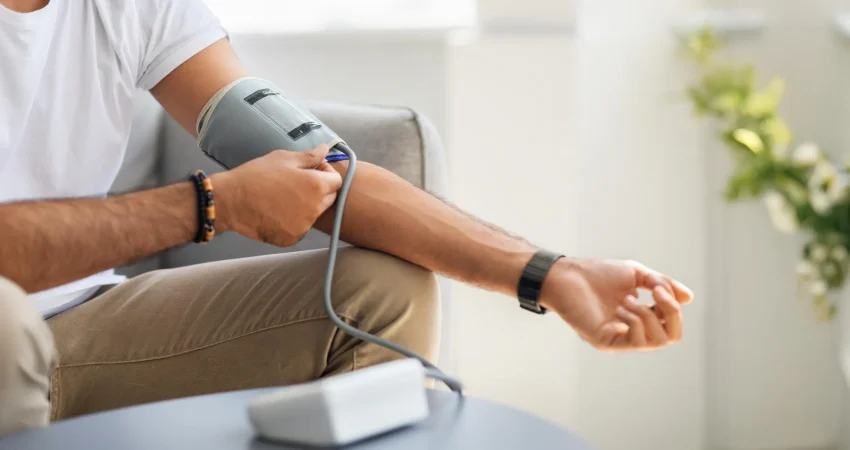
A groundbreaking study led by Johns Hopkins Medicine has revealed a critical, often overlooked factor that can significantly impact blood pressure measurements: the patient’s arm position. Researchers found that common practices during blood pressure screenings, such as resting the arm on the lap or allowing it to hang unsupported, can artificially elevate readings. This discrepancy has profound implications, potentially leading to incorrect diagnoses of hypertension, a silent but dangerous condition affecting millions.
The Subtle Swing of the Arm: Unpacking the Study’s Findings
The research, meticulously detailed in a recent publication in JAMA Internal Medicine, rigorously compared three distinct arm positions during blood pressure checks: an arm supported on a desk, an arm resting on the patient’s lap, and an arm hanging freely at the patient’s side. The findings were stark and scientifically significant. Supporting the arm on a lap increased systolic blood pressure – the "top number" representing the pressure when the heart beats – by an average of nearly 4 millimeters of mercury (mmHg). Even more pronounced was the effect of an unsupported arm hanging at the side, which led to an average systolic increase of nearly 7 mmHg.
These figures are not mere statistical curiosities. Dr. Tammy Brady, M.D., Ph.D., a leading figure in pediatric hypertension and the study’s senior author, emphasized the magnitude of this revelation. "Arm position can make a huge difference in obtaining an accurate blood pressure measurement," stated Dr. Brady, who also holds prominent positions within the Department of Pediatrics and the Welch Center for Prevention, Epidemiology, and Clinical Research at Johns Hopkins University School of Medicine. Her assertion underscores a fundamental flaw in standard measurement protocols that has gone unaddressed for too long.
The study’s conclusions strongly reinforce existing clinical guidelines from organizations like the American Heart Association (AHA), which have long advocated for the patient’s arm to be firmly supported at heart level during blood pressure measurement. Yet, the everyday reality of clinical practice, as observed by the researchers, often falls short of these recommendations.
The Silent Epidemic: The Pervasive Threat of Hypertension
Understanding the gravity of these findings requires a brief look at the prevalence and impact of high blood pressure. According to the American Heart Association, nearly half of all adults in the United States are living with elevated blood pressure. This condition, diagnosed when the force of blood against the artery walls consistently exceeds normal levels (typically around 120/80 mmHg), is often referred to as the "silent killer" because it rarely presents overt symptoms in its early stages.
Untreated, hypertension significantly elevates the risk of life-threatening cardiovascular events, including heart attacks and strokes. It can also contribute to kidney disease, vision loss, and other serious health complications. The insidious nature of hypertension makes early and accurate detection paramount. Routine medical visits serve as a critical opportunity for screening, as blood pressure can often be managed effectively through a combination of lifestyle modifications—such as weight loss, a balanced diet, and regular exercise—and, when necessary, medication.
Charting the Course for Accuracy: The AHA’s Measurement Protocol
The American Heart Association’s current clinical practice guidelines offer a comprehensive framework designed to enhance the accuracy of blood pressure measurements. These guidelines meticulously detail several crucial steps, including:
- Appropriate Cuff Size: Ensuring the cuff fits snugly and correctly around the upper arm is vital for accurate readings. An ill-fitting cuff can lead to falsely high or low measurements.
- Proper Support: The patient’s back should be supported by the chair, and their feet should be flat on the floor with legs uncrossed. This promotes relaxation and reduces extraneous muscle activity that can influence readings.
- Arm Positioning: This is the focal point of the Johns Hopkins study. The arm should be positioned at heart level, ideally supported by a desk or table. The middle of the blood pressure cuff should align with the midpoint of the upper arm, which generally corresponds to the heart’s level when seated.
Despite these clear directives, the Johns Hopkins researchers observed a common deviation in practice. Many blood pressure checks occur with patients seated on exam tables, offering minimal or no arm support. In some instances, a clinician might hold the patient’s arm, while in others, the patient is instructed to rest their arm in their lap. These variations, seemingly minor, are now understood to have significant physiological consequences on the recorded pressure.
The Johns Hopkins Study: Methodology and Participant Demographics
The rigorous investigation involved 133 adult participants, recruited between August 9, 2022, and June 1, 2023. The demographic makeup of the study group was notable, with 78% identifying as Black and 52% as female. Participants’ ages ranged from 18 to 80 years. To ensure a robust experimental design and account for potential order effects, participants were randomly assigned to one of six groups, each experiencing the three tested arm positions in a different sequence.
All measurements were conducted during a single visit, scheduled between 9 a.m. and 6 p.m. To simulate the typical pre-screening patient experience, participants were asked to empty their bladders and then walk for two minutes before resting. This preparatory phase aimed to mimic the mild exertion and transition of arriving at a clinic or medical office. Following this, participants rested in a seated position for five minutes, with their backs and feet adequately supported, ensuring a baseline state of calm.
Each participant was fitted with an upper arm blood pressure cuff selected based on the circumference of their individual upper arm, a critical step for accuracy. A digital blood pressure device was then employed to capture three sets of three measurements, with a 30-second interval between each individual reading. This multi-reading approach helps to mitigate the impact of transient fluctuations and provides a more reliable average.
Precision in Measurement: Controlled Conditions for Unbiased Results
The research team took extensive measures to ensure the precision and control of each measurement. After each group of three readings, the blood pressure cuff was removed. Participants then repeated the two-minute walking and five-minute resting sequence. This repeated preparation was crucial to resetting physiological conditions before the next set of measurements under a different arm position.
A fourth set of three measurements was taken during the same visit for each individual, this time with the arm supported on a desk. This additional measurement was incorporated to account for the known variability that can occur in blood pressure readings even under controlled conditions, providing a valuable point of comparison.
Every measurement was conducted in a quiet, private setting to minimize external distractions. Participants were also explicitly instructed to refrain from speaking with researchers or using their mobile phones during the blood pressure checks, further ensuring a state of physiological calm and focus.
Quantifying the Discrepancy: The Numbers Behind the Misdiagnosis
The study’s results definitively illustrated the significant impact of arm position. The two commonly observed clinical positions – resting the arm on the lap and leaving it unsupported at the side – consistently yielded substantially higher blood pressure readings compared to the recommended supported-on-a-desk position.
Specifically, resting the arm on the lap resulted in an overestimation of systolic blood pressure by an average of 3.9 mmHg. Diastolic blood pressure, the "bottom number" reflecting the pressure in the arteries when the heart rests between beats, was similarly overestimated by an average of 4.0 mmHg.
The effect was even more pronounced when the arm was left unsupported at the side. This position led to an overestimation of systolic pressure by a notable 6.5 mmHg and diastolic pressure by 4.4 mmHg.
The Diagnostic Chasm: How Small Deviations Lead to Big Problems
The implications of these overestimations are far-reaching and can directly impact patient care. Sherry Liu, M.H.S., an epidemiology research coordinator at the Welch Center and a study author, explained the potential diagnostic consequences. "If you are consistently measuring blood pressure with an unsupported arm, and that gives you an overestimated BP of 6.5 mmHg, that’s a potential difference between a systolic BP of 123 and 130, or 133 and 140 – which is considered stage 2 hypertension," Ms. Liu elaborated.
Stage 2 hypertension is a significant medical concern, often requiring aggressive treatment. A misdiagnosis stemming from incorrect arm positioning could lead to unnecessary medication, potential side effects, and the psychological burden of being labeled with a chronic condition when the underlying issue might be a simple positional error. Conversely, it could also lead to underdiagnosis in individuals whose true blood pressure hovers around a critical threshold, delaying necessary interventions.
The investigators acknowledge a potential limitation of their study: the findings may be specific to measurements taken with automated devices. While widely used, these devices might interact differently with physiological forces compared to manual auscultatory methods. Therefore, the results may not directly translate to readings obtained with other types of blood pressure equipment.
A Call to Action: Patient Empowerment and Clinical Adherence
Dr. Brady underscored the critical takeaway from the research: "The findings nevertheless show why clinicians should follow recommended measurement procedures more carefully." This emphasizes the need for ongoing training and adherence to established protocols within healthcare settings.
However, the responsibility does not lie solely with healthcare providers. Dr. Brady also urged patients to become active participants in their own health management. "Patients must advocate for themselves in the clinical setting and when measuring their BP at home," she stated. This empowerment includes politely inquiring about proper arm positioning and ensuring their home blood pressure monitoring devices are used correctly.
The study’s collaborative authorship includes Di Zhao, Ahmed Sabit, Chathurangi Pathiravasan, Junichi Ishigami, Jeanne Charleston, Edgar Miller III, Kunihiro Matsushita, and Lawrence Appel, all from Johns Hopkins. The research was generously supported by Resolve to Save Lives, an initiative funded by Bloomberg Philanthropies, the Bill and Melinda Gates Foundation, and Gates Philanthropy Partners, with additional support from the Chan Zuckerberg Foundation.
In conclusion, this Johns Hopkins Medicine study serves as a vital reminder that seemingly minor details in medical procedures can have profound clinical consequences. By adhering to evidence-based guidelines for arm positioning during blood pressure measurement, healthcare professionals can significantly improve diagnostic accuracy, ensure appropriate patient care, and collectively combat the silent epidemic of hypertension more effectively. Patients, in turn, are encouraged to be informed and proactive participants in this critical aspect of their health.

0 Comments