
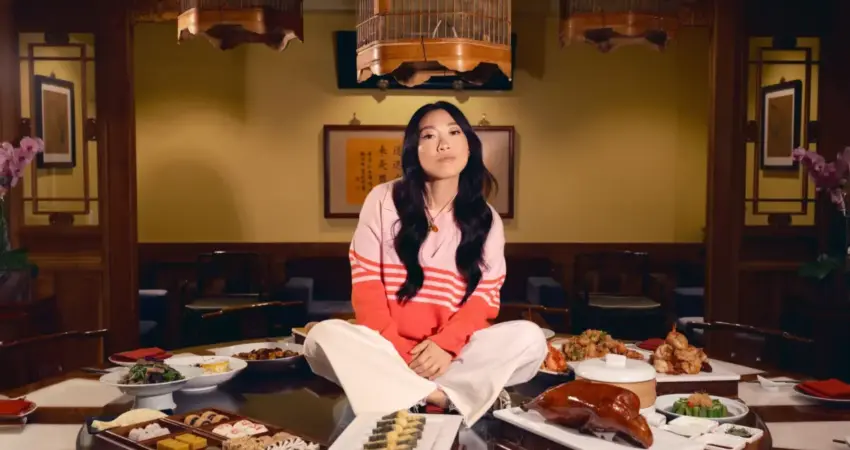
In the heart of Los Angeles, within the seemingly organized chaos of her kitchen, Nora Lum, known globally as Awkwafina, embarks on a culinary adventure that mirrors her own journey of self-discovery. The opening scene of her new docuseries, Awkwafina: The Unlikely Cook, finds the multifaceted performer—actor, comedian, and rapper—in a lighthearted battle with her stovetop. Ramen simmers precariously on one burner, while Spam aggressively sizzles on another, a domestic tableau that elicits a fond, albeit brutally honest, critique from her nonagenarian grandmother, Powah, via FaceTime: "It looks like shit." This unvarnished reality sets the stage for a series that delves into the profound connection between food, identity, and the Asian American experience, particularly for those who, like Lum, may not have grown up with a deep-seated knowledge of their culinary heritage.
The premise of the show is elegantly simple yet deeply resonant: Lum, who readily admits to a lack of traditional cooking prowess, sets out to explore the world of Asian American cuisine and its cultural significance. "Food is so important to being Asian," she states directly to the camera, articulating a sentiment that forms the bedrock of the series. "You can’t talk about being Asian without food being the thread that pulls it all together." This statement, however, carries a poignant undertone for Lum, who, at 38, finds herself confronting a personal disconnect from this foundational aspect of her identity.
A Legacy in Flushing: The Lum’s Restaurant Dynasty
Lum’s exploration is not merely an abstract quest for culinary knowledge; it is deeply rooted in her personal history and family legacy. Raised in Forest Hills, Queens, a borough she affectionately celebrated in her Comedy Central show, Awkwafina Is Nora From Queens, Lum’s connection to New York’s vibrant Asian American community is undeniable. Yet, beyond her personal experiences, she is descended from a significant lineage within the local restaurant scene.
Her great-grandfather, Jimmy Lum, established the family’s Chinese restaurant in Flushing, Queens, in 1952. This establishment was one of the earliest of its kind in the neighborhood, a pioneering venture that played a role in shaping the culinary landscape of the area. Lum recalls, "If you lived in New York, not just Queens, at a certain era, almost 10 out of 10 times, you remember Lum’s." Her sentiment is echoed by veterans of the food industry, who readily share vivid recollections of Lum’s, citing its famed pupu platters, succulent lobster egg rolls, and its distinctive, glitzy, neon-lit ambiance. These memories paint a picture of a beloved institution that was more than just a restaurant; it was a cultural touchstone for a generation of New Yorkers.
While Lum has previously explored her Korean heritage on an episode of No Taste Like Home With Antoni Porowski, her paternal family’s restaurant history remains a more distant, almost mythical, chapter. The establishment closed its doors before she was born, leaving her with a fragmented understanding of its significance. "When they talk about it, it’s like they’re talking about a long-lost family member," she muses, highlighting the emotional distance from a part of her own heritage. This yearning to connect with her roots fuels her journey in The Unlikely Cook.
The Pop-Up Revival: Reconnecting with Family Roots
The docuseries follows Lum as she engages with a diverse array of Asian American chefs and restaurateurs across the country. A central thread of the series involves her collaboration with chefs Cory Ng and Zhan Chen of New York City’s Potluck Club. Together, they embark on a project to resurrect Lum’s, albeit temporarily, as a one-night pop-up event. This ambitious undertaking serves as a tangible bridge between Lum’s past and present, allowing her to experience firsthand the legacy her family established.
This endeavor also illuminates a broader trend within the Asian American culinary world: the complex relationship between younger generations and the restaurant industry. Lum observes that many chefs she encounters are children of restaurateurs who, after initially diverging from their families’ paths, eventually find their way back to the culinary world on their own terms. "A lot of their families did not want them to go into the industry. They’re subverting the stereotype in a way," she notes. This subversion represents a redefinition of success and a reclamation of culinary heritage, often in forms that diverge from the traditional expectations of their predecessors.
Lum confesses to a long-held, albeit somewhat romanticized, aspiration: "I always dreamed of [being] the intrepid restaurant worker." However, her family’s attitude toward her involvement in cooking was far from encouraging. "Whether it was dishes or cooking, no one trusted me with it. I convinced myself that I’m just not a cook." This deeply ingrained self-perception is precisely what The Unlikely Cook seeks to challenge and ultimately dismantle.

A Culinary Road Trip: Exploring Diverse Flavors and Influences
Lum’s culinary education takes her far beyond the confines of her Los Angeles kitchen. The series chronicles her travels across the United States, showcasing a vibrant tapestry of Asian American culinary innovation. Her journey includes an immersive experience at Mister Jiu’s in San Francisco, where she witnesses the meticulous preparation of a Peking duck. She also spends time at the Culinary Institute of America in New York, gaining foundational knowledge, and embarks on a Texas barbecue tour with her friend and fellow comedian Jimmy O. Yang.
The Texas leg of her journey is particularly revealing. Stops at Curry Boys BBQ in San Antonio, a unique fusion of traditional Texas brisket served atop green Thai curry, and Eaker Barbecue in Fredericksburg, featuring bulgogi sausage, highlight the dynamic evolution of American cuisine. Lum expresses her fascination with seeing Asian influences integrated into an environment as distinctly Texan as barbecue. "Seeing Asian people in this environment that’s so Texas, where the two cultures are very different," she remarks, "broadened her perception of how chefs layer their influences in a way that wasn’t a compromise." This exploration underscores the fluidity and adaptability of culinary traditions when transplanted and reimagined in new cultural contexts.
Moments of Revelation and Unvarnished Truth
A standout episode sees Lum traveling to Hawaii for a whole-hog barbecue. There, she encounters chef Mark Noguchi, who explains the use of an imu, an underground pit oven. Lum’s immediate, and somewhat naive, question, "Like the bird?" playfully underscores her initial lack of familiarity. This moment encapsulates the show’s charm: Lum’s ignorance is a source of humor, but it also lends the series a disarming tenderness. She approaches each new experience with an open mind and a willingness to learn, even when faced with unfamiliar techniques and traditions. "It’s like one of those school nightmares where you hadn’t completed the class and then you’re just walking in for the test," she admits, acknowledging the vulnerability inherent in her learning process.
The series does not shy away from Lum’s struggles in the kitchen. Mistakes are made, and she is often put in situations that push her comfort zone. However, what emerges as a surprising revelation for Lum is the unexpected gentleness she experiences when cooking alongside professional chefs. "I’ll cook for a chef any day," she states, drawing a stark contrast with her personal life. "With my family, I’ll order out." This statement speaks volumes about her evolving relationship with cooking and the newfound confidence she has gained. The chefs, rather than being critical, often serve as patient mentors, creating an environment conducive to learning and growth.
Self-Discovery Beyond the Plate
As Lum reflects on her journey, she acknowledges that the series transcends a simple exploration of food and collective Asian culture. "As much as it was a journey of food and collective Asian culture, it was also self-discovery," she asserts. While she navigates the complexities of her heritage and the culinary world, she is also confronting her own perceptions and limitations.
The series concludes not with a definitive mastery of cooking, but with a more nuanced understanding of her place within her family’s culinary narrative and the broader Asian American food landscape. There remains an element of uncertainty, a "question mark as to what it all means," which Lum candidly acknowledges, perhaps in a "narcissistic way." This self-awareness adds another layer to her journey, suggesting that self-discovery is an ongoing process, deeply intertwined with the exploration of one’s cultural roots.
Awkwafina: The Unlikely Cook offers a compelling and often humorous look at the intersection of food, family, and identity. Through Lum’s relatable journey from culinary novice to a more confident explorer, the series celebrates the rich diversity of Asian American cuisine while reminding viewers that understanding one’s heritage can be an adventurous, and at times, delicious, undertaking. The show’s success lies not just in showcasing impressive culinary skills, but in its honest portrayal of Lum’s personal growth and her evolving relationship with the very traditions that have shaped her identity.

0 Comments