
 By Eva Lovia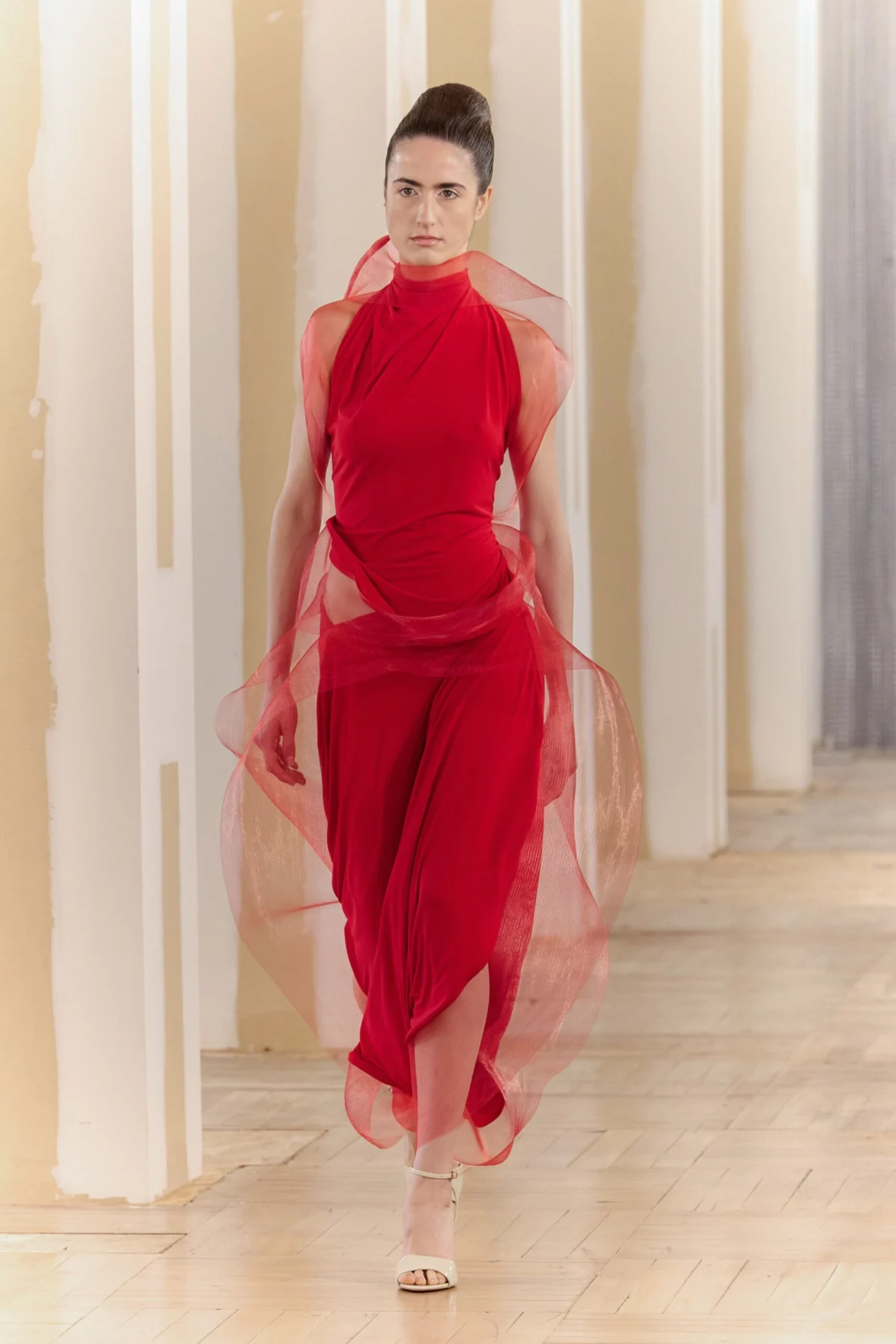
The return of Ernesto Naranjo to the official calendar of Mercedes-Benz Fashion Week Madrid (MBFWMadrid) marks a significant milestone in the designer’s career, signaling a homecoming that bridges a decade of international experience with a renewed focus on technical versatility. Naranjo, who first emerged on the Madrid scene in 2014 as a burgeoning talent from Central Saint Martins, has spent the intervening years refining a design language that reconciles the rigorous discipline of Parisian haute couture with the vibrant, emotive aesthetics of his native Andalusia. His latest collection for the Fall season serves as a testament to this evolution, moving beyond the "event designer" label to embrace a sophisticated system of modular separates, geometric patterns, and multifunctional garments that reflect a changing global luxury market.
A Decade of Evolution: From London to Paris and Back to Madrid
Ernesto Naranjo’s trajectory is a case study in the globalization of Spanish fashion. After his initial 2014 debut in Madrid while still a student, Naranjo moved to London to hone his craft at Central Saint Martins, an institution renowned for fostering radical creativity. His talent eventually led him to the studios of Maison Margiela in Paris, where he worked under the tutelage of John Galliano. This period was instrumental in shaping Naranjo’s understanding of garment construction, volume, and the narrative power of a collection.
Since founding his eponymous label and entering the world of fashion education, Naranjo has balanced the roles of creator and mentor. This dual perspective is evident in his current work, which displays a pedagogical clarity in its construction while maintaining a high level of artistic experimentation. The Fall collection represents the culmination of this ten-year journey, showcasing a designer who has mastered the technical requirements of the industry without losing the experimental spirit of his youth.
The Architectural Foundation: Circular Cuts and Geometric Precision
The cornerstone of the new collection lies in its structural philosophy. Naranjo utilized "building block" patterns based primarily on circular and square cuts, a technique that challenges traditional tailoring by allowing the fabric to dictate the silhouette through its natural drape and tension. This geometric approach resulted in what industry observers have described as "soft sculptures" on the body.
Key pieces within this framework include a reimagined Little Black Dress (LBD) and a striking two-tone cape, both of which utilize the inherent properties of the circular cut to create movement and depth. By minimizing traditional seams and relying on the mathematical precision of the patterns, Naranjo achieved a sense of fluidity that contrasts with the architectural weight of the garments. This method not only reduces fabric waste—aligning with contemporary sustainability goals—but also provides a canvas for the wearer to interact with the garment in various ways.
Versatility and the Shift Toward "Build-a-Look" Separates
In a strategic departure from his reputation as a designer of singular, high-impact event dresses, Naranjo’s latest outing emphasizes the importance of separates. This shift mirrors a broader trend in the luxury sector where consumers are increasingly seeking "investment pieces" that offer versatility across different contexts.
The collection features multifunctional items, such as tops engineered to be worn as skirts, and repurposed belts that function as dramatic, sculptural collars. This modular approach allows for a "build-a-look" philosophy, catering to a clientele that values personalization and the ability to transition from formal settings to more casual environments. Naranjo acknowledged this shift in focus, stating that while he remains an "event designer" at heart, he felt a professional necessity to step outside his comfort zone and explore the functional possibilities of daily wear.
Cultural Synthesis: Andalusian Heritage Meets Global Modernism
While the construction of the collection leans toward the avant-garde, its soul remains deeply rooted in Naranjo’s Andalusian heritage. This is most visible in the artisanal details, specifically the straw pom-poms that appeared throughout the show. These elements, peeking from the folds of pink chiffon blouses or adorning belts slung decoratively over the shoulder, are direct references to the floral arrangements traditionally worn by flamenco dancers.
By sourcing these elements from Andalusia, Naranjo reinforces a connection to local craftsmanship, a move that provides the collection with an authentic narrative hook. The use of straw—a humble, organic material—contrasts sharply with the more opulent fabrics like glittering lamé and draped jersey, creating a dialogue between the rustic traditions of Southern Spain and the high-glamour aesthetics of international fashion.
Artistic Influences: From the Gutai Movement to Studio 54
Naranjo’s creative process is heavily informed by a diverse array of artistic references, spanning from post-war Japanese avant-garde to the height of 1970s New York nightlife. The influence of the Gutai movement—a Japanese art collective known for its emphasis on the relationship between spirit, body, and matter—is reflected in the collection’s focus on the "performance" of the garment. The opening looks, featuring jersey framed with crinoline, appeared to "dance" independently of the models, embodying the Gutai principle of giving life to inanimate materials.
Furthermore, the works of artists Ángela de la Cruz and Gillian Theobald provided a framework for the collection’s exploration of form and deconstruction. De la Cruz, known for her "broken" canvases that blur the line between painting and sculpture, finds a parallel in Naranjo’s use of minimal closures and ribbon ties. These elements suggest a state of undress or a garment in transition, adding a layer of sensuality to the technical precision of the cuts.
The glamour of Studio 54 served as the primary inspiration for the collection’s more fluid pieces. Draped jersey and metallic lamés were used to evoke the hedonistic elegance of the disco era, though Naranjo filtered these through a modern lens, ensuring the results remained sophisticated rather than nostalgic.
Economic and Industry Context: The Spanish Fashion Landscape
Naranjo’s return comes at a pivotal time for the Spanish fashion industry. According to data from the Asociación Creadores de Moda de España (ACME), the design fashion sector contributes significantly to Spain’s Gross Domestic Product (GDP), representing approximately 2.8% of the national economy and over 4% of the labor market. Events like MBFWMadrid are essential for maintaining the visibility of Spanish brands in an increasingly competitive global market.
The decision to focus on separates and multifunctional garments is also a savvy economic move. Market analysis indicates that the "occasion wear" segment, while lucrative, is more susceptible to economic fluctuations than the high-end "ready-to-wear" market. By expanding his repertoire to include versatile separates, Naranjo is positioning his brand for greater commercial resilience and broader international appeal.
Chronology of the Collection’s Development
- Conceptualization (Post-Pandemic): Naranjo begins shifting his focus from purely "event-based" silhouettes to a more modular system of dressing, influenced by his time teaching and observing the changing habits of luxury consumers.
- Research and Sourcing (Andalusia): The designer spends time in his home region, collaborating with local artisans to develop the straw pom-pom embellishments and sourcing traditional materials to be used in modern contexts.
- Pattern Development (Technical Phase): Utilizing the techniques learned in London and Paris, Naranjo develops the circular and square-cut patterns that serve as the foundation for the Fall collection.
- Integration of Artistic Themes: The collection is refined through the lens of the Gutai movement and the sculptural works of Ángela de la Cruz, leading to the inclusion of crinoline-framed jersey.
- Presentation at MBFWMadrid: The collection is debuted, marking Naranjo’s first major showing in the capital since his early career, receiving acclaim for its technical maturity and emotional resonance.
Broader Impact and Industry Implications
The critical reception of Ernesto Naranjo’s Fall collection suggests a growing appetite for fashion that balances technical innovation with cultural storytelling. For the Spanish fashion industry, Naranjo represents a new generation of designers who are equally comfortable in the ateliers of Paris and the craft workshops of Andalusia. This ability to synthesize global standards with local identity is increasingly seen as the key to success for independent luxury brands.
Furthermore, Naranjo’s focus on minimal closures and the "sensuality of a stray button" points toward a broader movement in fashion away from over-engineered garments toward a more intuitive, human-centric approach to design. By allowing the fabric and the pattern to lead, Naranjo offers a vision of luxury that is both intellectually rigorous and physically liberating.
As Naranjo continues to expand his brand, his role as a bridge between the educational, technical, and creative sectors of the industry will likely grow. His successful return to Madrid Fashion Week not only solidifies his place in the Spanish fashion pantheon but also sets a high standard for how contemporary designers can navigate the complexities of heritage, craftsmanship, and modern commerce. The collection serves as a reminder that fashion, at its best, is not just about the clothes themselves, but about the evolution of the person who creates them and the culture they represent.