
 By Eva Lovia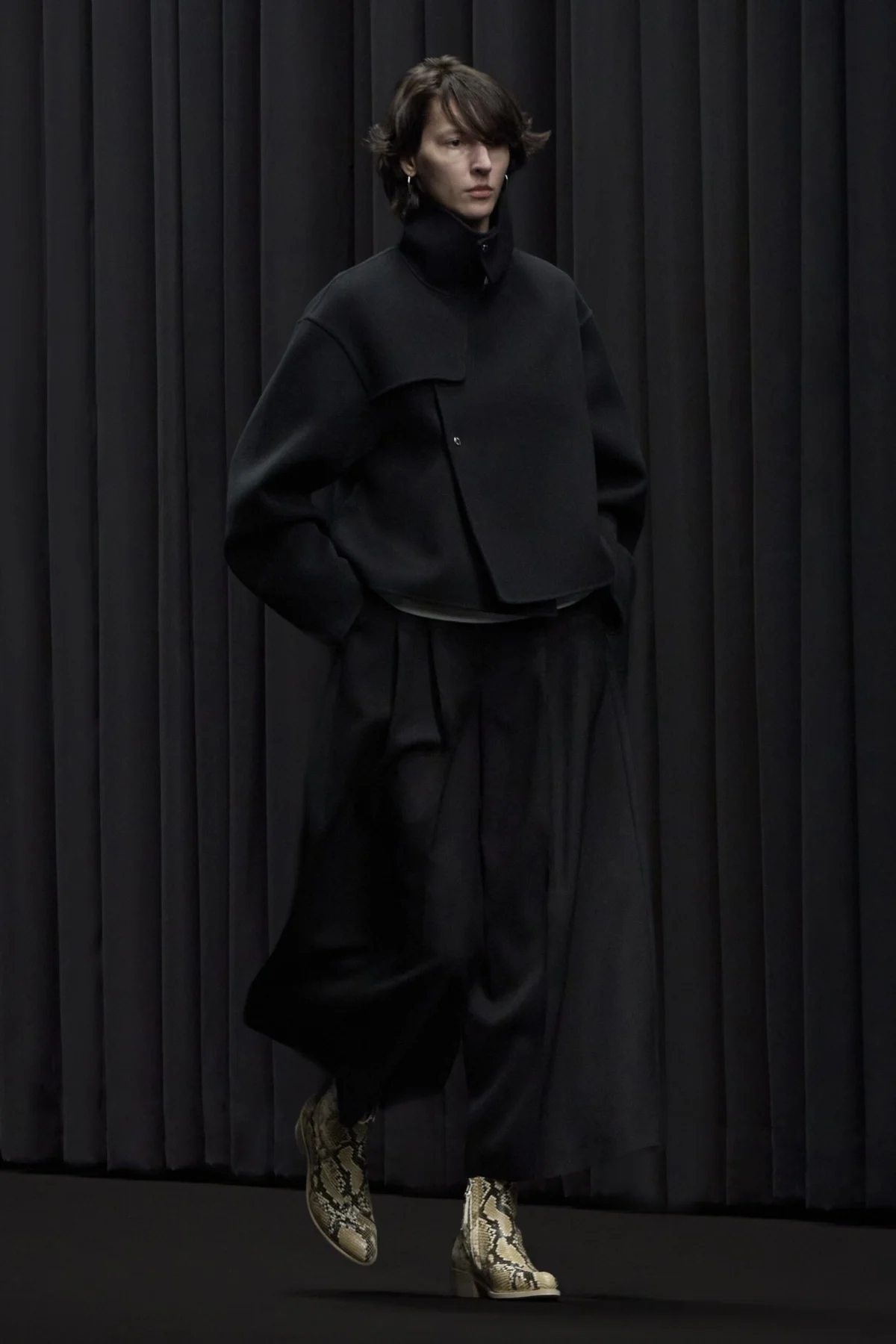
The Japanese fashion house Hyke, led by the design duo Hideaki Yoshihara and Yukiko Ode, has released its Fall/Winter 2026 collection, further cementing its reputation for meticulously deconstructing and modernizing vintage military and workwear. The latest outing, characterized by a predominantly monochromatic palette with an emphasis on deep blacks, utilizes a lookbook format set against a stark black curtain. While the lighting and color choices presented a visual challenge for casual observers, the collection revealed a sophisticated layer of tactile textures and technical precision upon closer inspection. This season continues the brand’s long-standing philosophy of "Heritage and Evolution," a concept that has guided Yoshihara and Ode since they transitioned from vintage clothing purveyors to high-fashion designers.
The Evolution of the Hyke Design Philosophy
Hideaki Yoshihara and Yukiko Ode’s background as owners of a vintage clothing store informs every stitch of the Hyke archive. Before launching the brand, the duo spent years sourcing and studying the construction of mid-century American and European garments. This "vintage otaku" (obsessive fan) approach is the bedrock of the Fall/Winter 2026 collection. Unlike many contemporary labels that merely replicate vintage silhouettes, Hyke focuses on the "update"—the process of taking a garment designed for a specific utility, such as forestry or naval operations, and re-engineering it for a modern urban environment.
The designers noted that every season represents an evolution of the same core concept. By relying on intuition to update archival pieces, they ensure that the brand remains consistent while avoiding stagnation. The Fall/Winter 2026 collection specifically highlights the designers’ ability to bridge the gap between historical accuracy and avant-garde silhouette manipulation.
Historical Reinterpretations: From the CCC to the CPO
The collection features several standout pieces that reference specific historical acronyms and organizations. A primary highlight is the reinterpretation of the Civilian Conservation Corps (CCC) logger jacket. The CCC was a voluntary public work relief program that operated from 1933 to 1942 in the United States for unemployed, unmarried men. The original jackets were designed for rugged durability in forestry and conservation work. Hyke’s version replaces the heavy, stiff canvas of the 1930s with a combination of tactile wool and a high-performance technical fabric. This juxtaposition of traditional natural fibers with modern synthetics is a hallmark of the collection.
Similarly, the collection revisits the CPO (Chief Petty Officer) jacket. Originally a staple of the U.S. Navy, the CPO jacket was traditionally a heavy wool flannel shirt-jacket designed to provide warmth and utility for high-ranking non-commissioned officers. Hyke has transformed this military staple by utilizing "shagged out" alpaca wool, providing a luxurious, high-pile texture that contrasts with the garment’s rigid, utilitarian origins.
Beyond military and workwear, the collection delved into Nordic heritage. A Fair Isle pattern was integrated into sweaters, clasp cardigans, and neck gaiters. This specific pattern was a reinterpretation of a favorite Nordic sweater belonging to Yukiko Ode. To elevate the piece from a standard knit, the designers added subtle frills at the shoulder, introducing a feminine, chic element to an otherwise sturdy, traditional aesthetic.
The Eddie Bauer Collaboration and the 1936 Skyliner
One of the most significant aspects of the Fall/Winter 2026 collection is the continued collaboration with the American heritage brand Eddie Bauer. This partnership is particularly resonant given Hyke’s obsession with clothing history. The centerpiece of this collaboration is a reinterpretation of the 1936 Skyliner Jacket.
The Skyliner holds a unique place in fashion history as the first down jacket ever patented in the United States. Eddie Bauer created the original after a near-fatal bout of hypothermia during a winter fishing trip, leading him to seek a more effective insulation method than wool. Hyke’s version of the Skyliner retains the iconic diamond quilting but adjusts the volume and proportions to align with contemporary silhouettes. By integrating this historical milestone into their collection, Yoshihara and Ode demonstrate their "superpower" of breathing new life into garments that are nearly a century old, making them relevant for a 21st-century audience.
Footwear and Accessories: Collaborative Precision
Hyke’s approach to accessories this season remains focused on specialized collaborations that prioritize craftsmanship. The footwear for Fall/Winter 2026 was developed in partnership with Beautiful Shoes, a label known for its minimalist and high-quality construction. The result included leather ankle boots and loafers that complemented the collection’s voluminous silhouettes. The footwear maintained a "studious" and grounded aesthetic, avoiding unnecessary ornamentation in favor of clean lines and premium materials.
In terms of eyewear, Hyke collaborated with Eyevan, a storied Japanese eyewear brand established in 1972. The glasses featured in the lookbook were described as "studious-looking specs," reinforcing the collection’s intellectual and technical undertones. These collaborations allow Hyke to maintain a high level of expertise across all categories of the outfit without compromising the central design vision.
Technical Analysis of Silhouettes and Materials
The Fall/Winter 2026 collection is defined by a bold play with volume and proportion. While the color palette is restrained—focusing on black, navy, and chambray blue—the interest is generated through the physical space the garments occupy.
1. Cropped and Roomy Tailoring
The collection introduced double-breasted jackets cropped high at the waist. These were styled with exceptionally roomy tailored trousers, creating a silhouette that feels both grounded and architectural. This contrast in length and volume is a recurring theme in modern Japanese design, but Hyke executes it with a specific focus on the drape of technical fabrics.
2. The Cascading Chambray
A notable departure from the heavy outerwear was a blue chambray button-up shirt. Rather than a standard fit, the garment was extended to cascade down to the ankles, blurring the line between a traditional work shirt and a formal duster or dress. This piece serves as a prime example of how the designers manipulate a humble, utilitarian fabric into something elegant and fashion-forward.
3. Fabric Composition
Data from the collection indicates a heavy reliance on high-density weaves and blended fibers. The use of alpaca wool provides thermal efficiency without the weight of traditional sheep’s wool, while the "technical-looking" fabrics suggest the inclusion of GORE-TEX or similar weather-resistant membranes, though the brand often develops its own proprietary blends to achieve a specific hand-feel.
Market Context and Industry Impact
Hyke occupies a unique position in the global fashion market. While it is deeply rooted in Tokyo’s fashion scene, its influence extends to the global "Gorpcore" and "Techwear" movements. The brand’s ability to take archival pieces and make them look "right for the moment" has made it a favorite among collectors and enthusiasts who value authenticity over fast-fashion trends.
The decision to focus on a lookbook for the Fall/Winter 2026 reveal, rather than a traditional runway show, reflects a broader shift in the industry toward digital-first storytelling. For Hyke, this format allows for a more controlled presentation of their "evolutionary" concept, even if the dark aesthetic requires the viewer to engage more deeply with the imagery to see the details.
Industry analysts suggest that Hyke’s strength lies in its consistency. In a market often driven by radical shifts in creative direction, Yoshihara and Ode’s commitment to "updating" rather than "reinventing" provides a sense of reliability for retailers and consumers alike. This approach has allowed the brand to maintain successful long-term partnerships with global entities like Adidas and Moncler in previous seasons, and now Eddie Bauer.
Chronology of the Collection’s Development
The development of the Fall/Winter 2026 collection followed a rigorous timeline of research and prototyping:
- Early 2025: Research phase. Yoshihara and Ode revisited their personal archives and sourced rare 1930s logger jackets and mid-century naval gear.
- Mid 2025: Material development. Collaboration with Japanese textile mills to create the specific "shagged" alpaca wool and technical wool blends.
- Late 2025: Prototype phase. The 1936 Skyliner was re-proportioned, and the Fair Isle patterns were digitized and modified with the shoulder frill detail.
- Early 2026: Final production and lookbook styling. The decision to use a black-on-black aesthetic was finalized to emphasize texture over color.
Conclusion and Future Implications
The Hyke Fall/Winter 2026 collection is a testament to the enduring appeal of functional design. By looking back a century to the Civilian Conservation Corps and the early innovations of Eddie Bauer, Yoshihara and Ode have created a wardrobe that feels contemporary yet timeless. The collection’s emphasis on silhouette—specifically the cropped jackets and ankle-length chambray—suggests a continued move toward experimental proportions in the "utilitarian luxury" sector.
As the designers noted, their work is an ongoing evolution. The "vintage otakus" of the future will likely look back at Hyke’s own archives with the same reverence that Yoshihara and Ode hold for the workwear of the 1930s. By prioritizing technical integrity and historical context, Hyke ensures that its garments are not merely seasonal trends, but artifacts of design that will remain relevant for generations to come. The collection successfully navigates the fine line between being a "geeky" tribute to the past and a bold statement on the future of technical fashion.