
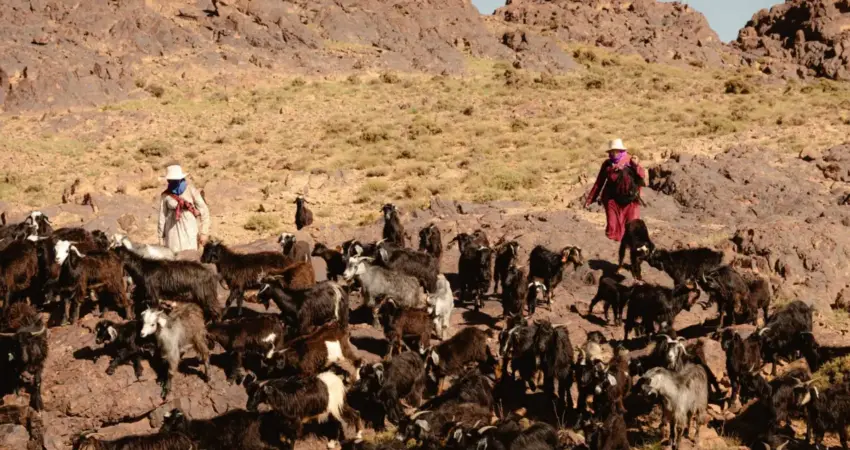
In the rugged expanse of Jebel Saghro, a volcanic landscape defined by basalt towers and deep canyons, one of the world’s oldest seasonal migrations continues despite mounting modern pressures. The Aït Atta, a historically powerful Amazigh—or "free people"—tribe of southeast Morocco, have for millennia conducted a 180-mile trek known as transhumance. This pastoral journey involves moving livestock from the parched winter pastures of Jebel Saghro to the cooler summer grazing grounds of the High Atlas Mountains. Today, this way of life faces an existential crossroads, caught between the tradition of their ancestors and the shifting socio-economic realities of the 21st century.
The Cultural Heritage of the Aït Atta
The Aït Atta confederation has long been a dominant force in the pre-Saharan regions of Morocco. Historically, they were known for their sophisticated democratic system of governance and their fierce resistance to colonial incursions, notably during the 1933 Battle of Bou Gafer. Their identity is inextricably linked to the land and their herds of goats and sheep, which serve as both their primary source of sustenance and their economic currency.

Transhumance is the heartbeat of this culture. It is not merely a move for resources but a structured social event governed by traditional rights to specific migration routes and campsites. Families like the Belâawanes, led by matriarch Telhou and her husband Hmad, represent the remaining few who maintain this cycle. The journey requires a deep, intuitive knowledge of the terrain, where "Land of Thirst" is not just a name for the Jebel Saghro, but a constant environmental reality.
The "Keepers" Collection: A New Model for Experiential Tourism
As traditional lifestyles globally face the threat of extinction, the luxury travel sector is pivoting toward "knowledge-based" tourism. Black Tomato, a pioneer in off-the-grid travel, recently launched "The Keepers," a collection of itineraries designed to immerse travelers in the lives of individuals who possess rare, inherited knowledge.

According to Black Tomato co-founder Tom Marchant, the modern traveler increasingly views human connection and the acquisition of traditional skills as the ultimate luxury. The Keepers collection includes experiences ranging from studying under a 28th-generation Daoist master in Chengdu, China, to learning the tidal patterns from a mariscador on Chile’s Chiloé Island.
In Morocco, this model allows travelers to join the Aït Atta on their migration. The experience is designed to be a "student-spectator" hybrid, where participants support the family’s journey while being supported by a sophisticated logistics team. This team often includes former nomads who have transitioned to village life but retain the skills necessary to navigate the high-altitude passes of the Atlas.

Socio-Economic Pressures and the Decline of Nomadism
The transition from a nomadic to a sedentary lifestyle is accelerating due to a confluence of legal, environmental, and social factors. Data from the region suggests a sharp decline in the number of families participating in the annual trek. Within the Ait Slilou sub-tribe, for instance, only six families made the journey to Jebel Saghro this year, a staggering drop from the upwards of 80 families that participated in previous decades.
Mandatory Education and Youth Migration
A primary driver of this shift is Morocco’s Law 51.17, enacted in 2019, which mandates school attendance for children between the ages of 6 and 16. While this legislation aims to increase literacy and economic opportunity, it simultaneously removes the "younger hands" necessary for the labor-intensive work of herding. For the Belâawane family, four of their six children are currently in school, leaving only their 17-year-old daughter, Saâdia, to assist with the arduous task of moving 200 goats across vertical scree slopes.

The Impact of Climate Change
Environmental volatility has further complicated the pastoral lifestyle. Morocco has recently endured some of its most severe droughts in decades, leading to the shrinkage of viable pastures and the drying of traditional wells. The "Land of Thirst" has become increasingly literal, forcing many families to abandon their herds in favor of permanent settlements in villages like Tagdilt or the Dades Valley. Once introduced to the modern conveniences of electricity and running water, many of the younger generation find it difficult to return to the hardships of the trail.
The Logistics of a High-Altitude Migration
The trek is a grueling physical undertaking that follows a strict daily chronology dictated by the needs of the livestock. A typical day begins before sunrise, often signaled by the vocalizations of donkeys and goats.

Daily Routine and Terrain
The caravan is a self-contained ecosystem. A standard family unit may consist of 200 goats, herding dogs, chickens for eggs, and donkeys for transporting essential supplies like tea kettles, water jugs, and blankets. The route often involves ascending passes such as Tizi n’ Tircht, which sits at an elevation of 8,200 feet.
While the men typically guide the pack animals along established dusty trails, the women and children handle the "off-roading" aspect of the migration. This involves scrambling up near-vertical cliffs to ensure the goats can graze on sparse vegetation. The rhythm is slow; the herd stops every hour to graze, meaning that while the support team may reach a campsite by early afternoon, the herders often do not arrive until dusk.

Cultural Exchange and Traditional Skills
The migration serves as a classroom for traditional Berber skills. Travelers are taught the art of making aghroum, a traditional Moroccan flatbread tossed by hand and baked over an open fire. Evenings are centered around communal meals, such as harira (a thick tomato-based soup) or couscous studded with goat meat and local vegetables. These meals are eaten from a single communal bowl, reflecting the tribe’s emphasis on collective survival and social cohesion.
Political Shifts in a Traditional Setting
Despite the remote nature of the Jebel Saghro, the Aït Atta are not insulated from national politics. The recent appointment of Morocco’s first female prime minister was a topic of significant discussion among the nomadic camps. Reactions within the tribe varied: while some men jokingly viewed it as a challenge to traditional patriarchal structures, women like Telhou expressed a quiet pride in the milestone.

This intersection of ancient lifestyle and modern political progress highlights the complex identity of the contemporary Amazigh. They are a people holding onto a millennia-old heritage while navigating a country that is rapidly modernizing and seeking a more prominent role on the global stage.
Implications for the Future
The survival of transhumance in Morocco may depend on a delicate balance between government support and sustainable tourism. The high-end, low-impact model proposed by companies like Black Tomato provides a financial incentive for families to continue their traditional practices. By turning the migration into a valuable cultural asset, it may be possible to slow the rate of sedentarization.

However, the challenges remain formidable. The "nomad way" is a life of "hard things"—finding water, protecting herds from jackals, and braving the elements. As the older generation of "Keepers" like Telhou and Hmad age, the question remains whether the cultural pride of the Aït Atta will be enough to entice the next generation to return to the mountains.
For now, the shrill bleats of goats continue to echo across the basalt towers of Jebel Saghro. The red djellabas of the matriarchs are still visible against the volcanic rock, signaling that the herd is moving, the cycle is holding, and the "free people" of the Atlas are, for another season, following the path of their ancestors.

The experience of the Aït Atta migration is available through Black Tomato’s "The Keepers" collection. The five-night, six-day journey includes private guides, deluxe glamping accommodations, and immersive cultural activities, with prices starting at $12,950 per person.

0 Comments