
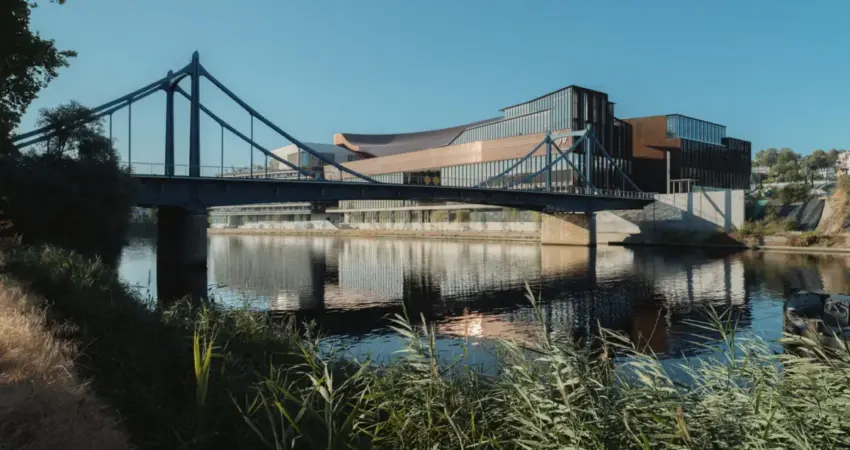
The landscape of the Parisian art world is set for a significant expansion toward the city’s southwestern periphery with the announcement of the official opening date for Large, a major new contemporary art center. Situated on the historic Île Seguin in Boulogne-Billancourt, the institution is scheduled to open its doors on October 17, 2026. This development marks a pivotal moment in the ongoing metamorphosis of the island from a former industrial powerhouse into one of Europe’s most ambitious cultural districts. Spanning 1.25 acres, the facility will provide approximately 27,000 square feet of exhibition space, positioning it as a cornerstone of the French capital’s decentralized cultural strategy.
Architectural Vision and Design Philosophy
The design of Large is the result of a high-profile collaboration between the Catalan firm RCR Arquitectes—recipients of the 2017 Pritzker Architecture Prize—and the French practice CALQ. The architectural approach emphasizes a dialogue between the island’s industrial heritage and the natural flow of the River Seine. RCR Arquitectes, known for their masterful use of light, transparency, and raw materials, have conceived a structure that plays with scale and perspective.
The building’s interior is defined by a 4,000-square-foot atrium that serves as a public gateway. From this central hub, visitors are guided through a series of monumental escalators and corridors that reveal internal views of the galleries and external vistas of the surrounding river and the hills of Meudon. A primary feature of the center is a massive, pillar-free main gallery with a ceiling height of 46 feet, designed to accommodate large-scale installations that would be difficult to house in the more traditional, constrained museum spaces of central Paris.
The choice of RCR Arquitectes reflects a broader trend in French cultural patronage, which increasingly favors architects who can blend minimalist aesthetics with environmental sensitivity. The building also incorporates several terraces, effectively extending the gallery experience into the open air and providing a panoramic connection to the Parisian skyline and the suburban landscape.

Historical Context: From Renault to RCR
To understand the significance of Large, one must look at the history of Île Seguin. For much of the 20th century, the island was the literal and symbolic heart of French industry. Between 1929 and 1992, it housed the flagship factory of the Renault Group. At its peak, the facility was a "working-class fortress," employing tens of thousands of workers and serving as a flashpoint for social movements and labor strikes that shaped modern France.
Following the factory’s closure in 1992, the island remained largely dormant for decades, sparking numerous debates over its future. Proposals ranged from high-density housing to a satellite campus for the Louvre. Ultimately, the local government of Boulogne-Billancourt and private developers opted for a "Pointe des Arts" (Arts Point) master plan. This 13-acre redevelopment project aims to turn the island into a multidisciplinary cultural destination.
Large represents the latest phase of this transformation. It joins existing landmarks such as La Seine Musicale, the Shigeru Ban-designed concert hall that opened in 2017, and a sprawling eight-screen Pathé cinema complex. By 2026, the island will also feature the Parc Gauthier Mougin, a public green space slated to display over 30 permanent sculptures, alongside a four-star hotel and various gastronomic establishments.
Inaugural Exhibition: Moteur Imaginaire
The center will launch with an exhibition titled "Moteur Imaginaire" (Imaginary Engine), curated by Cecilia Alemani. Alemani, who gained international acclaim as the curator of the 2022 Venice Biennale, has designed the show to pay direct homage to the island’s automotive past. Running from October 17, 2026, to March 7, 2027, the exhibition will explore the complex socio-technological relationship between humanity and the machine.
"The exhibition takes its inspiration from the symbolic legacy of the historic Renault factory on the Île Seguin, a site that has long been at the forefront of French industry," Alemani stated during the project’s conceptual unveiling. She noted that the automobile serves as a "catalyst for technological change, environmental transformations, urban development, and new social identities."

The exhibition will feature:
- Scale: 120 works by 55 artists representing 23 countries.
- Historical Depth: Pieces by 20th-century masters including Jean Dubuffet, Niki de Saint Phalle, Jean Tinguely, and Victor Vasarely.
- Contemporary Commissions: 17 new works specifically created for the space.
- Specific Highlights: Ghanaian artist Paa Joe and his son have crafted a hand-carved coffin modeled after the 1899 Renault Type B, while Bianca Bondi will present a Renault 12 chassis reclaimed by nature through the use of salt, water, and vegetation. Bertrand Lavier will also contribute a Renault Formula One car treated with his signature painterly style.
Economic and Social Implications
The establishment of Large is a strategic move for the Greater Paris (Grand Paris) region. By placing a high-caliber art center at the end of Métro Line 9, planners are attempting to ease the cultural congestion of the city center while stimulating the economy of the southwestern suburbs.
The business model of Large emphasizes accessibility and cultural democratization. Approximately 40% of the building’s footprint will be accessible to the public without a ticket. This includes the amphitheater-style atrium, a bookstore, a dedicated children’s art space, and "Extra Large," a café with a panoramic terrace.
Furthermore, the institution has announced an aggressive pricing policy to attract younger audiences. Entry to all exhibitions will be free for visitors aged 26 and under. This initiative aligns with broader French governmental goals to lower barriers to entry for cultural education. For the general public, full-price admission is set at 15 Euros (approximately $16.80), placing it in line with other major private foundations such as the Fondation Louis Vuitton and the Bourse de Commerce – Pinault Collection.
Timeline of Development
The path to the 2026 opening has been marked by several key milestones in the Île Seguin redevelopment:

- 1992: Renault factory officially closes.
- 2005: Demolition of the industrial buildings is completed.
- 2017: Opening of La Seine Musicale at the island’s tip.
- 2021-2023: Construction begins on the Large site following the approval of the Pointe des Arts master plan.
- 2024-2025: Installation of specialized climate control and security systems necessary for high-value art loans.
- October 17, 2026: Official public opening of Large and the "Moteur Imaginaire" exhibition.
Analysis: Paris as a Global Contemporary Art Hub
The opening of Large arrives at a time when Paris is experiencing a resurgence as a global center for contemporary art, challenging the long-standing dominance of London and New York. The success of Art Basel Paris (formerly Paris+ par Art Basel) and the presence of mega-galleries like Gagosian and Perrotin have already signaled this shift.
However, Large offers a different value proposition. Unlike the private foundations in the city center, which often focus on the personal collections of billionaires, Large is positioned as a center dedicated primarily to the French art scene and thematic, curator-led projects. By engaging with the industrial history of its site, it avoids the "white cube" sterility often criticized in modern galleries, offering instead a narrative-driven experience that connects art to labor, history, and urban evolution.
The project also benefits from the Grand Paris Express infrastructure project, which will eventually improve connectivity between the suburbs. While currently reachable via a 10-minute walk from the Pont de Sèvres station (Line 9), the long-term transport plan for the region will make the island more accessible to a wider demographic across the Île-de-France region.
Operational Information
Large will operate on a schedule designed to maximize public engagement:
- Days: Wednesday to Sunday.
- Hours: 11:00 a.m. to 7:00 p.m.
- Late Openings: Fridays until 9:00 p.m. to cater to the after-work crowd and students.
As the 2026 opening approaches, the international art community will be watching closely to see if Large can successfully bridge the gap between Paris’s prestigious past and its suburban future. By reclaiming a site once synonymous with the assembly line and repurposing it for the assembly of ideas, the project stands as a testament to the enduring power of cultural adaptive reuse.

0 Comments