
The global horological market is currently witnessing a distinct divergence in consumer behavior as the ubiquity of wearable technology, led by the Apple Watch and various fitness trackers, meets a growing counter-movement favoring traditional analog timepieces. While smartwatches have dominated the consumer electronics sector for the past decade, a significant segment of the population is revisiting the traditional wristwatch not as a primary data tool, but as a functional accessory for specific social, professional, and psychological contexts. This shift is particularly evident among users who seek a "digital detox" or a more refined aesthetic for formal occasions without committing to the high capital expenditure typically associated with luxury horology. For many, the entry point into this analog revival is the sub-$100 price bracket, a market segment that balances utility, style, and accessibility.
The Dual-Watch Paradigm: Utility vs. Aesthetics
The rise of the smartwatch, which began in earnest with the 2015 launch of the Apple Watch, fundamentally changed how individuals interact with time. By integrating notifications, health metrics, and communication tools onto the wrist, the smartwatch became an indispensable utility for millions. However, the "clunky" aesthetic and the intrusive nature of constant haptic feedback have created a niche for the traditional watch. Industry analysts note that even "power users" of smart technology often find themselves reverting to analog pieces for date nights, networking events, or periods of intentional disconnection.
The traditional watch offers a level of simplicity that modern technology cannot replicate. It does not require nightly charging, it does not interrupt conversations with notifications, and it serves as a static element of a wardrobe rather than an evolving piece of hardware. For the uninitiated or those hesitant to invest thousands in a mechanical Swiss timepiece, the sub-$100 category provides a low-risk environment to test the ergonomics and personal appeal of a traditional wrist-worn device.
A Chronological Evolution of the Wristwatch Market
To understand the current resurgence of affordable watches, one must look at the historical trajectory of the industry. The wristwatch transitioned from a military necessity in the early 20th century to a status symbol in the mid-century, before facing the "Quartz Crisis" of the 1970s. During this period, the advent of highly accurate and inexpensive quartz movements nearly decimated the traditional Swiss mechanical watch industry. However, it also democratized timekeeping, making reliable watches available to the masses for the first time.
By the early 2000s, watches had largely become fashion statements or luxury items, as the mobile phone took over the primary role of timekeeping. The introduction of the smartwatch in the mid-2010s threatened to render the entry-level analog watch obsolete. Yet, a decade later, brands like Timex, Fossil, and Skagen have maintained their relevance by leaning into heritage, minimalist design, and the "tool watch" philosophy. The current market is defined by a hybrid approach where consumers toggle between high-tech wearables for fitness and low-tech analog pieces for social and professional presentation.
Analyzing the Entry-Level Leaders: Three Case Studies
In the current market, three specific models have emerged as high-value propositions for those seeking to transition from or supplement a smartwatch. These models represent different design philosophies: the rugged field watch, the polished dress-casual watch, and the minimalist contemporary watch.
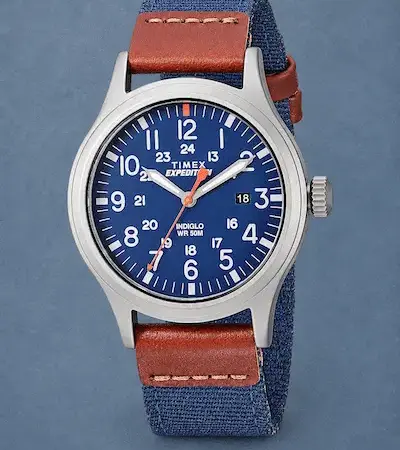
The Timex Expedition Scout: The Quintessential Field Watch
The field watch is a design born of necessity, tracing its roots back to the "trench watches" of World War I. The Timex Expedition Scout exemplifies this heritage. Its design priorities are legibility and durability, featuring a straightforward dial, prominent Arabic numerals, and a robust strap. Timex, a brand founded in 1854 as the Waterbury Clock Company, has long championed the "everyman" watch.
The Expedition Scout’s inclusion of the "Indiglo" backlight—a technology Timex introduced in 1992—remains a significant selling point in the sub-$100 category. Unlike the glowing OLED screens of smartwatches, Indiglo provides a soft, uniform light that is less disruptive in dark environments. Market data suggests that the Expedition Scout remains one of the most frequently recommended "first watches" for men due to its versatility and "no-nonsense" reputation. Its ability to garner compliments even from horological enthusiasts speaks to its successful execution of classic design principles.
The Relic Rylan: The Accessible Professional Aesthetic
Relic, a sub-brand of the Fossil Group, serves as a strategic entry point for consumers who desire the look of a substantial metal timepiece without the luxury price tag. The Relic Rylan focuses on a "dress-casual" crossover, utilizing stainless steel construction and refined dial accents, such as the diamond marker at the 12 o’clock position.
Fossil, founded in 1984, revolutionized the industry by treating watches as fashion accessories rather than just timekeeping instruments. The Rylan follows this philosophy, offering a variety of colorways—from gunmetal to classic silver tones—that allow it to transition seamlessly from a corporate environment to a formal dinner. For the professional who finds a silicone-strapped smartwatch out of place with a tailored suit, the Rylan provides a weightier, more intentional presence on the wrist.
The Skagen Signatur: The Minimalist Movement
Representing the "less is more" philosophy, the Skagen Signatur reflects the Danish design movement that emphasizes clean lines and functional simplicity. Skagen, founded in 1989 and later acquired by the Fossil Group, targets a demographic that values a slim profile. The Signatur’s thin case allows it to slide easily under a shirt cuff, a common pain point for users of bulkier smartwatches.
The minimalist aesthetic of the Signatur makes it perhaps the most versatile of the three, as it does not lean too heavily into either the rugged or the flashy. In an era of "Quiet Luxury," where consumers are moving away from overt branding and complex interfaces, the Signatur’s clean dial and subtle color pops on the hands appeal to those seeking a sophisticated but understated accessory.
Supporting Data and Market Sentiment
Recent reports from the Federation of the Swiss Watch Industry (FH) and various consumer electronics market research firms highlight a fascinating trend. While the volume of low-end Swiss watches has faced pressure from smartwatches, the "fashion watch" and "heritage" brands in the sub-$100 to $200 range have seen a stabilization. In 2023, the global watch market was valued at approximately $75 billion, with quartz-movement watches—the technology powering the Timex, Relic, and Skagen models—retaining a significant portion of the volume.
Consumer surveys indicate that the primary drivers for purchasing a traditional watch in the smartwatch era are:
- Aesthetic Variety: 42% of respondents cited the desire to match their watch with their outfit.
- Battery Independence: 35% expressed fatigue with the daily charging requirements of smart devices.
- Digital Well-being: 23% noted that wearing a traditional watch helped them check their phone less frequently, thereby reducing screen time.
Industry experts suggest that the "compliment factor" of an inexpensive traditional watch often exceeds that of a high-end smartwatch. This is attributed to the fact that smartwatches are now viewed as a standard utility, whereas a chosen analog watch is perceived as a reflection of personal style.
Official Responses and Industry Outlook
While Apple and Samsung do not officially comment on the competition from traditional watchmakers, their marketing strategies have shifted to emphasize health and safety features (such as fall detection and ECG monitoring) to differentiate their products from "passive" timepieces. Conversely, traditional brands like Timex have leaned into their history, launching "reissue" collections that capitalize on nostalgia and the timeless nature of analog gear.
Analysts at Deloitte’s Swiss Watch Industry Study have noted that "the entry-level segment is becoming a gateway for a new generation of collectors." By starting with a $50 Timex or an $80 Skagen, consumers develop an appreciation for horology that may eventually lead them to higher-end mechanical brands. This "ladder" effect is crucial for the long-term health of the traditional watch industry.
Broader Impact and Future Implications
The continued relevance of the sub-$100 traditional watch has broader implications for consumerism and sustainability. Unlike smartwatches, which have a functional lifespan of 3 to 5 years before hardware obsolescence or battery degradation renders them unusable, a quartz analog watch can last for decades with simple battery changes. This longevity appeals to a growing demographic of eco-conscious consumers who are wary of the "planned obsolescence" inherent in the tech industry.
Furthermore, the psychological impact of the "analog choice" cannot be overstated. In an age of constant connectivity, the act of wearing a device that only tells the time is a statement of intent. It represents a reclaiming of the user’s attention. Whether it is a rugged field watch for outdoor adventures or a slim minimalist piece for the office, these inexpensive timepieces prove that value is not always measured in bitrates or price tags, but in the ability of an object to serve its purpose with elegance and reliability.
As the market continues to evolve, the traditional watch is unlikely to disappear. Instead, it will coexist with the smartwatch, serving as a reminder that there is still a place for simplicity in a complex digital world. For the consumer, the availability of high-quality, affordable options means that the barrier to entry is lower than ever, allowing anyone to experience the unique satisfaction of a classic timepiece.

0 Comments