
The global watch market is witnessing a distinct behavioral shift as a growing segment of consumers, previously dedicated to wearable technology, begins to reincorporate traditional analog timepieces into their daily wardrobes. This trend, often driven by a desire for aesthetic simplicity and a reprieve from the constant connectivity of smartwatches, has revitalized the entry-level horological market, specifically for watches priced under $100. While the Apple Watch has dominated the wrist-wear landscape for the past decade, a significant portion of its user base reports a recurring need for "digital detox" periods, leading them back to the functional minimalism of quartz-driven traditional watches. Industry analysts suggest that this movement is not necessarily a rejection of technology, but rather a diversification of personal style where the smartwatch serves as a tool for fitness and productivity, while the analog watch serves as a statement of fashion and occasional disconnection.
The Evolution of Wrist-Wear: From Utility to Connectivity and Back
The history of the modern wristwatch has moved through several distinct eras, beginning with the transition from pocket watches to trench watches during World War I. For decades, the mechanical and later quartz movements defined the industry until the 2014 introduction of the Apple Watch, which fundamentally altered consumer expectations. By 2019, Apple was reportedly shipping more watches than the entire Swiss watch industry combined. However, the saturation of the smartwatch market has led to an unforeseen consequence: "notification fatigue." As users become overwhelmed by the intrusive nature of wrist-based alerts, the demand for "dumb" watches—devices that perform the singular task of telling time—has seen a measurable uptick.
This shift is characterized by a chronological return to basics. In the early 2010s, the focus was on maximizing features: heart rate monitoring, GPS, and cellular connectivity. By the early 2020s, the pendulum began to swing toward "quiet luxury" and minimalist aesthetics. For many, the high cost of entry for luxury Swiss brands like Rolex or Omega remains a barrier, creating a lucrative space for brands like Timex, Fossil, and Skagen to capture the attention of budget-conscious consumers looking for a secondary or tertiary timepiece.
Market Analysis: The Viability of the Sub-$100 Watch Tier
The sub-$100 watch category relies heavily on quartz movement technology, which was perfected in the 1970s and 1980s. Unlike mechanical movements that require intricate gears and springs, quartz watches utilize a battery and a tiny crystal of quartz to maintain highly accurate time. This allows manufacturers to produce reliable timepieces at a fraction of the cost of their mechanical counterparts. While these watches lack the "soul" or craftsmanship prized by horological purists, they offer significant value for the average consumer.
Data from retail market reports indicates that the "affordable" segment of the watch industry is sustained by three primary factors: durability, legibility, and versatility. Consumers in this bracket are typically looking for a "field watch" for rugged use, a "dress watch" for formal occasions, or a "minimalist watch" for professional environments. By keeping costs low, these manufacturers allow consumers to build a "watch wardrobe" without the financial risk associated with luxury investments.
Case Study: The Utilitarian Appeal of the Field Watch
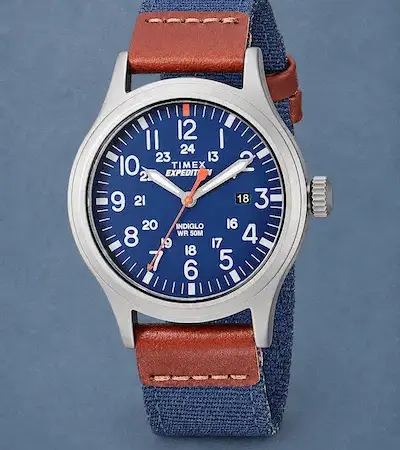
The Timex Expedition Scout represents a cornerstone of the affordable watch market, drawing on a military heritage that dates back to the early 20th century. Field watches were originally designed for soldiers who required a legible, durable, and reliable way to coordinate maneuvers. The Expedition Scout maintains these principles with a straightforward dial, high-contrast numerals, and a functional date complication.
A key technical feature of this model is the Indiglo backlight, a proprietary technology patented by Timex in 1992. This electroluminescent panel allows the entire dial to be illuminated, a feature that many users find more practical than the fading luminosity found on more expensive analog watches. Market feedback suggests that the Timex Expedition Scout is frequently cited as a "gateway" watch for smartwatch users. Its lightweight construction and unassuming design provide a stark contrast to the bulky, screen-heavy profile of a modern smartwatch, making it a preferred choice for casual wear and outdoor activities.
The Bridge Between Fashion and Horology: Fossil and Relic
The Fossil Group has long occupied a unique position in the market, acting as a bridge between high-fashion brands and traditional watchmaking. Its subsidiary line, Relic, is positioned specifically for the entry-level consumer. The Relic Rylan model exemplifies the "dressier" side of the budget market. Utilizing stainless steel cases and bracelets, these watches mimic the aesthetic of luxury "sport-luxury" watches while maintaining a price point accessible to the general public.
The Rylan features design elements such as contrasting markers and subtle dial accents, including small diamond-style markers, which aim to provide a sense of intentionality in dressing. Analysts note that for many men, a metal-link watch serves as a rite of passage into professional attire. The Relic line allows for this transition without the four-figure price tag of a high-end stainless steel watch. By focusing on "shelf appeal" and a substantial feel on the wrist, Fossil captures a demographic that prioritizes appearance and the tactile experience of a traditional watch over movement complexity.
Minimalism as a Response to Digital Overload: The Skagen Influence
Skagen, a brand founded in 1989 and later acquired by the Fossil Group, represents the "Danish Modern" school of design. The Skagen Signatur model focuses on a slim profile and a clean, uncluttered dial. This design philosophy is particularly appealing to the "minimalist" movement that has gained traction on social media and in lifestyle circles over the last decade.
The Signatur’s thin case is a deliberate engineering choice, allowing the watch to sit low on the wrist and slide easily under the cuff of a dress shirt—a common complaint among users of thicker smartwatches. The use of sandblasted dials and simple leather straps reflects a broader trend in industrial design that favors "less is more." For the consumer attempting a digital detox, the Skagen Signatur provides a visual "calm" that a glowing OLED screen cannot replicate.
Official Responses and Industry Perspectives
While the major Swiss conglomerates (such as the Swatch Group or Richemont) rarely comment directly on the sub-$100 market, their actions suggest an awareness of its importance. The 2022 release of the "MoonSwatch"—a $260 collaboration between Swatch and Omega—proved that there is a massive appetite for affordable versions of iconic designs.
Market analysts at firms like Deloitte, in their annual Swiss Watch Industry Study, have noted that the "entry-level" segment is crucial for "recruiting" the next generation of watch enthusiasts. "If a consumer begins with a $50 Timex or an $80 Skagen and finds they enjoy the experience of wearing a traditional watch, they are statistically more likely to upgrade to a mid-tier or luxury mechanical watch later in life," the report suggests.
Furthermore, representatives from Timex have publicly stated that their goal is to provide "honest timepieces." This positioning leans into the authenticity movement, where consumers are increasingly looking for products that do not track their data or require nightly charging. The simplicity of a 10-year battery life in a quartz watch is now being marketed as a feature of convenience, ironically competing with the "convenience" of a smartwatch.
Broader Impact and Future Implications
The continued relevance of the affordable analog watch has broader implications for both the tech and fashion industries. For the tech industry, it signals a "feature ceiling" where adding more sensors and screens to a wearable device may eventually yield diminishing returns in consumer satisfaction. There is a growing recognition that "constant connectivity" has psychological costs, and the analog watch has become a symbol of the "right to disconnect."
For the fashion industry, the resurgence of affordable watches reinforces the idea that style is not strictly tied to price. The fact that a $50 watch can garner compliments from high-net-worth individuals, such as financial advisors or executives, suggests that the "social currency" of a watch is often tied to its design and how well it fits the wearer’s persona, rather than its horological pedigree.
Looking forward, the market is likely to see a continued "hybridization" of collections. The modern consumer is unlikely to abandon the smartwatch entirely; instead, they will treat it as a specialized tool for the gym or the office, while maintaining a collection of affordable analog watches for weekends, evenings, and travel. This "bimodal" approach to wrist-wear ensures that the traditional watch industry will not only survive the digital age but thrive as a necessary aesthetic and psychological counterweight to it.
In conclusion, the transition from a high-tech smartwatch to a budget-friendly analog timepiece is more than a simple change in accessories; it is a reflection of a wider cultural negotiation with technology. By offering durability, style, and a break from the digital grind, the sub-$100 watch market remains a vital and growing sector of the global economy, proving that in a world of infinite data, sometimes the most valuable thing a device can do is simply tell the time.

0 Comments