
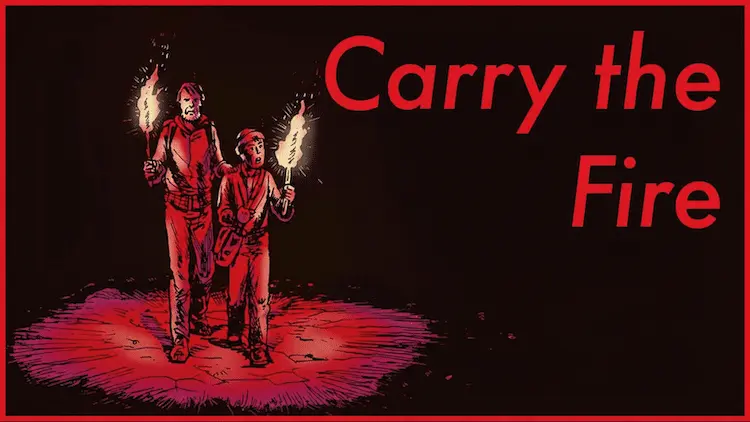
Cormac McCarthy’s 2006 novel, The Road, has transcended its origins as a work of post-apocalyptic fiction to become a foundational text in modern literary discussions regarding fatherhood, ethics, and the preservation of human civilization. Awarded the Pulitzer Prize for Fiction in 2007, the novel depicts an unnamed father and son traversing a desolate, ash-covered American landscape following an unspecified cataclysm. While the setting is one of extreme deprivation and horror, the central narrative mechanism is the "fire" the characters claim to carry—a multifaceted metaphor for moral integrity, hope, and the transmission of values between generations. This concept has resonated deeply with readers, particularly fathers, who view the story not merely as a survivalist tale, but as a somber meditation on the responsibilities of a parent to instill virtue in an increasingly cynical world.
The Narrative Core and the Metaphor of the Fire
The plot of The Road is deceptively simple: a man and his young son walk toward the coast in hopes of finding a warmer climate. They push a shopping cart filled with meager supplies, constantly evading "bad guys"—marauding gangs who have turned to cannibalism and slavery in the absence of food and law. The man is terminally ill, coughing up blood throughout the journey, which adds a ticking-clock element to his mission. His primary goal is not just the physical survival of his son, but the preservation of the boy’s soul.
The recurring dialogue regarding "carrying the fire" serves as the novel’s moral anchor. In McCarthy’s sparse, punctuation-light prose, the fire represents the spark of humanity that distinguishes the "good guys" from the "bad guys." It is the refusal to succumb to nihilism or the savage pragmatism that would justify harming others for one’s own gain. For the father, the fire is his son; the boy is frequently described in divine terms, as a "golden chalice" or a "tabernacle." For the son, the fire is an internal light that he must learn to tend once his father is gone. This dynamic transforms a bleak survival story into a high-stakes pedagogical exercise in which the curriculum is human decency.
Chronology of a Literary Phenomenon
The evolution of The Road from a manuscript to a cultural touchstone followed a specific trajectory of critical and commercial success:
- 2003: Cormac McCarthy visits El Paso, Texas, with his young son. While looking out at the city from a hotel window, he imagines what the landscape might look like in 50 or 100 years, an experience he later cited as the genesis of the book.
- September 2006: The Road is published by Alfred A. Knopf. It receives immediate critical acclaim for its minimalist style and emotional weight.
- March 2007: Oprah Winfrey selects the novel for her influential book club, significantly boosting its commercial reach and bringing McCarthy’s often-inaccessible prose to a mainstream audience.
- April 2007: The novel is awarded the Pulitzer Prize for Fiction. The committee describes it as "a lush and heart-breaking futuristic novel."
- November 2009: A film adaptation directed by John Hillcoat and starring Viggo Mortensen is released. The film’s visual depiction of the "ash-choked world" further cements the story’s imagery in the public consciousness.
- 2010–Present: The novel becomes a staple of high school and university curricula, often used to discuss environmental ethics, existentialism, and the "father-protector" archetype in literature.
Supporting Data and Sociological Context
The enduring popularity of The Road can be analyzed through its performance and its influence on the "post-apocalyptic" genre. Since its release, the book has sold millions of copies globally and has been translated into over 30 languages. According to data from literary analysts, the mid-2000s saw a 25% increase in the production of dystopian and post-apocalyptic fiction, a trend that critics often attribute to the twin influences of 9/11 and the environmental anxieties of the era.
Furthermore, the "Art of Manliness" and other paternal-focused organizations have identified The Road as a "must-read" for modern fathers. In a 2016 survey of literary preferences among male readers, themes of "protection" and "legacy" were cited as the most compelling aspects of the book. The emotional response described by many readers—a sense of "cathartic release" or "sobbing"—is frequently noted by psychologists as a reaction to the "thrownness" of the human condition. This term, coined by philosopher Martin Heidegger (Geworfenheit), describes the realization that humans are cast into a world they did not choose, forced to find meaning in an indifferent universe.
Critical and Academic Reactions
Literary critics have long debated the source of the novel’s power. The late Harold Bloom, a preeminent American critic, included McCarthy in his list of the four major American novelists of his time, noting that The Road achieved a "harrowing" quality that few modern works could match.

Academic analysis often focuses on the religious overtones of the "fire." Dr. Erik J. Wielenberg, a professor of philosophy, suggests that the "fire" is a secularized version of the divine—a commitment to moral truth in a godless world. Conversely, some theological critics argue that the father’s devotion to his son is an imitatio Dei, a reflection of a father’s sacrificial love.
Inferred reactions from the "bad guys" within the narrative—the cannibals and marauders—serve as a foil to the father’s philosophy. Their existence suggests a world where the social contract has utterly collapsed, leaving only "the ends justify the means" as a guiding principle. By rejecting this, the father and son represent a "remnant" of civilization, a concept rooted in biblical tradition.
Broader Impact and Modern Implications
The influence of The Road extends into contemporary media and the "father-protector" subgenre. Critics have pointed to the novel as a direct inspiration for the narrative structure of the 2013 video game The Last of Us, which similarly follows a father figure protecting a young ward through a decimated landscape. The film Logan (2017) also mirrors the "dying protector" trope established by McCarthy, where the protagonist must ensure the survival of the next generation’s moral compass before his own light is extinguished.
Beyond entertainment, the "carry the fire" metaphor has been adopted by various leadership and character-building programs. It serves as a shorthand for:
- Resilience: Maintaining hope and agency when external circumstances are dire.
- Moral Continuity: The intentional passing of values from parent to child.
- Integrity: Doing what is right when there is no one left to enforce the law or reward the behavior.
In an era characterized by political polarization and digital cynicism, the question "Am I carrying the fire?" has become a personal litmus test for many. It asks whether an individual is contributing "heat and light" to their community or merely succumbing to the coldness of apathy.
Fact-Based Analysis of the Legacy
The legacy of The Road is ultimately tied to its refusal to provide a happy ending, offering instead a "hopeful" one. The father dies, but the son is found by a "good family" who also "carries the fire." This conclusion validates the father’s grueling journey and his rigid moral code.
From a journalistic perspective, the book serves as a case study in how literature can shape social values. It does not preach; rather, it places the reader in a position of extreme empathy. For fathers, the book acts as a mirror, reflecting the fear of inadequacy and the desire for their children to surpass them in virtue. The "conviction" felt by readers—the desire to be more civil, less cynical, and more intentional—is a documented psychological outcome of engaging with "tragic beauty."
As the world continues to grapple with existential threats, from climate instability to social fragmentation, the minimalist dialogue between a father and his son remains relevant. The "fire" is not a literal flame, but the persistent, often painful effort to remain human in an inhuman environment. McCarthy’s work suggests that as long as one person is willing to "immolate" their own self-interest for the sake of the next generation’s decency, the flame of civilization remains unextinguished.

0 Comments