
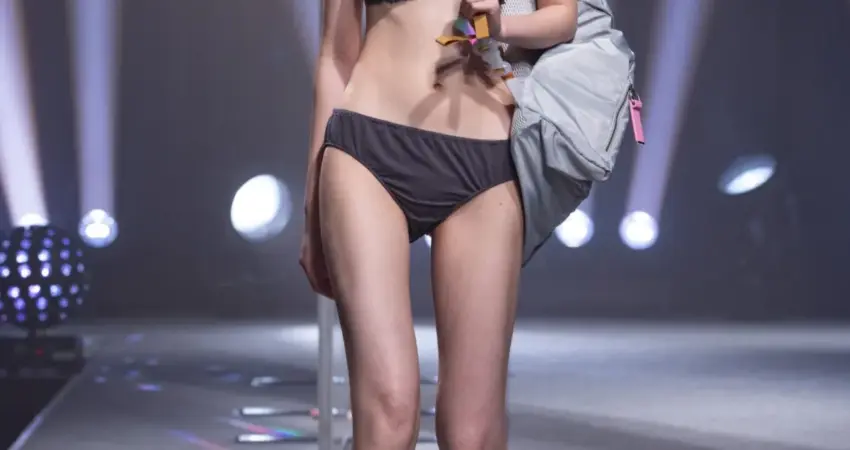
The heart of Tokyo’s Harajuku district witnessed a profound convergence of subculture and high fashion as designer Mikio Sakabe unveiled his Spring 2027 collection within the iconic corridors of the La Foret department store. Utilizing the legendary "teeny-bopper" mall as an unconventional stage, Sakabe presented a collection that interrogated the boundaries between fantasy and the banal reality of consumerist spaces. The presentation, themed around a "swimsuit show held in a shopping mall," drew its primary inspiration from the niche world of Japanese gravure magazines—publications marketed toward men that feature models in swimwear, lingerie, or cosplay, often characterized by a specific aesthetic of wide-eyed innocence and staged vulnerability.
By choosing La Foret as the venue, Sakabe tapped into decades of youth culture history. Since its opening in 1978, La Foret Harajuku has served as the epicenter for Tokyo’s most avant-garde trends, providing a home for everything from the "Lolita" subculture to the "Urahara" movement. Sakabe’s decision to return to this commercial landmark was both a nod to the past and a commentary on the current state of Japanese retail and identity.
Conceptual Framework: The Hyperreal and the Sadness of the Mall
Sakabe’s Spring 2027 collection was not merely an exercise in garment construction but a sociological exploration of the "hyperreal." The designer sought to capture the specific atmosphere of Japanese commercial spaces—bright, flashy, and aspirational, yet underscored by a persistent sense of melancholy. "There’s something interesting about the concept of a fashion show in a Japanese fashion mall," Sakabe remarked during a post-show briefing. "It feels bright and showy, but it’s also a little sad."
To emphasize this duality, the production design intentionally disrupted the pristine image of the luxury runway. The floor was littered with discarded coffee cups, crumpled drink cans, and various remnants of urban detritus. This "lived-in" debris served as a stark contrast to the ethereal, often surreal clothing, reminding the audience of the physical reality that exists beneath the gloss of fashion marketing. The juxtaposition of gravure-inspired fantasy against the gritty reality of a littered mall floor encapsulated Sakabe’s recurring theme: the desperate, often futile, human desire to escape reality through aesthetic consumption.
Design Analysis: Deconstruction and Subcultural Signifiers
The collection itself was a study in contradictions, alternating between literal interpretations of swimwear and Sakabe’s signature avant-garde tailoring. Models appeared in "straight-up" bikinis that paid direct homage to gravure aesthetics, yet these were frequently layered with complex, deconstructed garments that challenged the viewer’s perception of the body.
Sakabe, an alumnus of the Royal Academy of Fine Arts in Antwerp and a contemporary of Balenciaga’s Demna, utilized his technical prowess to slash and reassemble oversized shirting and tailoring into chaotic, voluminous shapes. These garments were often festooned with frills or featured floppy, elongated appendages reminiscent of bunny ears—a classic trope of Japanese "kawaii" (cute) culture and cosplay. By taking these elements and distorting them through a high-fashion lens, Sakabe transformed symbols of childlike innocence into something more complex and, at times, unsettling.
A defining feature of the presentation was the use of helmet-like, eye-obscuring wigs. This signature accessory, which Sakabe has refined over several seasons, served to anonymize the models, turning them into uniform avatars of his creative vision. The wigs effectively stripped away the "bambi-eyed" personality typical of gravure models, replacing it with a blank, almost robotic facade that focused the audience’s attention entirely on the silhouette and the movement of the fabric.
Footwear Innovation: The Success of Grounds
While the clothing provided the conceptual weight, the footwear anchored the collection in commercial reality. Every model was outfitted with bubble-soled sneakers from Sakabe’s highly successful footwear project, Grounds. Founded in 2019, Grounds has become a global phenomenon, bridging the gap between niche designer fashion and mass-market appeal.
The brand, which now employs approximately 100 people globally, is known for its distinct, jewel-like oversized soles that create the sensation of "walking on air." The inclusion of these sneakers in the Spring 2027 show was a testament to Sakabe’s ability to build a sustainable business model around avant-garde ideas. The bulbous, futuristic footwear complemented the "alien" aesthetic of the helmet wigs and the deconstructed garments, further blurring the lines between sportswear, streetwear, and high-concept runway fashion.
Chronology of the Event and Audience Reaction
The show began with a deliberate pacing that allowed the audience to take in the environmental details of the La Foret set. The first several looks established the gravure theme, featuring models in minimalist swimwear that seemed almost out of place in the industrial, trash-strewn environment. As the show progressed, the complexity of the garments increased. The introduction of oversized, slashed blazers and shirts marked a shift toward Sakabe’s more traditional "Antwerp" influences.
Industry insiders and long-time followers of the Tokyo fashion scene noted the show’s emotional resonance. Throughout the middle of the presentation, the "bunny ear" motifs and chaotic frills began to dominate the runway, creating a visual noise that mirrored the sensory overload of a Harajuku shopping center. The final look of the show—a half-worn shirtdress decorated with slits of silver—served as the collection’s climax. Sakabe described these silver accents as "portals to another universe," a final nod to the theme of escapism that permeated the entire event.
The reaction from the crowd, which included a mix of international buyers, local influencers, and dedicated fans from across Asia, was overwhelmingly positive. Sakabe’s ability to mine underground culture and translate it into desirable, ironic fashion has earned him a loyal following, particularly in markets like China and South Korea, where the "hyper-kawaii" and "deconstructed" aesthetics are currently seeing a resurgence.
Strategic Context: Sakabe’s Influence and the Antwerp Connection
To understand the significance of the Spring 2027 collection, one must look at Mikio Sakabe’s position within the global fashion hierarchy. Having studied alongside Demna Gvasalia at Antwerp, Sakabe belongs to a generation of designers who revolutionized the industry by bringing "ugly" or "common" aesthetics into the luxury sphere. While Demna took this philosophy to Balenciaga and Vetements, Sakabe has remained focused on the specific subcultures of East Asia.
Sakabe’s work is often categorized alongside other "post-Antwerp" designers who prioritize concept and subversion over traditional beauty. His mastery lies in his ability to take elements that might be considered "low-brow"—such as gravure magazines or cheap mall culture—and elevate them through sophisticated pattern-making and intellectual inquiry. This approach has allowed him to maintain a unique voice in a crowded market, positioning him as a leader of the Tokyo avant-garde.
Broader Implications for Tokyo Fashion Week
The success of Sakabe’s show at La Foret has broader implications for the future of Tokyo Fashion Week (Rakuten Fashion Week Tokyo). In recent years, the event has struggled to maintain the same level of international visibility as its counterparts in Paris or Milan. However, shows like Sakabe’s demonstrate that Tokyo remains a powerhouse of conceptual creativity.
By utilizing a local landmark like La Foret, Sakabe highlighted the importance of "place" in fashion storytelling. The show argued that fashion does not exist in a vacuum; it is deeply tied to the environments in which it is consumed and the subcultures from which it draws breath. This focus on local narrative, combined with the global commercial success of the Grounds brand, provides a roadmap for other Japanese designers looking to balance artistic integrity with business growth.
Furthermore, the collection’s focus on the "futility of escape" reflects a wider cultural sentiment in post-pandemic Japan. As the world becomes increasingly digital and "hyperreal," the search for a source of fantasy becomes more desperate. Sakabe’s work suggests that while we may try to find these portals in magazines or shopping malls, we are ultimately tethered to the messy, discarded reality of the present.
Conclusion: A Portal to the Future
Mikio Sakabe’s Spring 2027 presentation was more than a seasonal update; it was a poignant reflection on the state of modern identity and the enduring allure of the Harajuku spirit. By blending the eroticized fantasy of gravure with the banal "sadness" of a shopping mall, Sakabe created a collection that was simultaneously ironic, desirable, and deeply human.
As the Grounds brand continues to expand its global footprint and Sakabe continues to push the boundaries of deconstructed tailoring, his influence on the global fashion stage is set to grow. The "portals" he opened at La Foret may not have led to another universe, but they certainly provided a clearer view of the complex, beautiful, and sometimes tragic world of contemporary Japanese fashion. In the end, Sakabe proved that even in a littered shopping mall, there is room for a source of fantasy—provided one knows where to look.

0 Comments