
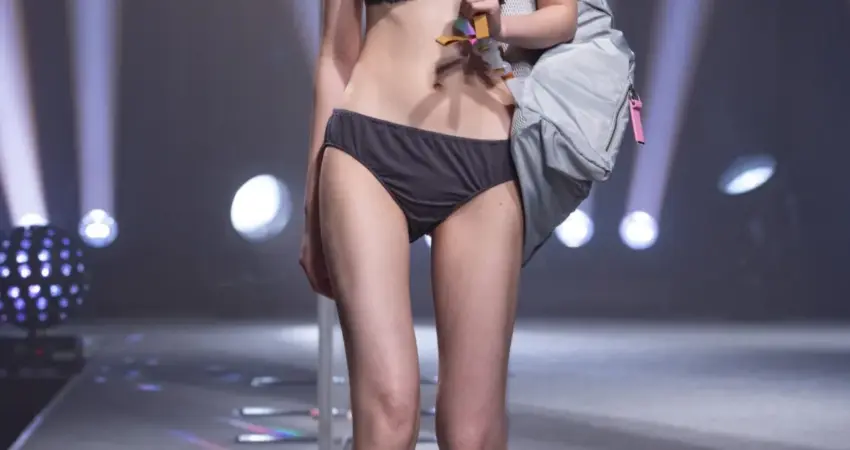
In a move that seamlessly blended the gritty realities of urban consumerism with the ethereal escapism of Japanese subculture, designer Mikio Sakabe presented his Spring 2027 collection at the iconic La Foret mall in Harajuku. The presentation, held during the height of Rakuten Fashion Week Tokyo, transformed the legendary "teeny-bopper" shopping hub into a stage for a profound exploration of "gravure" culture—a uniquely Japanese media phenomenon. By choosing a venue synonymous with youth fashion and commercialism, Sakabe invited attendees to witness a collection that was as much a social commentary as it was a display of avant-garde tailoring.
The Spring 2027 show was anchored by a concept Sakabe described as a “swimsuit show held in a shopping mall.” Drawing inspiration from gravure magazines—publications marketed toward men that feature models in suggestive, often "bambi-eyed" poses wearing lingerie, swimwear, or cosplay—the designer sought to investigate the thin line between the bright, showy nature of fashion and the underlying melancholy of artificial fantasy. This juxtaposition was central to the runway’s atmosphere, which challenged traditional notions of high-fashion presentation through a carefully curated "lived-in" environment.
The Setting: A Critique of Consumerist Desolation
The choice of La Foret Harajuku as a venue was far from incidental. Since its opening in 1978, La Foret has served as the epicenter of Tokyo’s youth fashion movements, housing hundreds of boutiques that cater to ever-evolving subcultures. By staging his show within this commercial cathedral, Sakabe highlighted the proximity of fashion to the banality of everyday consumption.
To further ground the collection in reality, the runway was intentionally littered with discarded coffee cups, crumpled drink cans, and various remnants of urban refuse. This set design served as a stark contrast to the high-concept garments, reinforcing the designer’s observation that fashion shows in Japanese malls often feel "bright and showy but also a little sad." The intentional mess suggested a post-event fatigue, or perhaps the discarded remnants of the very fantasies sold within the mall’s walls. This environmental storytelling provided a somber backdrop for a collection that oscillated between hyper-feminized "gravure" aesthetics and aggressive, deconstructed menswear-inspired silhouettes.
Chronology of the Spring 2027 Presentation
The show commenced with a series of looks that directly referenced the "swimsuit show" motif. Models emerged in minimalist bikinis, interspersed with Sakabe’s trademark deconstructed tailoring. The progression of the show followed a rhythmic alternation between the exposed vulnerability of the swimwear and the protective, chaotic layers of oversized shirting and jackets.
Midway through the presentation, the garments became increasingly complex. Sakabe’s expertise in deconstructivism was on full display as traditional shirting was slashed, re-layered, and adorned with unconventional appendages. Floppy, rabbit-ear-like extensions protruded from shoulders and waistlines, adding a touch of "kawaii" (cute) culture that felt both playful and slightly unsettling when paired with the models’ obscured faces.
The finale brought the concept of "portals" to the forefront. The closing look, a half-worn shirtdress, featured precision-cut slits lined with silver fabric. These metallic accents caught the mall’s fluorescent lighting, appearing as shimmering gateways to another dimension. This final piece served as a literal representation of the collection’s theme: the desire to escape a mundane reality through the "silver portals" of fantasy, even while acknowledging the futility of such an endeavor.
Design Signature: Wigs, Footwear, and Global Expansion
A defining visual element of the Spring 2027 show was the recurrence of Sakabe’s signature "helmet-like" wigs. These eye-obscuring hairpieces, which have become a staple of his recent collections, served to de-individualize the models, turning them into vessels for the clothing rather than recognizable personalities. "Somehow I really like them," Sakabe remarked during a post-show briefing, noting that the wigs contribute to the "unreal" or "doll-like" quality of the gravure-inspired aesthetic.
Equally prominent were the "Grounds" sneakers worn by every model. Founded by Sakabe in 2019, the footwear project has become a massive commercial success, characterized by its distinctive "bubble" soles that appear to suspend the wearer in air. The brand has seen explosive growth over the past four years, now employing approximately 100 people globally and maintaining a strong retail presence throughout Asia, particularly in China and South Korea. The inclusion of Grounds footwear in the Spring 2027 show underscored the designer’s ability to bridge the gap between niche, underground concepts and scalable, commercial enterprises.
Background: The Antwerp Connection and Cultural Mining
Mikio Sakabe’s approach to fashion is deeply rooted in his academic background at the Antwerp Royal Academy of Fine Arts. A member of the illustrious class of 2006, Sakabe studied alongside Demna Gvasalia (now creative director of Balenciaga). While Demna has taken his subversive sensibilities to the pinnacle of Parisian luxury, Sakabe has focused on mining the depths of Japanese underground culture, transforming ironic or "low-brow" influences into desirable high fashion.
His work often deals with the "Otaku" (geek) culture and the specific visual language of Akihabara and Harajuku. By focusing on gravure magazines for Spring 2027, Sakabe tapped into a sector of Japanese media that is often overlooked by the high-fashion establishment. His ability to twist these "vaguely erotic" and "left-field" starting points into sophisticated garments has earned him a dedicated following across Asia, where his fans appreciate the intellectual depth behind the surface-level irony.
Supporting Data and Market Impact
The success of the Mikio Sakabe brand and its subsidiary, Grounds, reflects a broader trend in the Japanese fashion industry: the rise of independent designers who leverage subcultural capital to build international businesses. According to industry data from Rakuten Fashion Week Tokyo, "niche-to-global" brands have seen a 15% increase in export volume over the last three years, with footwear leading the charge.
Grounds, in particular, has become a case study in how a designer-led footwear brand can achieve mass-market appeal without losing its "cool" factor. By employing 100 people across various global hubs, Sakabe has transitioned from a boutique designer to a significant employer and exporter. Analysts suggest that the "bubble sole" aesthetic appeals to a Gen Z demographic that values both comfort and a futuristic, "otherworldly" silhouette—traits that were highlighted throughout the Spring 2027 runway show.
Industry Analysis: The Futility of Reality
The Spring 2027 collection serves as a poignant analysis of the modern human condition, particularly the struggle to find meaning in a world dominated by superficial imagery. By contrasting the "hyperreal" perfection of gravure models with the "banal" setting of a shopping mall, Sakabe highlights a collective desire to escape the mundane.
The presence of trash on the runway acts as a "memento mori" for the consumer age, reminding the audience that even the most beautiful fantasies eventually result in waste. This thematic depth is what separates Sakabe from his contemporaries; he does not merely create clothes but constructs narratives that reflect the anxieties of his audience. The "slits of silver" in his final garments represent the glimmer of hope or the "fantasy source" that people hunt for, even if that hunt is ultimately circular.
Conclusion and Broader Implications
Mikio Sakabe’s Spring 2027 show at La Foret Harajuku was more than a seasonal update; it was a masterful execution of "ironic fashion" that remains deeply rooted in craftsmanship. By utilizing his signature deconstructed tailoring and the commercial power of his Grounds footwear, Sakabe demonstrated that he remains one of the most vital voices in Tokyo’s fashion scene.
As Tokyo continues to assert its influence on the global stage, Sakabe’s work provides a blueprint for how designers can remain authentic to their local subcultures while achieving international scale. The collection’s focus on the "sadness" of the mall and the "fantasy" of the magazine suggests a designer who is acutely aware of the world around him, using fashion as a tool to navigate the complexities of 21st-century life. For the fans across Asia and the industry insiders in attendance, the show was a reminder that in the hands of a master like Sakabe, even a discarded coffee cup can become part of a profound artistic statement.

0 Comments