
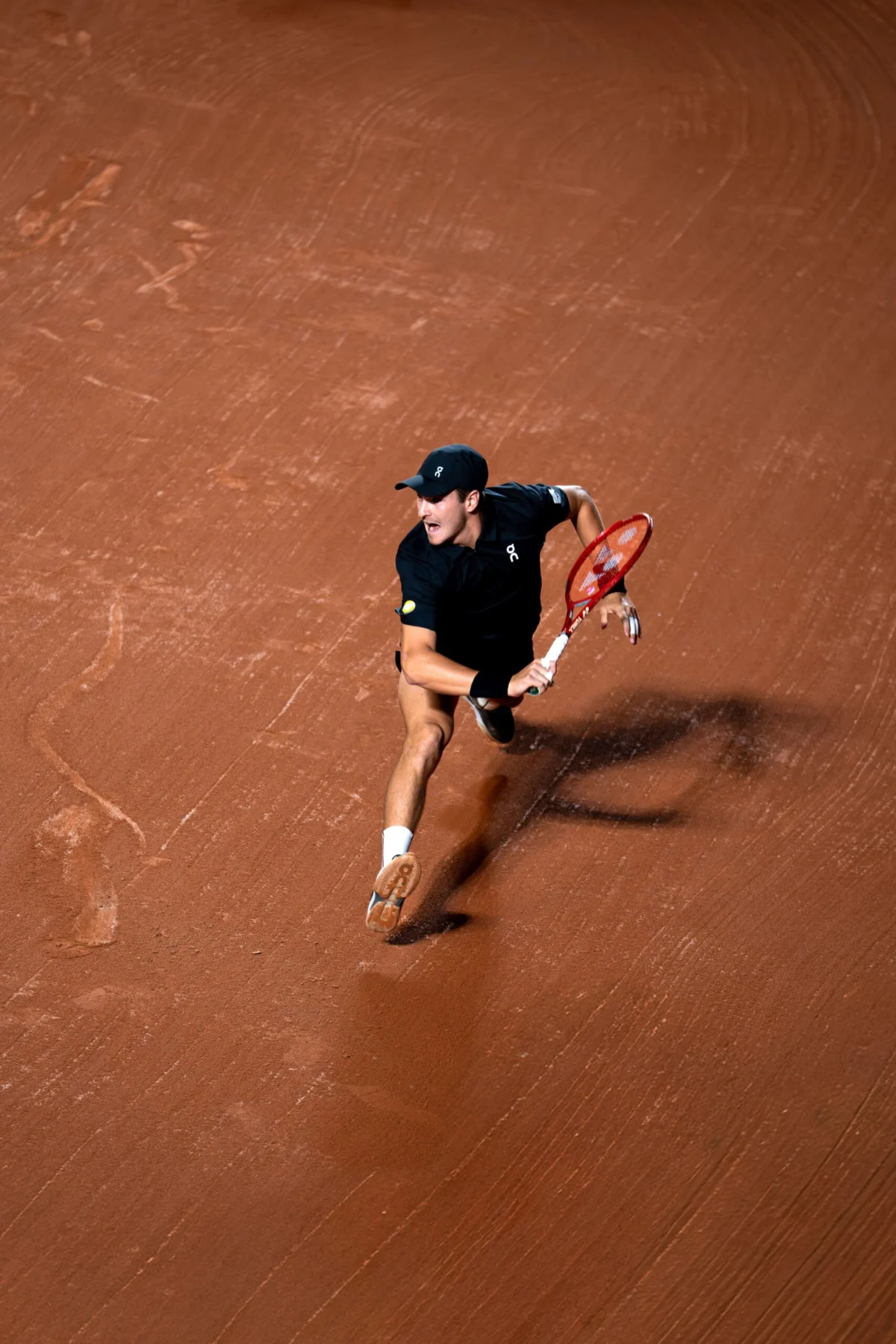
Joao Fonseca, the 19-year-old Brazilian tennis sensation, navigated the bustling corridors of Miami Gardens’ Hard Rock Stadium this week, embodying the poise of a seasoned veteran despite his status as one of the youngest competitors in the ATP 1000 circuit. Dressed in a cyan-hued On T-shirt—the brand famously backed by Roger Federer—and sporting a Rolex with a fluted bezel alongside a Whoop fitness tracker, Fonseca represents a new breed of athlete where technical prowess on the court is seamlessly integrated with a sophisticated commercial profile. As the Miami Open commences, Fonseca finds himself at the center of a media whirlwind, a byproduct of his meteoric rise over the past twelve months and his status as the primary torchbearer for Brazilian men’s tennis.
The atmosphere surrounding Fonseca is one of palpable anticipation. During a recent media session, the young athlete engaged in the modern requirements of professional sports: creating social media content, answering obscure trivia regarding the history of the ATP Masters 1000 tournaments, and discussing his cultural interests, including the Oscar-nominated film The Secret Agent by Brazilian director Kleber Mendonça Filho. Despite the repetitive nature of these obligations, Fonseca’s presence remains commanding. Standing lanky and long-limbed, he possesses an assurance that belies his teenage years, a quality that has intensified as his ranking has climbed. Having spent two years on the professional tour, Fonseca appears to have transitioned from a promising prospect to a legitimate contender, settling into the demanding lifestyle of an elite global athlete.
Technical Evolution and the Mental Game
Fonseca’s progression is not merely a matter of physical maturation; it is rooted in a deepening understanding of the psychological nuances of professional tennis. "I think I’m understanding a little bit more about how the top players play—not technically, but mentally," Fonseca noted during a walk through the Hard Rock Stadium complex. He emphasized the importance of managing critical points and the tactical "tricks" required to navigate high-stakes matches. This mental fortitude was most evident during his recent performance at the BNP Paribas Open in Indian Wells, California.
In a Round of 16 encounter that captured the attention of the tennis world, Fonseca faced the world number two, Jannik Sinner. While Sinner ultimately secured the victory, the match was far from a routine win for the Italian. Fonseca pushed both sets to tiebreaks and held three set points in the opening frame. Utilizing what analysts have termed a "nuclear forehand," Fonseca demonstrated an ability to match the pace and intensity of the game’s current leaders. His performance against Sinner served as a proof of concept: Fonseca possesses the weaponry to disrupt the dominance currently shared by Sinner and Carlos Alcaraz, who have largely monopolized the tour’s major titles over the last three seasons.
Reflecting on the Sinner match, Fonseca acknowledged the difficulty of finding weaknesses in the Italian’s game. "I knew that if I went hard, it was going to come back hard as well," he explained. The experience reinforced the necessity of maintaining consistency at the highest level, noting that elite players like Sinner rarely commit unforced errors under pressure. This realization has shaped Fonseca’s current training regimen, which focuses on physical durability and mental resilience as much as technical shot-making.

A Chronology of Rapid Ascent
The rise of Joao Fonseca has been characterized by a series of strategic breakthroughs and a resilience in the face of physical setbacks. To understand his current position in the Miami Open draw, one must look at the timeline of his development:
- Early 2023: Fonseca makes a significant impact on the junior circuit, reaching the later stages of the Australian Open juniors and establishing himself as a top-tier prospect.
- Mid-2023: He transitions more fully into the professional ranks, securing wildcards and making his presence felt at the Miami Open, where he began to build a local fanbase.
- Late 2023: Fonseca captures two tour-level titles on the ATP Challenger circuit, providing the points necessary to break into the higher echelons of the rankings.
- Early 2024: A lower back injury briefly sidelines the Brazilian, causing a slight dip in his ranking but allowing for a period of physical rehabilitation and mental reset.
- March 2024: Fonseca returns to form at Indian Wells, pushing Jannik Sinner to the brink and signaling his readiness for the Miami Open.
Currently, Fonseca reports being at 100% physical capacity. His stated objective is clear: a place in the world’s top five. To achieve this, he and his coaching staff are methodically addressing the "little things," including the management of downtime on tour. To combat the mental fatigue and overthinking that often plague young players during long weeks of travel, Fonseca relies on a close-knit support team and hobbies such as playing the board game Catan, which provides a strategic outlet away from the tennis court.
The Miami Factor and the Brazilian Connection
The Miami Open holds a unique significance for South American players, and for Brazilians in particular. South Florida is home to one of the largest Brazilian expatriate populations in the United States, effectively turning the Hard Rock Stadium into a home venue for players like Fonseca. This demographic reality has not been lost on tournament organizers. James Blake, the former world number four and current Director of the Miami Open, has publicly advocated for Fonseca’s matches to be held on the stadium court.
Blake’s assessment is based on both marketability and competitive merit. "Joao needs to be on the stadium court for as long as he’s in the tournament," Blake remarked, recognizing the electric atmosphere the Brazilian fans bring to the stands. For Fonseca, this environment—once a source of shy apprehension—has become a catalyst for performance. He describes the "Miami vibe" as loud, crowded, and ultimately amazing, noting that he has learned to transform the external pressure of a cheering crowd into internal motivation.
This support was instrumental in Fonseca’s first-round victory yesterday against Hungary’s Fábián Marozsán. In a grueling three-set match, Fonseca showed the grit necessary to overcome a tactical opponent, setting up a highly anticipated second-round clash against Carlos Alcaraz. The matchup against Alcaraz is viewed by many as a "gut-check" for the young Brazilian—a chance to test his progress against the reigning Wimbledon champion on one of the sport’s biggest stages.
Data and Implications for the ATP Tour
Fonseca’s emergence comes at a pivotal moment for the ATP Tour. As the "Big Three" era of Federer, Nadal, and Djokovic nears its inevitable conclusion, the sport is searching for a diverse group of young stars to maintain global engagement. Fonseca fits this mold perfectly, offering a combination of explosive athleticism and a massive market in South America.

Data from the ATP suggests that players who break into the top 100 before the age of 20 have a significantly higher probability of reaching a Grand Slam final. Fonseca is currently tracking along this elite trajectory. His serve speed and baseline power metrics already rank within the top 20th percentile of the tour, a rare feat for a player of his age and build. Furthermore, his partnership with On—a brand that has been highly selective with its ambassadors, including world number one Iga Swiatek and American star Ben Shelton—indicates that the industry views him as a long-term fixture at the top of the game.
Broader Impact and the Future of Brazilian Sport
Beyond his individual career, Fonseca carries the weight of a nation’s expectations. Brazil has a storied tennis history, most notably defined by the three French Open titles of Gustavo "Guga" Kuerten. However, since Kuerten’s retirement, the country has sought a male player capable of consistently competing for major titles. While Beatriz Haddad Maia has revitalized Brazilian tennis on the WTA side, Fonseca represents the best hope for a similar resurgence in the men’s game.
The implications of Fonseca’s success extend to the grassroots level in Brazil. His rise is expected to drive increased investment in tennis academies and local tournaments across South America, a region that has traditionally struggled with the high costs of international travel and player development.
As Joao Fonseca prepares for his match against Carlos Alcaraz, he appears unfazed by the magnitude of the moment or the expectations of his countrymen. "I am more used to it now," he said, looking down the corridors of the stadium where his image is already plastered on promotional banners. "I am prepared." Whether he upsets Alcaraz or not, Fonseca has already established himself as a central figure in the next generation of tennis, a player whose presence is as commanding off the court as his forehand is on it. The 2024 Miami Open may well be remembered as the tournament where Joao Fonseca transitioned from a phenom to a powerhouse.

0 Comments