
Following a high-profile exhibition of his work at London’s Victoria and Albert Museum (V&A), Ryunosuke Okazaki has returned to the runway, signaling a transformative phase in his career. The Hiroshima-born designer, who first garnered international acclaim as a finalist for the 2022 LVMH Prize, is moving beyond the realm of pure sculptural art into a more nuanced intersection of wearable fashion and conceptual philosophy. His latest collection represents a pivotal shift, maintaining the visceral, androgynous grandeur of his signature "exoskeletons" while introducing his first substantive foray into the ready-to-wear market. This evolution marks a critical juncture for a designer whose business has historically relied on the patronage of art collectors and museums rather than the traditional retail cycle.
The Architectural Language of the Body
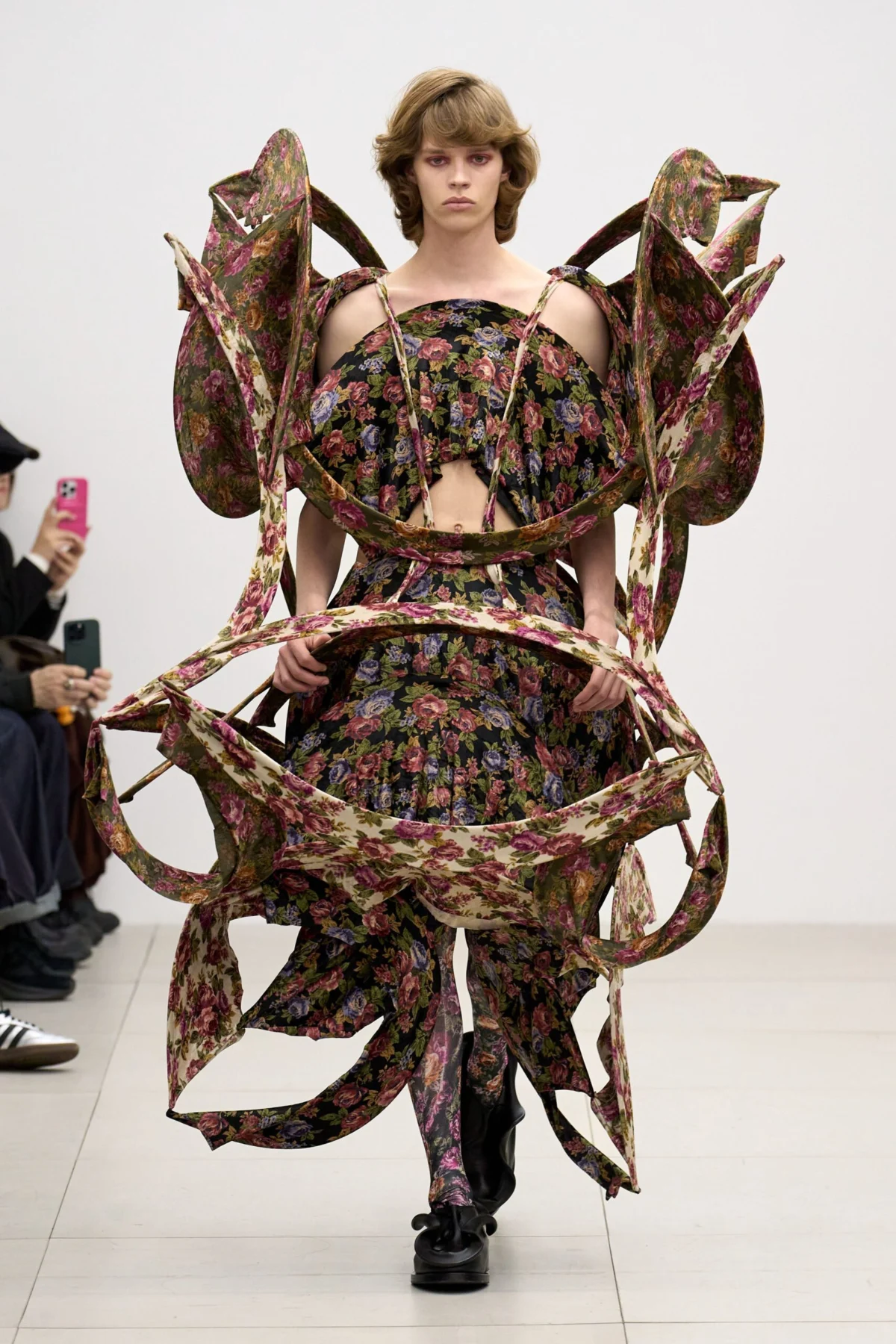
Okazaki’s work has long been defined by its rejection of traditional tailoring in favor of organic, architectural forms. In this latest presentation, the designer’s extraordinary exoskeletons were showcased not as static gallery pieces, but as living extensions of the human form. When witnessed in motion on a runway rather than a mannequin, these structures reveal a complex duality. The sweeping curves and protruding spikes, constructed through meticulous ribbing and boning, often resemble protective armor. However, they simultaneously convey a profound sense of tenderness.
The interaction between the garments and the models suggests a symbiotic relationship. As the models navigate the runway, their limbs curve and wrap around the protruding elements, effectively becoming part of the sculpture itself. This tactile engagement exposes the softness and fragility of the human skin beneath the rigid, alien joints. The technical execution of these pieces challenges the traditional definition of "wearability," pushing the boundaries of how fabric and structure can dictate human movement.
Bridging Art and Commerce: The Shift to Ready-to-Wear
While Okazaki’s reputation is built on avant-garde silhouettes that command attention in museum settings, the current collection indicates a strategic move toward commercial viability. Building on the foundation of accessories—specifically bags and shoes—introduced in previous seasons, this collection marked the designer’s first genuine attempt at ready-to-wear (RTW) garments.
Among the standout pieces were a green turtleneck sweater featuring removable boning at the shoulders and a tube dress defined by a scythe-like shape across the torso. These items represent a "distilled" version of Okazaki’s high-concept work, offering the market a way to engage with his aesthetic without the logistical challenges of his larger sculptural pieces. By incorporating removable elements, Okazaki allows the wearer to modulate the level of avant-garde expression, a move that industry analysts suggest is essential for expanding a niche artistic brand into a sustainable fashion house.
The introduction of these pieces coincides with a broader trend in the luxury market where "art-wear" is increasingly sought after by consumers looking for unique, conversation-starting garments that retain a sense of artisanal craftsmanship. Okazaki’s transition suggests an awareness of the need to balance his "prayer for peace" with the practicalities of a global fashion business.
Materiality, Print, and the Animal Kingdom
A significant departure in this collection was the introduction of bold prints, a medium Okazaki has previously avoided. The use of python and leopard patterns served as a direct reference to the animal kingdom, reinforcing the themes of animism and the worship of nature that permeate his work. These prints contrast sharply with the heritage patterns also present in the collection—namely tweed and pinstripes.
The inclusion of traditional tailoring fabrics like tweed represents a collision of two universes: the historical weight of traditional garments and Okazaki’s futuristic, almost alien, design language. This juxtaposition creates a tension between the familiar and the unknown, grounding his cosmic designs in the reality of textile history.
Perhaps the most personal element of the collection was a floral pattern featured in the penultimate look. Okazaki admitted to an initial aversion to the print, describing it as "old-fashioned" and "unappealing." He noted that it reminded him of the nostalgic, domestic patterns found on his grandmother’s futon. However, he chose to "cherish" this feeling of rejection, eventually transforming his "hatred" into a creative catalyst. "There’s something very human about florals, like a person trying to print nature onto something," Okazaki remarked during a post-show discussion. This transformation of sentiment mirrors the broader theme of his work: the ability of art to transmute negative or complex emotions into something life-affirming.
Chronology of a Rising Talent
To understand the significance of this latest collection, one must look at the trajectory of Okazaki’s career over the last three years:
- 2021: Okazaki graduates from Tokyo University of the Arts, immediately making waves with his "Jomon" collection, inspired by Japanese prehistoric pottery.
- 2022: He is named a finalist for the LVMH Prize, bringing his work to the attention of the global fashion elite and securing his place as a leading voice in the new Japanese avant-garde.
- 2023: His work is featured in the V&A’s "Japan: Myths to Manga" exhibition in London, cementing his status as a designer whose work transcends fashion to be viewed as contemporary art.
- Current Season: The launch of his first RTW pieces and the integration of print, signaling a maturation of his business model and a deepening of his philosophical inquiries.
The Philosophy of Peace and ‘Kidoairaku’
Okazaki’s creative output is inextricably linked to his upbringing in Hiroshima. He has consistently described his work as a "prayer for peace," a sentiment that takes on a protective quality in his armor-like designs. This season, however, that prayer became more intimate. By working more closely with the contours of the body, Okazaki shifted from a "transcendent, conceptual idea of prayer" to something he describes as "inherent in everyday life." This shift represents a desire to bridge the gap between the artist and the observer, making his message more accessible and personal.
The emotional landscape of the collection was further underscored by the accompanying music, which shifted between dark, foreboding tones and meditative sequences. This was inspired by the Japanese concept of kidoairaku (喜怒哀楽). This four-character idiom encapsulates the full spectrum of human emotion:
- Ki (Joy): Represented in the lightness and fluid movement of certain structures.
- Do (Anger): Evident in the sharp, aggressive spikes and darker color palettes.
- Ai (Sadness): Reflected in the vulnerability of the exposed skin and the nostalgic floral prints.
- Raku (Pleasure): Found in the tactile richness of the fabrics and the harmony between body and garment.
Okazaki noted that he strives for honesty in his creations, ensuring that his expression remains constant whether he is working in the context of a museum or a runway.
Broader Impact and Market Implications
The evolution of Ryunosuke Okazaki holds significant implications for the Japanese fashion industry and the global luxury market. As established Japanese houses like Comme des Garçons and Issey Miyake continue to influence the world stage, Okazaki represents a new generation that is less concerned with deconstruction and more focused on "reconstruction" through a sculptural lens.
From a market perspective, the shift toward ready-to-wear is a strategic necessity. While museum acquisitions and high-net-worth art collectors provide prestige, the longevity of a fashion brand requires a retail presence. By translating his complex silhouettes into items like turtlenecks and tube dresses, Okazaki is positioning himself to enter high-end boutiques and department stores, potentially following the path of other "art-designers" like Iris van Herpen.
Furthermore, his focus on the "prayer for peace" resonates deeply in a contemporary global climate marked by conflict. His work offers a unique proposition: fashion not just as aesthetic adornment, but as a symbolic protective layer and a medium for philosophical reflection. In an era where consumers are increasingly looking for brand purpose and authenticity, Okazaki’s unwavering commitment to his Hiroshima-rooted philosophy provides a compelling narrative that distinguishes him from his contemporaries.
In conclusion, Ryunosuke Okazaki’s latest collection is more than a seasonal update; it is a manifesto of growth. By blending the "hatred" of the old-fashioned with the "hope" of the new, and the rigidity of the exoskeleton with the softness of the human form, he has created a collection that accounts for the complexities of the human experience. His work continues to suggest that even in dark times, the transformation of art into life—and life into love—is not only possible but necessary.

0 Comments