
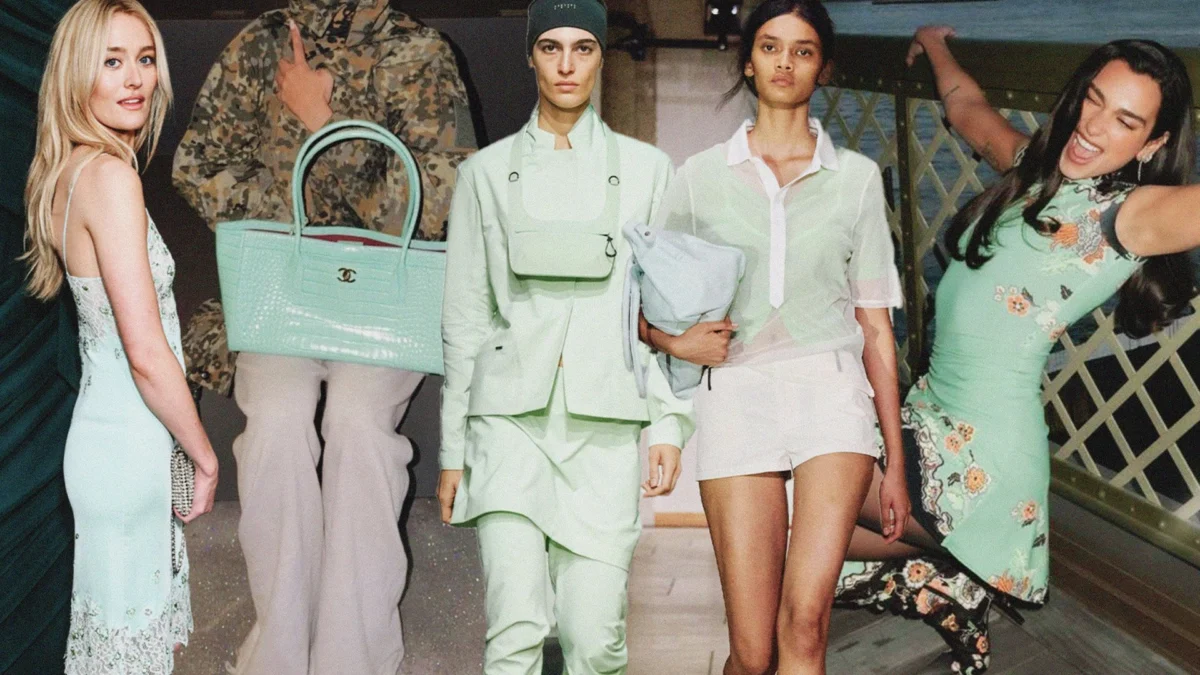
The fashion industry is currently witnessing a significant shift in its color semiotics, moving away from the warm, saturated "foodie" tones that dominated recent seasons toward a cooler, more clinical aesthetic. After the ubiquity of pistachio green and the subsequent reign of "butter yellow"—a trend famously accelerated by figures like Hailey Bieber and her "lemon-tini" summer aesthetic—a new visual movement has emerged. Termed "toothpaste dressing," this trend prioritizes frosty mint greens and icy, pale blues, signaling a departure from the sun-drenched palettes of the early 2020s in favor of a "minty fresh" refresh that balances clinical precision with ethereal whimsy.
This aesthetic evolution was brought into the spotlight during the most recent Oscars weekend, where actor Sarah Pidgeon debuted a frosty-toned sequin slip dress from the Chanel Métiers d’art 2026 collection, designed by Matthieu Blazy. Pidgeon described the garment as having a "mermaid" quality, noting that while the color was reminiscent of toothpaste, it represented a "super chic" iteration of the shade. Simultaneously, global pop icon Dua Lipa further solidified the trend’s arrival, appearing in a floral blue-green Roberto Cavalli ensemble paired with coordinated mint boots, demonstrating the versatility of the palette across different stylistic genres.

The Evolution of the Cool-Toned Palette: A Chronology
The transition to toothpaste dressing has been a calculated progression across multiple runway seasons, rather than an overnight phenomenon. Market analysts note that mint green and icy blue began as "challenger shades" to the dominant blush pinks and "millennial purples" that have saturated retail floors for nearly a decade.
Spring/Summer 2025: The Pastel Pivot
On the Spring/Summer 2025 runways, mint green officially unseated blush pink as the industry’s "pastel du jour." Designers utilized the shade to convey transparency and lightness. At Fendi, the color was executed through gauzy organza dresses that played with opacity and shadow. Chanel’s presentation at the Grand Palais utilized the botanical backdrop to highlight sparkle-smattered mint tweed suits and diaphanous icy blue capes, suggesting a more "royal" and structured application of the color. Meanwhile, Johanna Parv, an Estonian designer based in London, integrated lush light greens into sporty silhouettes, proving that the color could function within a utilitarian and performance-oriented wardrobe.
Fall 2025: Disrupting the Winter Palette
By the Fall 2025 season, the palette shifted from light and airy to structured and disruptive. Traditionally, winter collections rely on heavy earth tones, charcoal, and deep jewel tones. However, brands like Givenchy and Stella McCartney introduced mint into structured silhouettes, pairing the "toothpaste" shades with charcoal tailoring and rich brown fabrics. This created a visual tension that felt more modern than the monochromatic minimalism of previous years.

2026 Projections: Organic Greens and Architectural Blues
Looking toward 2026, the trend is expected to broaden into a wider movement of organic greens, where mint meets jade, moss, and minimal botanic tones. The Spring 2026 collections have already shown a deeper exploration of these cool tones. Simone Rocha’s "debutante-y" Spring 2026 line featured frosty blue chiffons accented with pearls and floral motifs. Dior adopted the shade for architectural bubble dresses, using the clinical coolness of the blue to play with different "stages of femininity," moving the color away from its associations with childhood and toward high-concept couture.
Materiality and the Technical Challenges of "Toothpaste" Tones
One of the primary challenges for designers adopting mint and icy blue is the risk of the garments appearing "sterile" or resembling medical uniforms. Brooke Callahan, an LA-based designer known for her vibrant use of tomato red and turquoise, noted the difficulty of working with these shades in traditional cotton poplin. According to Callahan, lighter blues and greens can "go in the way of hospital scrubs pretty quickly" if the material lacks the necessary luster or texture.
To combat this, designers are turning to elevated fabrics that interact with light more dynamically. In a recent collaboration between Callahan and the London-based brand Hai, the designers reimagined signature shapes in dupion silks. Tessa Vermeulen, founder of Hai, explained that a "haze blue" served as a natural middle ground for the collaboration. The use of silk allowed the blue to feel "inviting" and "clean" rather than clinical, providing a tactile quality that cotton often lacks.

Similarly, Chanel’s recent collections have leaned heavily into texture to justify the mint palette. By applying the color to openwork crochet skirts, macrame belts, and the house’s signature bouclé and tweed, the brand has managed to make the "toothpaste" shade feel luxurious. The commercial success of this approach is evident in the retail frenzy surrounding Matthieu Blazy’s first drop of Chanel in-stores, where mint-capped pumps and "foamy-toned" bags have become high-priority items for consumers.
Designer Perspectives and Creative Motivations
For many independent designers, the adoption of mint and pale blue is a response to a long-held "color obsession." Hattie Tennant, founder of the London-based brand Fruity Booty, noted that her creative director, Jazz Mignone, developed a deep affinity for mint nearly a year before it hit the market. "Because of the design cycle, it took a while to come through, but it ended up landing exactly when we needed it," Tennant stated.
Fruity Booty’s approach involves using mint as a "lift" for muted wardrobes. Tennant suggests that a "flash of mint"—such as a bra strap visible under a gray knit—provides a fresh, "fruity" antidote to the somber tones of winter. This sentiment is echoed by Lucila Safdie, whose brand has become a favorite among "Internet It-Girls." Safdie utilizes mint alongside shades of raspberry and grape to create a "Sofia Coppola-coded" aesthetic. She argues that mint is uniquely flattering for a wide range of skin tones and adds a "touch of humor" to clothes that might otherwise feel overly melancholic or serious.

In Paris, Moldovan designer Fidan Novruzova has taken a more historical approach. For her Fall 2026 collection, Novruzova drew inspiration from Polish Art Deco icon Tamara de Lempicka. She utilized spearmint for long-lapeled shirts and boleros, pairing them with peplum skirts and heavy boots. In this context, the color serves as a tool for exploring modern femininity through structured, almost masculine, tailoring.
Market Impact and the Decline of the "Clean Girl" Aesthetic
The rise of toothpaste dressing marks a significant cultural shift in the fashion landscape. For several years, the "Clean Girl" aesthetic—defined by beige, cream, and ultra-minimalist neutrals—dominated social media and retail trends. However, industry analysts suggest that consumers are experiencing "neutral fatigue."
Toothpaste dressing offers a "clean" look that still incorporates color and storytelling. It moves away from the sterile perfection of the "Clean Girl" and toward a more whimsical, ironic, and romantic sensibility. By naming the trend after a common household product like toothpaste, the industry is embracing a sense of playfulness and irony that was absent during the height of the minimalist movement.

Data from luxury retail platforms indicates a 15% increase in searches for "mint green" and "icy blue" accessories over the last two quarters, suggesting that consumers are beginning to integrate these tones through "entry-point" items like handbags and footwear before committing to full monochromatic looks. The "Blazy effect" at Chanel has further validated this, with the brand’s mint-toned accessories seeing high sell-through rates globally.
Future Implications: A New Era of Storytelling
As fashion enters the 2026 cycle, toothpaste dressing is expected to remain a cornerstone of the industry’s color strategy. Its ability to bridge the gap between "athleisure" functionality and high-fashion romance makes it a versatile tool for designers across the spectrum.
The trend also highlights a renewed interest in "sensory fashion." Designers like Brooke Callahan describe the "right blue" as something a consumer "wants to reach out and touch or swim in." This focus on the emotional and tactile response to color suggests that fashion is moving into an era where storytelling and atmospheric mood take precedence over simple brand logos or viral silhouettes.

While toothpaste dressing may initially feel intimidating to the average consumer due to its association with "cool" and "frosty" tones, its integration into diverse fabrics—from Chanel’s tweed to Hai’s silk—proves its adaptability. As the industry continues to move away from the rigid constraints of minimalism, these minty fresh shades provide a necessary "pick-me-up," offering a visual palette that is as refreshing as it is sophisticated. The message from the runways is clear: the era of the neutral is fading, and the future of fashion is bright, cool, and undeniably minty.

0 Comments