
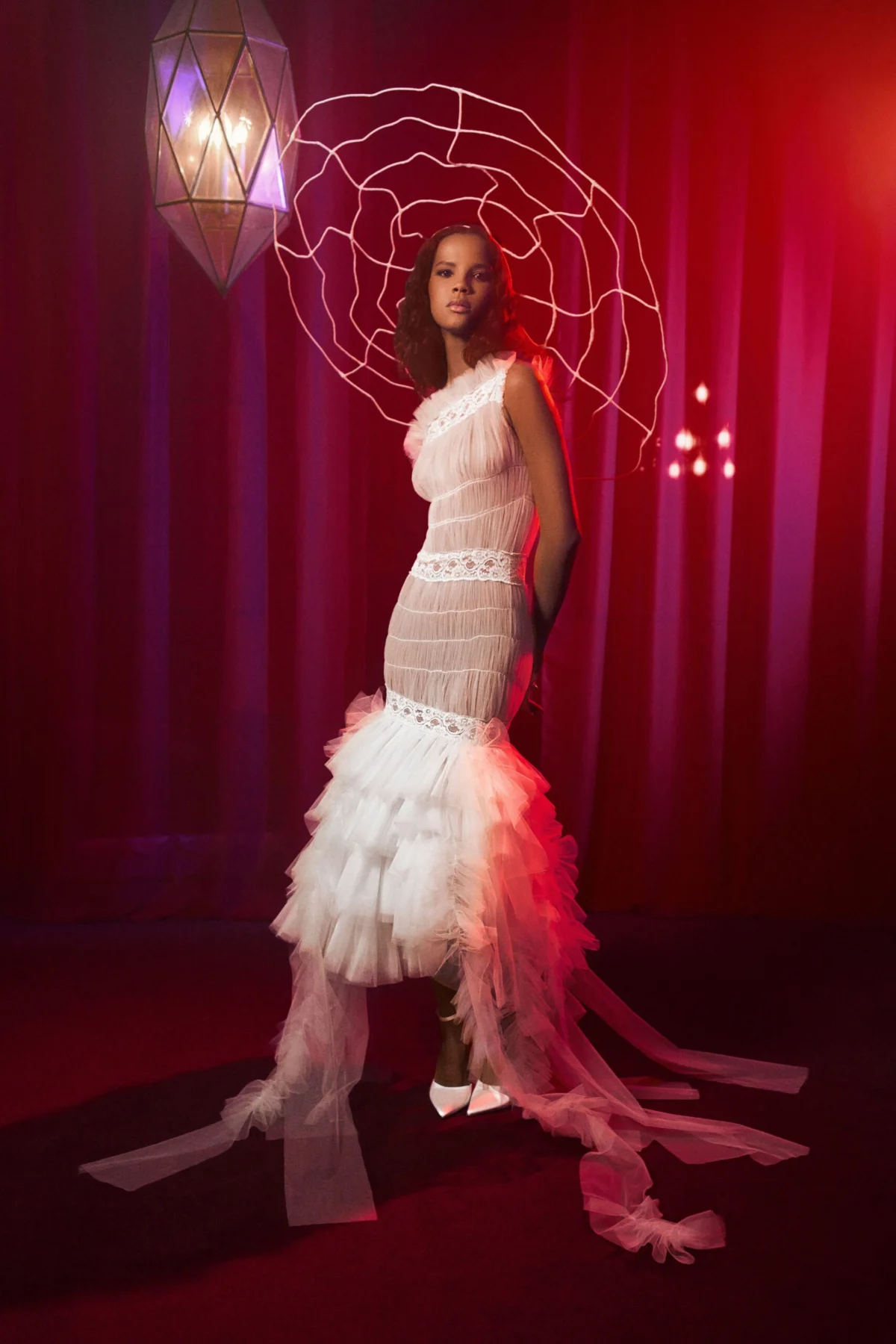
The Fall 2026 Ready-to-Wear collection by Rodarte marks a significant milestone in the creative trajectory of Kate and Laura Mulleavy, further solidifying their reputation as designers who seamlessly blend the ethereal with the avant-garde. Since the brand’s inception in 2006, the Mulleavy sisters have utilized romance as a foundational element of their design language. However, as demonstrated in their most recent presentation, "prettiness" remains a starting point rather than a destination. This collection serves as a sophisticated evolution of the darker, edgier themes that first emerged in their landmark Spring 2008 show, recontextualizing their signature "cobweb" aesthetic through the lens of meticulous construction and cinematic atmosphere.
The Evolution of the Rodarte Aesthetic: From Romance to Arachnology
When Rodarte debuted nearly two decades ago, the fashion industry immediately took note of their distinct approach to femininity—one that was rooted in delicate textures and a whimsical, often otherworldly sensibility. By their fifth collection in 2008, a shift occurred. The introduction of the now-iconic cobweb sweaters signaled an interest in the beauty of the macabre and the intricate patterns of nature. In the Fall 2026 collection, this fascination with arachnids has reached a pinnacle. The Mulleavys have transitioned from mere observers of nature to accomplished "arachnologists" of the atelier, utilizing complex wire-work and textile manipulation to create structural interpretations of spider webs.
The centerpiece of this thematic exploration is found in the collection’s headwear: gigantic, tulle-wrapped wire web hats that frame the models with an architectural intensity. These pieces do not suggest the fragility of a web found in decay, but rather the strength and precision of a web in its prime. This distinction is vital to understanding the Mulleavys’ current headspace; they are moving away from the deconstructed, distressed looks of previous seasons toward a more polished, intentional form of craftsmanship.
Technical Artistry: Materiality and Construction
The Fall 2026 collection is anchored by two pivotal looks featuring hand-beaded webs embedded directly into the gowns. These garments utilize a sophisticated layering of tulle and various iterations of Chantilly lace, a fabric historically associated with high-status mourning and bridal wear in European traditions. The use of Chantilly lace provides a bridge between the collection’s Gothic undertones and its contemporary execution.
A technical highlight of the presentation is the opening look, which features a top of smocked chiffon banded with lace. The designers described the movement of this piece as "collapsing like a slinky," a testament to the fluidity achieved through rigorous smocking techniques. This lightness is balanced by the weight of the lower garment, which consists of cascading ruffles and languorous trains that ground the ethereal upper half.
Beyond the web-inspired pieces, the collection introduces dramatic, sculptural dresses made of ruched taffeta. Kate Mulleavy noted that these designs were born from a desire to find a "midpoint between the Renaissance and the Gothic." This is evident in the silhouettes, which evoke the structured bodices of the 15th century while maintaining the somber, dramatic flair of the 19th-century Gothic Revival. The focus here is squarely on draping and construction, moving away from the narrative-heavy storytelling that has characterized some of Rodarte’s previous outings.
The Cinematic Influence: Lighting as a Design Element
The Mulleavy sisters have long been enmeshed in the world of cinema, having contributed costume designs to films such as Black Swan (2010) and directing their own feature, Woodshock (2017). For the Fall 2026 collection, the influence of film was less about the plot and more about the technicality of light. The presentation utilized lighting inspired by Luca Guadagnino’s 2018 reimagining of Suspiria—a film noted for its saturated, moody, and often unsettling visual palette.
Laura Mulleavy explained that the collection was an exploration of "great moments of clothing within film and really beautiful lighting." While this choice created an undeniable mood of mystery and high drama, some industry observers noted that the atmospheric lighting occasionally obscured the finer details of the garments’ construction. Nevertheless, the choice underscored the brand’s commitment to fashion as a multidisciplinary art form, where the environment in which a garment is viewed is as important as the garment itself.
Chronology of Rodarte’s Major Milestones
To understand the weight of the Fall 2026 collection, one must look at the timeline of Rodarte’s development:
- 2005-2006: Kate and Laura Mulleavy launch Rodarte in Los Angeles with a small collection of 10 pieces. They quickly win the CFDA/Vogue Fashion Fund runner-up prize.
- Spring 2008: The "Cobweb" collection debuts, introducing a darker, more experimental side of the brand that departs from traditional prettiness.
- 2010: The sisters design the costumes for the film Black Swan, earning critical acclaim and a broader global profile.
- 2011: Rodarte becomes the first American fashion house to have their work featured in a solo exhibition at the National Museum of Women in the Arts.
- 2017: The brand moves its runway shows to Paris Haute Couture Week, signaling an increased focus on artisanal techniques and high-end construction.
- 2020-2025: The brand navigates the post-pandemic landscape by leaning into "dreamscape" aesthetics, blending California cool with high-fashion fantasy.
- Fall 2026: The current collection synthesizes 20 years of design history, focusing on the "arachnology" of lace and the architectural possibilities of taffeta.
Market Analysis and Industry Reception
The Fall 2026 collection arrives at a time when the luxury fashion market is seeing a resurgence in demand for "artisanal ready-to-wear"—garments that bridge the gap between mass-produced luxury and bespoke couture. According to recent industry data, the segment of the market focused on high-craft, event-based dressing has grown by an estimated 12% over the last fiscal year, as consumers seek pieces with clear "hand-made" signatures.
Rodarte’s decision to focus on complex draping and hand-beading aligns with this trend. By emphasizing the "spun" nature of their garments rather than "decay," the Mulleavys are positioning their brand as a purveyor of modern heirlooms. While financial data for the privately held company is not public, retail partnerships with high-end platforms like Net-a-Porter and Saks Fifth Avenue suggest a stable and loyal consumer base that values the brand’s unique niche in the American fashion landscape.
Early reactions from fashion critics have been largely positive, though nuanced. Some analysts have pointed out that while the sculptural taffeta dresses represent a masterclass in construction, they may present a challenge for traditional retail environments due to their sheer volume and theatricality. However, as "red carpet" visibility continues to drive brand equity, these dramatic pieces are expected to be highly sought after for editorial and celebrity placements.
Broader Implications and Future Outlook
The Fall 2026 collection suggests a maturing of the Rodarte brand. By stepping away from a literal narrative and focusing on the technical interplay of fabric and light, the Mulleavys are asserting their role as serious couturiers within the ready-to-wear space. The collection’s rejection of "deconstruction"—a trend that has dominated the avant-garde for decades—marks a pivot toward a new kind of Gothicism: one that is clean, structural, and profoundly intentional.
As the sisters continue to draw from their deep well of cinematic and historical knowledge, the industry can expect Rodarte to remain a bastion of independent design. Their ability to maintain a distinct creative voice in a landscape increasingly dominated by large luxury conglomerates is a testament to the strength of their vision. The Fall 2026 collection is not just a display of clothing; it is a declaration that the "web" they began spinning in 2006 is now a complex, unbreakable structure of their own making.
Looking forward, the implications of this collection may be felt in the broader move toward "maximalist construction." As other designers experiment with minimalism and "quiet luxury," Rodarte’s embrace of Renaissance-inspired volume and intricate beading provides a necessary counter-narrative, proving that there is still a significant appetite for fashion that is unashamedly dramatic and technically demanding.

0 Comments