
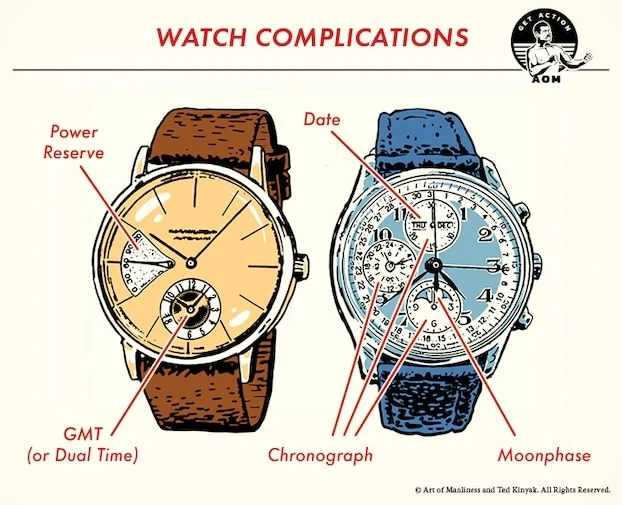
In the specialized field of horology, the term "complication" refers to any feature on a mechanical timepiece that performs a function beyond the standard display of hours, minutes, and seconds. While the primary purpose of a watch is the measurement of time, the integration of additional mechanical modules has historically served as a benchmark for engineering prowess and functional utility. From the earliest marine chronometers used for naval navigation to the sophisticated perpetual calendars of the modern era, complications represent the intersection of mathematical precision and micro-mechanical artistry. As the global luxury watch market continues to expand—with the Federation of the Swiss Watch Industry (FH) reporting record export values exceeding 26 billion CHF in recent years—understanding these mechanical features has become essential for collectors and consumers navigating the distinction between traditional craftsmanship and digital convenience.
The enduring appeal of mechanical complications persists despite the ubiquity of high-accuracy quartz movements and multifunctional smartwatches. Industry analysts suggest that the resurgence of interest in mechanical features is driven by a consumer desire for "analog permanence" and a tangible connection to engineering history. While ultra-high-end complications such as tourbillons, which counteract the effects of gravity on the movement, or minute repeaters, which chime the time using internal hammers and gongs, remain the province of haute horlogerie, five specific complications dominate the contemporary market due to their practical applications and historical significance.
A Chronological Evolution of Horological Complexity
The development of watch complications has historically followed the needs of specific industries, including maritime exploration, aviation, and professional racing. In the 18th century, the pursuit of the "longitude prize" drove the development of highly accurate marine chronometers, which were essentially timepieces with enhanced stability complications. By the late 19th and early 20th centuries, the transition from pocket watches to wristwatches necessitated the miniaturization of these complex systems.
The mid-20th century marked a "Golden Age" for functional complications. The 1940s and 1950s saw the introduction of the first mass-produced GMT watches for transcontinental pilots and the refinement of the automatic chronograph. However, the industry faced an existential threat during the "Quartz Crisis" of the 1970s, when inexpensive, battery-powered Japanese movements flooded the market. Mechanical watchmakers survived this period by repositioning complications not just as tools, but as symbols of luxury and heritage. Today, these mechanical features are viewed as a hedge against the planned obsolescence of digital technology, offering a lifespan that can span generations if properly maintained.
1. The Date Display: The Most Ubiquitous Utility
The date complication is the most frequently encountered addition to the standard three-hand watch movement. While it appears simple, the mechanical execution requires a date wheel—usually featuring 31 increments—to rotate once every 24 hours. The milestone for this complication occurred in 1945 with the release of the Rolex Datejust, the first self-winding wrist chronometer to indicate the date in a window on the dial.
Modern iterations of the date complication vary in complexity:
- Simple Date: Requires manual adjustment at the end of months with fewer than 31 days.
- Annual Calendar: A more advanced complication that automatically accounts for months with 30 or 31 days, requiring adjustment only once a year at the end of February.
- Perpetual Calendar: The pinnacle of calendar complications, which accounts for leap years and will not require manual adjustment until the year 2100.
Market data indicates that watches featuring at least a simple date window hold higher resale value and broader consumer appeal in the "daily wear" category compared to "no-date" models, primarily due to the practical convenience provided to office professionals and administrators.
2. The Chronograph: Precision Measurement of Elapsed Time
The chronograph is essentially a stopwatch integrated into the main movement of a watch. Historically, the first modern chronograph was invented by Louis Moinet in 1816 for astronomical equipment, though Nicolas Mathieu Rieussec popularized the term in 1821 when he created a "time writer" to clock horse races.
A standard chronograph features a center seconds hand that can be started, stopped, and reset via "pushers" on the side of the case. It often includes sub-dials to track elapsed minutes and hours. The technical sophistication of a chronograph is measured by its "clutch" and "actuation" systems. High-end models utilize a "column wheel" for smoother pusher engagement, while more affordable, robust movements use a "cam-actuated" system.
The chronograph’s cultural impact was solidified by its use in space exploration; the Omega Speedmaster Professional became the "Moonwatch" after being flight-qualified by NASA for all manned space missions. Today, while digital timers are more precise, the tactile engagement of a mechanical chronograph remains a primary draw for enthusiasts of automotive racing and aviation history.
3. The GMT and Dual Time: Navigating the Jet Age
As commercial air travel expanded in the 1950s, pilots required a way to track both local time and Greenwich Mean Time (GMT) to facilitate navigation and communication across time zones. This led to the development of the GMT complication, characterized by a fourth hand that completes one full rotation every 24 hours, often pointing to a graduated 24-hour bezel.
There are two primary mechanical approaches to this complication:
- The "Flyer" or "True" GMT: Allows the wearer to adjust the local hour hand independently in one-hour increments without stopping the movement. This is favored by frequent travelers.
- The "Office" or "Caller" GMT: Allows for the independent adjustment of the 24-hour GMT hand. This is ideal for those who remain in one location but need to track a second time zone for business purposes.
In an increasingly globalized economy, the GMT complication has transitioned from a niche pilot’s tool to a essential feature for international business professionals. It serves as a mechanical solution to "time zone fatigue," allowing for instant synchronization with global markets.
4. The Moonphase: Astronomical Heritage and Aesthetic Artistry
The moonphase is one of the oldest horological complications, tracing its roots back to ancient astronomical clocks and the Antikythera mechanism. It tracks the 29.5-day lunar cycle, displaying the current phase of the moon through a rotating disc visible through a shaped aperture on the dial.
Mechanically, a standard moonphase is driven by a 59-tooth gear (representing two full lunar cycles). Because the actual lunar month is approximately 29.53 days, a standard moonphase will accumulate one full day of error every two years, seven months, and two weeks. High-precision "astronomical" moonphases use more complex gearing to remain accurate for over 122 years.
While the practical necessity of tracking the lunar cycle has diminished for the modern urban dweller, the moonphase remains highly sought after for its aesthetic beauty. It serves as a reminder of the origins of timekeeping as an observation of celestial bodies. Luxury brands such as Patek Philippe and A. Lange & Söhne often use the moonphase as a centerpiece for their most prestigious dress watches.
5. The Power Reserve Indicator: Monitoring Mechanical Energy
For a mechanical watch to function, energy must be stored in a mainspring, either through manual winding or the motion of an automatic rotor. The power reserve indicator acts as a "fuel gauge," showing the wearer how much energy remains before the movement stops.
This complication was originally vital for marine chronometers, where a stopped clock could lead to disastrous navigational errors. In the modern context, it is particularly useful for collectors who rotate between multiple watches. As the industry moves toward "weekend-proof" movements—those with 70 to 80 hours of power reserve—the indicator provides visual confirmation that a watch taken off on Friday evening will still be running on Monday morning.
Market Analysis and Broader Implications
The inclusion of complications significantly impacts the valuation and collectibility of a timepiece. According to data from secondary market platforms like Chrono24 and WatchCharts, watches with "useful" complications (Date and GMT) tend to see more stable price retention than "pure" three-handers.
Furthermore, the complexity of a movement serves as a barrier to entry that protects the Swiss and high-end German watch industries from low-cost competition. The manufacturing of a split-seconds chronograph or a perpetual calendar requires a level of artisanal skill and specialized tooling that cannot be easily replicated by mass-production facilities.
From a sociological perspective, the choice of a specific complication often reflects the wearer’s lifestyle or aspirations. The chronograph suggests a preoccupation with performance and sport; the GMT signals a global, mobile lifestyle; the moonphase indicates an appreciation for the poetic and historical aspects of science.
Conclusion
The five most common watch complications—the date, the chronograph, the GMT, the moonphase, and the power reserve—represent a balance between mechanical tradition and functional utility. While technology has provided more accurate ways to track the date or time a lap, the mechanical complication offers a permanent, battery-free solution that operates on the laws of physics and micro-engineering. As horology continues to evolve, these features remain the primary language through which watchmakers communicate their skill and through which wearers express their personal connection to the history of timekeeping. For the modern consumer, these complications are not merely "added features," but are the defining characteristics that transform a simple timekeeper into a sophisticated instrument of human ingenuity.

0 Comments