
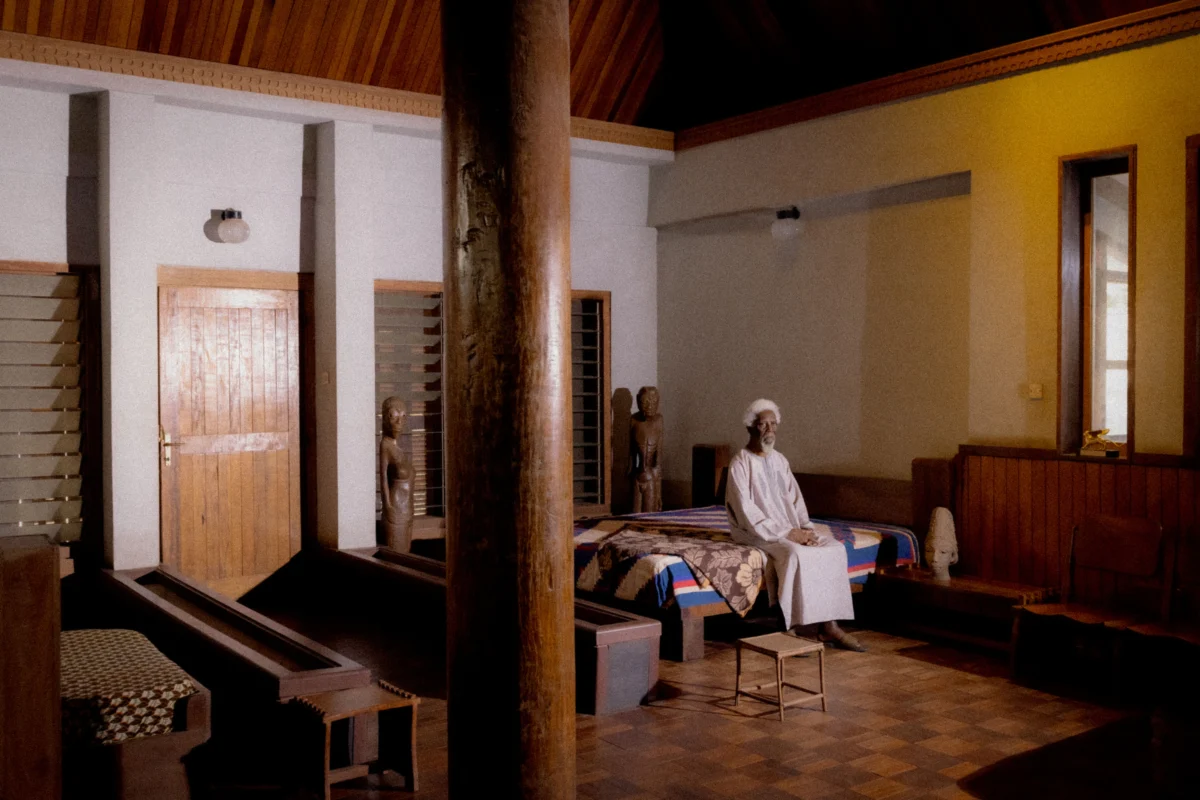
At 90 years old, Nigerian architect Demas Nwoko’s legacy is not merely confined to canvases or sculptures; it is deeply embedded within the very fabric of his rural sanctuary in Idumuje-Ugboko, a historic town nestled in the northern reaches of Nigeria’s Delta State. To reach this significant cultural nexus requires a journey through a landscape characterized by the striking red laterite soil, the lush expanse of palm groves, and the low-slung, spreading trees that cast an intricate tapestry of shadows. The surrounding vernacular architecture rises modestly from the earth, a testament to local craftsmanship. Some dwellings are adorned with earth-based clay, a traditional building material, while others remain unadorned, revealing the sun-baked brick and timber beneath. Bold geometric patterns punctuate select walls, and intricately carved wooden doors offer a glimpse into the pride and artistry of their makers. Following a gently curving path, Nwoko’s home, a structure that embodies his life’s work, finally comes into view.

The Architect as Master Builder: A Life Rooted in Tradition
Demas Nwoko, a figure described with a multitude of talents—artist, master builder, sculptor, architect, designer, and teacher—defies easy categorization. His multifaceted pursuits coalesce into a singular, profound creative legacy that continues to inspire and shape generations of artists, not only within Nigeria but far beyond its borders. His journey began within the royal household of Idumuje-Ugboko, where he was raised as the son of Obi Nwoko II, a traditional ruler. This upbringing provided him with an intimate understanding of his heritage and its aesthetic principles.
Nwoko’s foundational architectural inspiration was drawn from the Idumuje-Ugboko palace and the surrounding structures commissioned by his father. These designs were deeply rooted in the distinctive architectural tradition of neighboring Benin City. Across the broader Yorubaland region, which encompasses southwestern Nigeria, Benin, and Togo, this particular style was often reserved for royal palaces. However, in Benin, it was a domestic vernacular, a living architecture integrated into everyday life. "It was a model I knew from childhood," Nwoko has stated, reflecting on this formative influence.

While Nwoko’s early career included significant contributions to theatre and scenography, leading him to teach drama at the University of Ibadan, his commitment to his ancestral design tradition remained unwavering. "By then, I had already decided I was going to promote the architecture of Benin [in my work]," he explained. "I had examined it up and down; there is no architecture like it." This deep appreciation for the unique aesthetic and structural ingenuity of Benin’s architectural heritage became a guiding principle in his own work.
The Idumuje-Ugboko Sanctuary: A Synthesis of Heritage and Innovation
Nwoko’s own home, constructed in 1978, stands as a powerful embodiment of his architectural philosophy. It bears unmistakable echoes of the structures found in the ancient city of Benin. The ridged exterior columns at the entrance, for instance, are a direct homage to the fluted walls of the Oba’s Palace, the seat of the ruler of Benin City. Similarly, the pitched, overhanging roof, a recurring signature across many of Nwoko’s projects, subtly references the traditional housing styles prevalent in the southeastern parts of Nigeria.

Crucially, every element of this home was conceived and executed by Nwoko himself, utilizing traditional building methods and an intimate knowledge of local materials. This hands-on approach underscores his identity as a master builder, someone who not only designs but also physically constructs his visions.
The design of Nwoko’s home is further informed by the principles of the New Culture Studios in Ibadan, an evolving arts and culture center that initially served as his personal studio and residence. The exterior of the Idumuje-Ugboko home is clad in blocks of laticrete, a material Nwoko developed himself. This innovation was a direct response to legal restrictions that prohibited the use of local laterite soil, a cornerstone of traditional building. By ingeniously mixing laterite soil with cement, Nwoko created a material that honored his heritage while adhering to contemporary regulations. "There is nothing wrong with mud," Nwoko asserts, pointing to the existence of three-story homes across Yorubaland built with this readily available material. His conviction is clear: "A building is not viable if it doesn’t make use of local materials."

Interior Spaces: A Haven of Light, Air, and Artistic Expression
Inside Nwoko’s home, a palpable sense of sacred silence prevails, punctuated only by the subtle hum of a television. The expansive, open-plan layout eschews conventional room divisions, fostering a fluid movement through the space. This design philosophy, as Nwoko explains, reflects "our way of living: open plan, no rooms. The house is modeled in a similar way, so you can move through it very freely."
The dining area is a notable feature, showcasing stained-glass panels that evoke the artistic style of Nwoko’s earlier works, such as the Dominican Chapel in Ibadan. This space is furnished with his signature interlocking wooden chairs, a testament to his woodworking skill, crafted without a single nail.

Natural light is intentionally managed within the home, creating an atmosphere of serene intimacy. The primary source of illumination emanates from the central impluvium, a thoughtfully designed feature positioned above an indoor courtyard. This fiberglass-lined funnel channels a controlled stream of rainwater from the roof into the house, serving both a functional and aesthetic purpose. For Nwoko, the impluvium is a defining element, embodying the very essence of tropical architecture. "Architecture is about geography," he firmly states. "You have no business replicating the architecture of one geography in another. The purpose of designing any building, or habitat, is to protect the human being." This philosophy highlights his belief in context-specific design, tailored to the climate, culture, and environment of its location.
Upstairs, Nwoko drew inspiration from the Igbo architectural tradition of the "conical square." This design features a pitched roof supported by a single structural pillar at its center, creating a unique spatial dynamic. Since its construction in the 1970s, Nwoko’s home has largely retained its original form, with the only significant addition being a second floor that now serves as his private quarters.
.jpg)
"It is an ageless building," remarks Bofu Nwoko Ugbodaga, the designer’s daughter and senior partner at their architectural firm, New Culture Designs. "Every choice ever made here was intentional." This sentiment underscores the deliberate and thoughtful nature of the design, where every element contributes to the overall harmony and purpose of the sanctuary.
A Continuing Momentum: Beyond Architecture
Demas Nwoko’s influence extends far beyond the walls of his personal sanctuary. His artistic endeavors are woven into the very fabric of the home, with his sculptures occupying dedicated spaces. These carved wooden pieces are described as stark, confident, and profoundly expressive, reflecting his mastery of form and his deep connection to his cultural roots. Photographs, framed on natural timber shelving, further personalize the space, offering glimpses into his life and artistic journey.

Nwoko’s creative momentum remains undiminished. He has recently inaugurated a new church tower, a significant addition to the local landscape. Furthermore, he is actively engaged in writing a new book focusing on tropical architecture, sharing his lifetime of knowledge and experience with a broader audience. Collaborating with younger architects and artists, this creative pluralist continues to forge ahead, leaving an indelible mark on the field.
"The least I can do is to help as much as I can," he states with characteristic humility. "As long as there is work to do, how do I stop?" This dedication to his craft and his commitment to fostering the next generation of creative minds solidify his position as a pivotal figure in Nigerian art and architecture. His work is a powerful reminder of the enduring value of tradition, innovation, and a deep respect for the environment.

The influence of Demas Nwoko’s work is recognized not only within Nigeria but also on an international stage. His home, as a living testament to his architectural principles, was featured in the AD Middle East print issue for February/March 2026, further amplifying the reach and appreciation of his unique contributions to art and architecture. His legacy is a vibrant, ongoing narrative of cultural preservation, artistic innovation, and a profound understanding of the relationship between humanity and its built environment.

0 Comments