
Three years after its critically acclaimed debut, the Netflix series "Beef" has returned with a second season, continuing its exploration of how seemingly minor conflicts can ignite all-consuming, destructive rivalries. Creator Lee Sung Jin once again masterfully employs set design not merely as a backdrop, but as a potent visual narrative, mirroring the deep-seated disconnects between characters and exposing the underlying themes of class disparity, racial dynamics, and existential loneliness. While the first season focused on two strangers, Danny Cho and Amy Lau, season two introduces a new ensemble grappling with their own escalating feuds, with the opulent yet sterile environments of an elite country club and its associated enterprises serving as a crucial character in itself.
.jpg)
The Genesis of a New Conflict
Season two, released on April 16th, pivots to a Gen-Z couple, Ashley Miller (Cailee Spaeny) and Austin Davis (Charles Melton), who work in lower-echelon positions at the prestigious Monte Vista Point country club. Their lives take a dramatic turn when they witness a violent altercation between the club’s General Manager, Josh Martin (Oscar Isaac), and his interior designer wife, Lindsay Crane-Martin (Carey Mulligan). This explosive encounter becomes the catalyst for their plot to blackmail Josh, setting in motion a chain of events that entangles them with the club’s formidable new owner, Korean billionaire Chairwoman Park (Youn Yuh-jung). The narrative further complicates when Chairwoman Park, seeking to conceal her own illicit dealings, orchestrates a scheme involving cosmetic surgery trips to her husband’s clinic in Korea, drawing both couples into a web of deceit and personal ruin.
The visual language of "Beef" season two is meticulously crafted, with every setting—from the meticulously curated "make-believe world" of the country club and the staff residences to the clinical austerity of the Korean plastic surgery clinic—acting as a deliberate commentary on class mobility and the dynamics of power. The series consistently uses its environments to highlight the vast chasm between aspirations and reality, success and struggle, and outward appearances versus inner turmoil.
.jpg)
A World of Manufactured Serenity and Hidden Decay
The initial scenes of "Beef" season two immediately establish a sense of artificiality and temporal disorientation. An opening sequence depicts children playing amidst a chaotic yet seemingly joyful tableau of fake snow, polar bears, pastel flowers, beach waves, pumpkins, and haystacks. This jarring juxtaposition of disparate seasonal elements within a contained, perfectly manicured green lawn creates an unsettling atmosphere, hinting at a world detached from natural order and genuine experience. This deliberately artificial landscape serves as a metaphor for the fabricated reality that the elite inhabitants of Monte Vista Point strive to maintain.
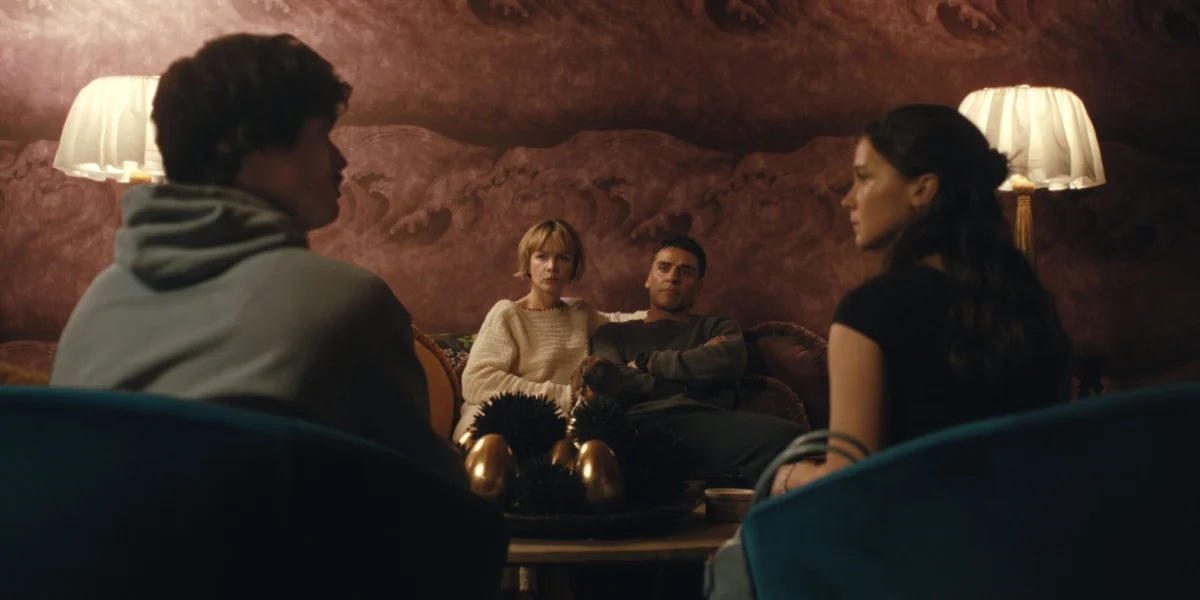
The country club itself, Monte Vista Point, is presented as an architectural embodiment of aspirational wealth. Its Spanish Colonial Revival facade, characterized by stucco exteriors, red accents, arched arcades, and a bell tower, projects an image of timeless elegance and exclusivity. However, as the series unfolds, the interiors reveal a more nuanced picture. Lindsay Crane-Martin, the club’s interior designer, imbues the public spaces with a decidedly feminine and perhaps overly saccharine aesthetic. Floor-to-ceiling pastels, pink tassels, floral curtains, and an abundance of flowers dominate the club parlor. While the walls are adorned with branches that mimic the surrounding greenery, the overall impression is one of stuffiness and a lack of genuine warmth, creating an environment that feels more like a meticulously staged set than a welcoming space. This design choice subtly critiques the superficiality of elite social spaces, where outward beauty often masks underlying emptiness.

In stark contrast to the club’s public face, the private residence of Josh and Lindsay Martin reveals a deeper, more troubling reality. Despite their apparent integration into the country club’s elite sphere, their home is depicted as "heavy and dark." The most striking element of their interior is the pervasive presence of alcohol, with bars in multiple rooms and bottles scattered throughout, suggesting a coping mechanism for unspoken anxieties and marital discord. Lindsay herself admits, "We’ve been here for six years, and nothing is finished." This unfinished state is visually represented by the clutter, dimly lit spaces, and a general sense of malaise, suggesting that even within the supposed upper echelons of society, perfection remains elusive and personal lives are often in disarray. The potential for their home’s charm is overshadowed by a palpable sense of misery.
The Stark Realities of the Staff
The living situations of the country club staff, Ashley and Austin, provide a stark counterpoint to the ostentatious displays of wealth. Their apartment, while aspiring to a similar aesthetic as the country club parlor, appears derivative and lacking in originality. The same pastel color palette and decorative motifs that define the club’s public spaces are echoed in their home, suggesting a mirroring of aspirational desires without the substance. This visual connection can be interpreted as a commentary on the limited avenues for genuine self-expression available to those in service roles, forced to adopt the superficial trappings of their employers’ world.

A notable exception in their home is Austin’s football trophy, a constant reminder of past achievements and a silent testament to his unfulfilled potential or current existential drift. He is often shown gazing at it, a symbol of a life he perhaps once envisioned or a past glory he clings to amidst his present uncertainties. This personal artifact stands out against the otherwise unremarkable décor, highlighting the individual struggles and buried ambitions within the seemingly monotonous lives of the club staff.
The contrasting environments of the club and its staff quarters underscore the show’s central themes of class disparity. While club members enjoy expansive, manicured grounds and luxurious interiors, the staff offices are depicted as cramped, depressing, and utilitarian. Ashley’s new office, described as "stuffy and depressing," is filled with stacks of brown papers, reflecting the drudgery of her administrative role. Similarly, Josh’s office, despite his managerial position, mirrors this sense of confinement. The presence of numerous ticking clocks on his wall is a potent visual cue, suggesting his days are numbered or that he is under immense pressure, counting down to an inevitable reckoning.

The Illusion of Control and the Power of Design
Lindsay Crane-Martin’s role as an interior designer is central to the visual narrative of the country club. Her design philosophy, characterized by a penchant for "frilly pastel" aesthetics, is evident in every space she touches, from the club parlor to her own home. This style, however, is met with sharp criticism from Chairwoman Park. When Lindsay proudly presents her "cheaply made in China fire hazard" pillows to the Chairwoman, her enthusiasm is met with a dismissive "colonial" remark. This exchange highlights not only a clash of aesthetic sensibilities but also a subtle commentary on cultural appropriation and the superficial understanding of luxury and taste. The Chairwoman’s subsequent assistant’s intervention, revealing her disdain for the term "colonial," further emphasizes the cultural nuances at play.
Chairwoman Park’s own home, glimpsed briefly, offers a stark contrast to Lindsay’s designs. Characterized by clean lines, low furniture, a neutral palette, and materials like glass, wood, and stone, her residence embodies a minimalist, sophisticated aesthetic. This design suggests a woman of power and discerning taste, whose influence is poised to reshape Monte Vista Point. The implication is that the club, under her ownership, will likely shed its overly decorative facade for a more streamlined, perhaps colder, elegance. This shift in design reflects a change in control and a move towards a more austere, business-like approach to luxury.

The plastic surgery clinic in Korea, Trochos, further amplifies the show’s thematic concerns. Its sterile, almost dystopian appearance is intentionally reminiscent of Chairwoman Park’s own residence, suggesting a connection between the pursuit of physical perfection and the exercise of power and control. The translucent walls of the treatment rooms, which allow Josh and Lindsay to briefly touch hands, serve as a poignant visual echo of their earlier marital transgressions, seen through windows into separate rooms of their home. This motif underscores the theme of isolation and the tragic irony of their physical proximity in their darkest hours, now separated by barriers that symbolize their broken relationship and the unbridgeable gap between them.
Josh’s prison cell, described as monochrome and uniform, mirrors the starkness of both the club’s more utilitarian spaces and the clinical environment of Trochos. This visual continuity across vastly different settings suggests a pervasive sense of confinement and lack of individual agency, whether imposed by societal structures, personal choices, or the pursuit of wealth and status.

The Cycle of Illusion and Unresolved Conflict
The series concludes with a sense of cyclical recurrence, mirroring the opening sequence. As Lindsay watches Josh’s prison release on television, her home’s décor—a calico-esque floral shower curtain and Toile de Jouy wallpaper—evokes an aristocratic fantasy, a reconstruction of the club she designed, highlighting her persistent attachment to the superficial symbols of status. The final scene, where children play at the same festival and the camera pans to Ashley, now the new GM, suggests that despite the chaos and personal ruin, life at Monte Vista Point continues, the illusion of serene progress largely intact. The sprawling, beautiful cemetery where Chairwoman Park mourns her husband, and which morphs into a giant clock divided into four seasons, ultimately symbolizes the frozen nature of time and the enduring illusion of stability within the world of Monte Vista, suggesting that the underlying conflicts and class struggles remain unresolved.
The set design in "Beef" season two is not merely decorative; it is integral to the storytelling, providing a rich tapestry of visual metaphors that explore the complexities of human relationships, societal hierarchies, and the elusive nature of happiness. By meticulously crafting each environment, the series invites viewers to question the appearances of wealth, the consequences of ambition, and the pervasive impact of our surroundings on our inner lives. The visual storytelling powerfully reinforces the show’s central premise: that beneath the polished surfaces of elite society lie the same human frailties and destructive impulses that fuel the escalating "beefs" at its core.

0 Comments