
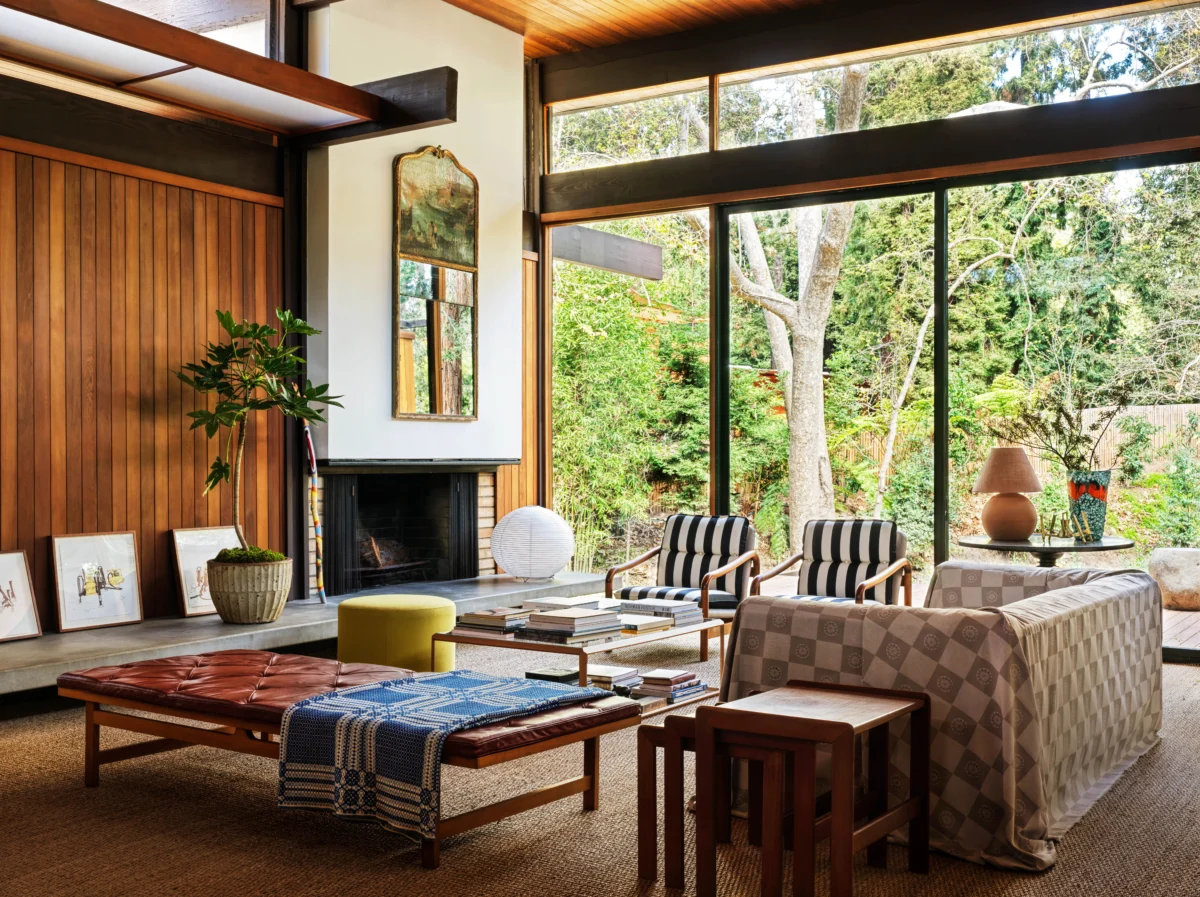
In a profound reflection on his architectural philosophy, the late Southern California luminary Ray Kappe articulated in a 2006 interview, "I was interested in the possibility of diversity within a common system, both in terms of plan relationships and spatial qualities." This insightful statement not only encapsulates his groundbreaking approach to design but also extends to the very essence of how interiors within his iconic structures come to life. A testament to this principle is the 1966 Rustic Canyon home, a sanctuary for filmmaker Alexandra Kerry, her husband Julien Dobbs-Higginson—co-founder of Madeworks—and their two daughters. Within this architectural masterpiece, a curated collection of Continental antiques and cherished family heirlooms coexist harmoniously with 20th-century design classics and contemporary art, all underscored by the characteristic volumetric dynamism and poetic interplay of natural light that define Kappe’s distinctive architectural vocabulary.

A Synthesis of Styles: Bridging Eras and Sensibilities
The residents, Alexandra Kerry and Julien Dobbs-Higginson, bring distinct cultural and personal histories that have shaped their approach to creating a home that is both deeply personal and architecturally sensitive. Dobbs-Higginson, with his British and French heritage and upbringing in Japan, possesses an inherent appreciation for minimalism and the refined restraint of Japanese design. However, he acknowledges the practical realities of modern family life, stating, "it’s hard to live by that code, especially with kids." This pragmatic perspective is balanced by Kerry’s own upbringing, influenced by her father, former US Secretary of State John Kerry, and her mother, writer Julia Thorne. Kerry describes her aesthetic leanings as a "traditional New England sensibility, mixing beautiful things from the past." Many of her most treasured pieces are heirlooms from her mother, who was raised in Rome. This blend of influences presented a unique challenge: how to honor Kappe’s architectural vision while seamlessly integrating their diverse collections.
"We wanted to honor Kappe’s vision, but we were a little stumped about blending the old and the new," Dobbs-Higginson admitted, highlighting the collaborative spirit that would be essential in realizing their home’s interior design. The task of orchestrating this delicate synthesis fell to designer Kate Driver, the founder of the Los Angeles-based design firm West Haddon Hall. Driver, deeply familiar with Kappe’s oeuvre, understood the profound impact of his architecture. "Kappe’s work is a reason to believe in modern architecture," she mused. "You walk into this house, your blood pressure drops, and you exhale." Her guiding principle was one of profound respect for the existing structure, akin to how an art conservator would approach a masterpiece. "I wanted to err on the side of not intervening too much. I would never paint over the work of an Old Master," she explained, underscoring her commitment to preserving the integrity of Kappe’s design.

The Kappe Design Ethos: A Foundation of Flexibility
Ray Kappe, a pivotal figure in the mid-century modern architectural movement, was renowned for his innovative use of wood, his integration of indoor and outdoor spaces, and his ability to create homes that felt both expansive and intimate. His designs often featured cantilevered decks, expansive clerestory windows, and interlocking wood volumes, creating a rhythmic interplay of solid and void, light and shadow. The Rustic Canyon home, built between 1965 and 1967, embodies these hallmarks, echoing the design principles of Kappe’s own celebrated residence, which also found a buyer in a significant sale earlier this year. Kappe passed away in 2019, and his wife, Shelly, in 2025, making the preservation and thoughtful inhabitation of their architectural legacy particularly poignant.
The architectural approach of Kappe was not merely about aesthetics; it was about creating a framework that could adapt and evolve with the lives of its inhabitants. His concept of "diversity within a common system" allowed for a multitude of spatial experiences and plan relationships, providing a versatile canvas for personal expression. This inherent flexibility is precisely what allowed Driver to successfully weave together the couple’s disparate collections. She aimed to "capture that mood" of Kappe’s own home—a space described as having "bold swaths of color, strategic hits of pattern, art leaning against walls, and stacks of books"—while infusing it with the personal narrative of Kerry and Dobbs-Higginson.

A Curated Dialogue: Objects of Art and Affection
The interior of the Rustic Canyon home is a testament to the power of thoughtful curation, where each piece tells a story and contributes to a larger narrative. In the living room, a pivotal space within the home, an antique trumeau mirror, a precious heirloom from Kerry’s great-grandmother, takes pride of place above the fireplace. This historical artifact shares the space with contemporary Scandinavian seating and tables, creating a dialogue between past and present. Adding another layer of artistic expression are drawings by the contemporary sculptor James Capper, whose work brings a modern edge to the room. Overhead, an Akari lantern by Isamu Noguchi, a design icon known for its delicate interplay of light and shadow, casts a warm, diffused glow. To further enliven the space, a Rose Uniacke ottoman, upholstered in a vibrant chartreuse linen, adds a pop of unexpected color and texture.
The dining area, an open space flowing from the main living area, further illustrates this harmonious convergence. Here, vintage Martin Visser chairs, known for their modernist simplicity, are arranged around an Eero Saarinen table, a classic of mid-century design. These pieces are juxtaposed with a pair of neoclassical Sheraton-style armchairs, another significant legacy from the Thorne family, bracketing a custom credenza. This credenza, inspired by the functional elegance of Charlotte Perriand, serves as a stage for a compelling display of art and objects. A drawing by Claes Oldenburg, a celebrated pop artist known for his oversized sculptures of everyday objects, adds a touch of playful whimsy. The objects adorning the credenza are equally significant: a gilded bronze Empire candelabrum, evoking the grandeur of a bygone era, stands at one end, while a 1960s glass-and-steel Artemide lamp, designed by Studio BBPR, at the other, represents a different facet of mid-century design innovation. This deliberate placement of objects, spanning centuries and artistic movements, encapsulates the home’s time-traveling ethos, creating a rich tapestry of personal history and aesthetic exploration.

Commitment to Well-being: Nontoxic Living and Sustainable Design
Beyond the aesthetic considerations, Kerry and Dobbs-Higginson’s commitment to "nontoxic living" significantly influenced their approach to furnishing their home. This concern was amplified by the arrival of their children, prompting them to prioritize products that promote a healthier environment. This passion led them to establish Madeworks, a multifaceted platform encompassing certification, consulting, and e-commerce. Madeworks aims to elevate the standards for healthier living by championing next-generation product formulations and fostering a more conscious consumer landscape. This dedication to human health and ecosystem viability aligns seamlessly with the architectural principles of a home designed to foster a deep connection with nature.
The house itself is situated in a lush setting, described by Dobbs-Higginson as a place where "there’s a creek in the backyard and redwood trees. You can hear the frogs and mountain lions and bobcats. It feels like you’re not in LA." This verdant environment, a vital component of the Kappe experience, underscores the importance of integrating indoor and outdoor living. The design choices within the home, from the choice of textiles to the selection of furniture, reflect this commitment to a holistic approach to well-being. The use of natural materials, the emphasis on natural light, and the careful selection of furnishings that minimize harmful off-gassing all contribute to an environment that is both beautiful and healthy.

A Designer’s Touch: Facilitating Harmony
Kate Driver’s role in this project extended beyond mere decoration; she acted as a crucial facilitator, helping the couple navigate the complexities of blending their distinct tastes with the architectural integrity of the Kappe residence. Her ability to understand their individual preferences and translate them into a cohesive design vision was instrumental. "I have to give Kate so many compliments for helping us bring our things together in a way that feels right for our family and right for the house," Kerry expressed, acknowledging the designer’s pivotal contribution. "She showed us how to make it all work." This sentiment highlights the collaborative nature of high-level interior design, where the designer acts as a curator and interpreter, ensuring that the client’s vision is realized in a way that respects both the personal and the architectural context.
The selection of specific pieces throughout the home further illustrates Driver’s sensitive approach. In the kitchen, a Bassam Fellows chrome-and-leather stool offers a touch of contemporary elegance. The breakfast area features chairs attributed to Guillerme et Chambron surrounding an Eero Saarinen table, a classic pairing that bridges French craftsmanship with American modernist design. Above, an Ingo Maurer pendant light adds a sculptural element. The entry hall is adorned with a Sheraton-style chair, a family heirloom, placed alongside a custom credenza inspired by Charlotte Perriand, topped with a 1960s Artemide Polinnia lamp by Studio BBPR. Artwork by Jenny Holzer contributes a conceptual layer to the space. Even the outdoor spaces are thoughtfully appointed, with a deck featuring a lounge chair by Gabriella Crespi, offering a luxurious retreat that extends the home’s sophisticated ambiance to the natural surroundings.

Enduring Relevance: Kappe’s Vision in the 21st Century
The enduring appeal of Ray Kappe’s architecture lies in its timeless quality and its ability to accommodate diverse lifestyles and aesthetic sensibilities. The Rustic Canyon home, as reimagined by Alexandra Kerry and Julien Dobbs-Higginson with the expert guidance of Kate Driver, stands as a powerful example of how a mid-century modern masterpiece can be revitalized and made relevant for contemporary living. The project demonstrates that embracing the past does not necessitate foregoing the present or the future. Instead, it involves a thoughtful dialogue between historical context and personal expression, a principle that Ray Kappe himself championed. The successful integration of antique furnishings, vintage design classics, and contemporary art within the structural framework of his architectural vision underscores the profound adaptability and lasting influence of his design philosophy. This residence is not merely a house; it is a living testament to the power of harmonizing diverse elements—personal histories, artistic expressions, and architectural genius—into a unified and enriching whole. The story of this home is a compelling narrative of how intentional design choices, guided by a deep respect for both the past and the present, can create spaces that are not only aesthetically striking but also deeply resonant with the lives lived within them.
This article originally appeared in the May issue of Architectural Digest.

0 Comments