
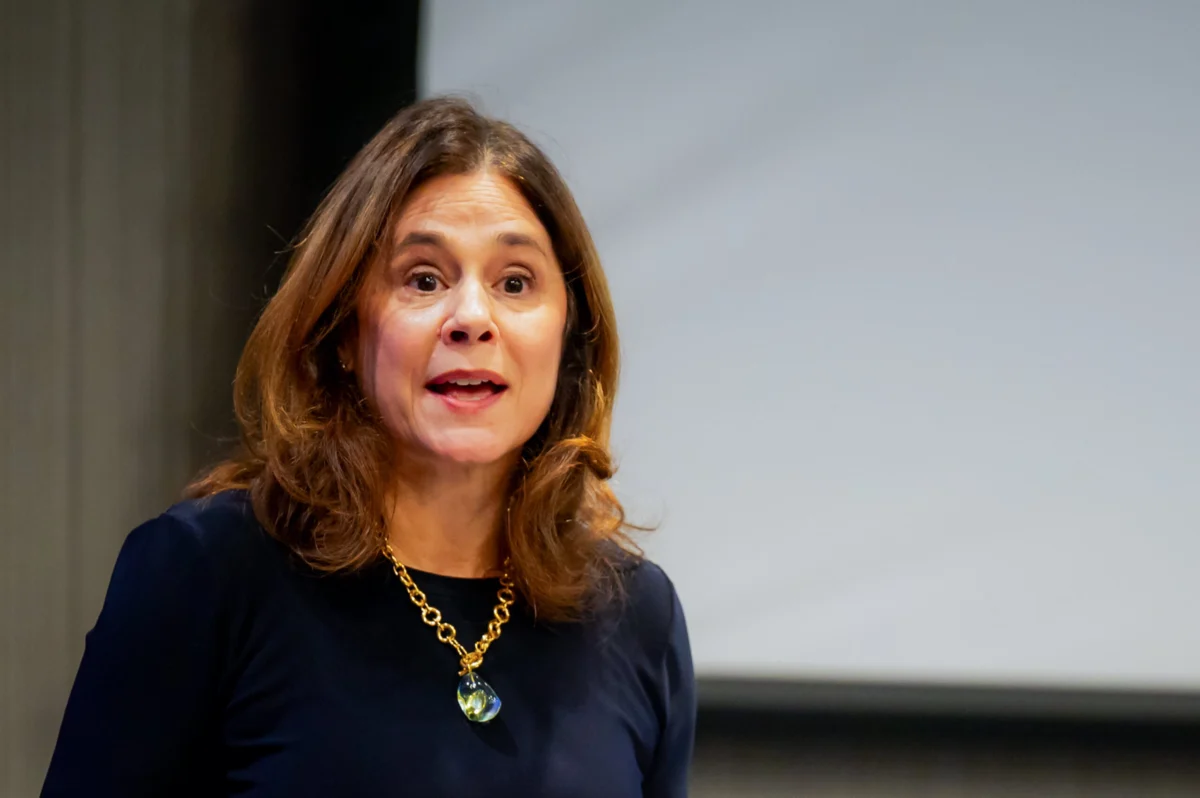
Dallas Federal Reserve President Lorie Logan, a voting member of the Federal Open Market Committee (FOMC) this year, issued a resolute call on Thursday for "modestly" higher interest rates, asserting that while recent inflation figures showed some progress, they were simply "not good enough" to declare victory in the central bank’s prolonged battle against elevated prices. Logan’s remarks, delivered in prepared comments for a speech in Houston, underscore a persistent hawkish stance within the Federal Reserve, emphasizing the urgent need to restore price stability after what she described as a five-year struggle against above-target inflation.
Her statement comes amidst a period of nuanced economic data, where headline inflation showed a monthly decline, yet year-over-year figures remain significantly above the Fed’s 2% target. Logan’s explicit advocacy for a rate hike differentiates her position from some of her colleagues, who have generally expressed a preference for further tightening only if inflation metrics fail to improve. For Logan, the imperative for action is clear and immediate. "I currently believe modestly higher interest rates would better balance the outlook and risks for the FOMC’s dual mandate goals," Logan stated. "Every month of above-target inflation has compounded the strain on Americans’ budgets." This sentiment reflects a deep concern for the erosion of household purchasing power and the long-term economic consequences of entrenched inflation.
The Nuance of Recent Inflation Data
Earlier in the week, the Bureau of Labor Statistics (BLS) released data that offered a glimmer of hope on the inflation front, yet simultaneously highlighted the scale of the challenge remaining. The Consumer Price Index (CPI) for June registered a monthly decline of 0.4%, marking the largest such drop since April 2020. This positive development was largely mirrored by the Producer Price Index (PPI), which tracks wholesale inflation, slipping by 0.3% over the same period. Both indicators benefited significantly from a notable slump in global oil prices, which alleviated cost pressures across various sectors. Additionally, some other key categories, most notably housing, showed signs of softening, contributing to the monthly moderation.
However, Logan was quick to contextualize these figures, arguing that a single month of relief does not signify a sustainable return to price stability. Despite the monthly deceleration, the year-over-year CPI remained elevated at 3.5%, while wholesale costs, as measured by the PPI, surged by 5.5% compared to the previous year. This discrepancy between monthly and annual figures is central to Logan’s argument: the cumulative effect of inflation over time means that a sustained period of disinflation is required to bring the average back down to target. "One month of relief is not enough. It is time to finish the job of restoring price stability," she declared. Employing a hockey analogy, Logan added, "In monetary policy as in hockey, you have to skate where the puck is going. Unfortunately, inflation does not appear to be headed sustainably back all the way to 2 percent." Her analogy suggests a proactive approach is necessary, anticipating future inflationary pressures rather than merely reacting to past data.
The Federal Reserve’s Dual Mandate and the Path to Price Stability
The Federal Reserve operates under a "dual mandate" established by Congress: to foster maximum employment and price stability. The latter is generally interpreted as achieving a 2% annual inflation rate over the long run, measured by the Personal Consumption Expenditures (PCE) price index. This target is not arbitrary; a modest level of inflation is generally considered healthy for an economy, providing a buffer against deflationary spirals and allowing for wage and price adjustments. However, when inflation significantly exceeds this target, it erodes purchasing power, creates economic uncertainty, and can lead to inefficient resource allocation.
The FOMC, the Fed’s primary monetary policy-making body, utilizes tools such as adjusting the federal funds rate – the target interest rate for overnight borrowing between banks – to influence broader economic conditions. By raising interest rates, the Fed aims to cool demand, making borrowing more expensive for consumers and businesses, thereby slowing economic activity and reducing inflationary pressures. Conversely, lowering rates stimulates demand. The challenge for policymakers like Logan lies in achieving price stability without inadvertently triggering a severe economic downturn or significantly increasing unemployment, thus balancing both aspects of the dual mandate.
Logan’s analysis pointed to a range of widely cited inflation gauges, along with alternative measures like core prices excluding housing, to illustrate that inflation remains stubbornly above the Fed’s target. Even accounting for the recent decline in energy prices and the fading impact of tariffs, she contends that underlying inflationary pressures persist. This suggests that the current disinflationary trend, while welcome, might be largely driven by volatile components and not yet reflective of a fundamental shift in core inflationary dynamics.
A Chronology of Inflation and the Fed’s Response
The current inflationary episode has its roots in the extraordinary economic conditions that emerged following the onset of the COVID-19 pandemic in early 2020. Initially, unprecedented fiscal stimulus packages, coupled with highly accommodative monetary policy (including near-zero interest rates and large-scale asset purchases, or quantitative easing), injected massive liquidity into the economy. As economies reopened, a surge in consumer demand clashed with severe supply chain disruptions, leading to widespread shortages and rising prices. The war in Ukraine in early 2022 further exacerbated energy and food prices, adding another layer of inflationary pressure.
For much of 2021, the Federal Reserve maintained that inflation was "transitory," largely driven by temporary supply-side shocks that would resolve themselves. However, as inflation proved more persistent and broad-based, impacting housing, services, and wages, the Fed began a significant pivot. In early 2022, the FOMC commenced a series of aggressive interest rate hikes, moving the federal funds rate from near-zero levels to its current elevated range. This tightening cycle has been one of the most rapid in decades, aimed at swiftly reining in inflation. Alongside rate hikes, the Fed also began quantitative tightening, reducing its balance sheet by allowing maturing bonds to roll off without reinvestment, further withdrawing liquidity from the financial system.
Despite these efforts, inflation has remained above the 2% target since early 2021. This prolonged period of elevated prices, now spanning over five years since the onset of the inflationary wave, is precisely why Logan believes further action is necessary. Her argument is that waiting for inflation to naturally subside entirely carries significant risks. "If inflation is not heading all the way to 2 percent on its own, then at least some policy restriction is needed to help get it there," she emphasized. "If higher inflation becomes entrenched, we’d need sharper rate increases to bring it back to target, with a larger cost for the labor market. Better modest restriction now than severe restriction later." This reflects a belief that proactive, even if uncomfortable, measures now can avert a more painful and disruptive intervention in the future.
Market Expectations and the Outlook for FOMC Decisions
Financial markets are closely attuned to signals from Fed officials, and Logan’s remarks have provided further clarity on the hawkish segment of the FOMC. According to the CME Group’s FedWatch tracker, which monitors fed funds futures pricing, markets already largely anticipate the FOMC to raise its key overnight borrowing rate by a quarter percentage point later this year. The consensus points towards a hike possibly as soon as September, though a move in October is considered more probable.
The upcoming FOMC meeting, scheduled for July 28-29, is less likely to see an immediate rate hike, with traders pricing in only a 12.3% probability of such a move. This suggests that while Logan’s call for "modestly higher" rates is significant, it might not translate into an immediate consensus for a hike at the very next meeting. The committee typically prefers to act with broad agreement, and a data-dependent approach often means waiting for more conclusive evidence before making significant policy shifts. However, Logan’s strong statement could certainly sway undecided members or reinforce the views of those already leaning towards further tightening.
Implications of Further Monetary Tightening
The prospect of further interest rate increases carries significant implications for various sectors of the U.S. economy. For consumers, higher rates translate directly into increased borrowing costs. Mortgage rates, already elevated, could climb further, making homeownership less accessible and increasing monthly payments for variable-rate mortgages. Similarly, interest rates on credit cards, auto loans, and other forms of consumer credit would likely rise, putting additional strain on household budgets already stretched by persistent inflation. This could lead to a slowdown in consumer spending, which is a major driver of economic growth.
Businesses would also face higher borrowing costs, impacting their ability to finance investments, expand operations, or even manage existing debt. Small and medium-sized enterprises, which often rely more heavily on variable-rate loans, could be particularly vulnerable. This could lead to a slowdown in hiring or even job reductions, as companies adjust to a more restrictive financial environment.
Logan explicitly acknowledged the potential "cost for the labor market" if the Fed is forced into "sharper rate increases" later. This highlights the delicate balancing act faced by the central bank. While taming inflation is paramount, pushing interest rates too high, too quickly, risks tipping the economy into a recession and causing significant job losses. The current labor market has shown remarkable resilience, with low unemployment rates and solid wage growth, but an aggressive tightening cycle could erode these gains. Logan’s argument for "modest restriction now" is rooted in the idea that a smaller, proactive tightening could prevent the need for a larger, more damaging intervention down the line, ultimately safeguarding the labor market from a more severe downturn.
The debate within the FOMC reflects the complexity of the current economic landscape. While some officials may prioritize the recent signs of disinflation and the potential for overtightening, Logan’s hawkish stance underscores the deep-seated concern that inflation is not yet on a sustainable path back to target. Her emphasis on the cumulative strain on American households and the long-term risks of entrenched inflation signals a continued commitment from a significant voice within the Federal Reserve to press ahead with monetary tightening until price stability is unequivocally restored. The coming months will reveal whether her specific call for "modestly higher interest rates" gains broader traction among her FOMC colleagues, shaping the trajectory of U.S. monetary policy and the broader economy.

0 Comments